


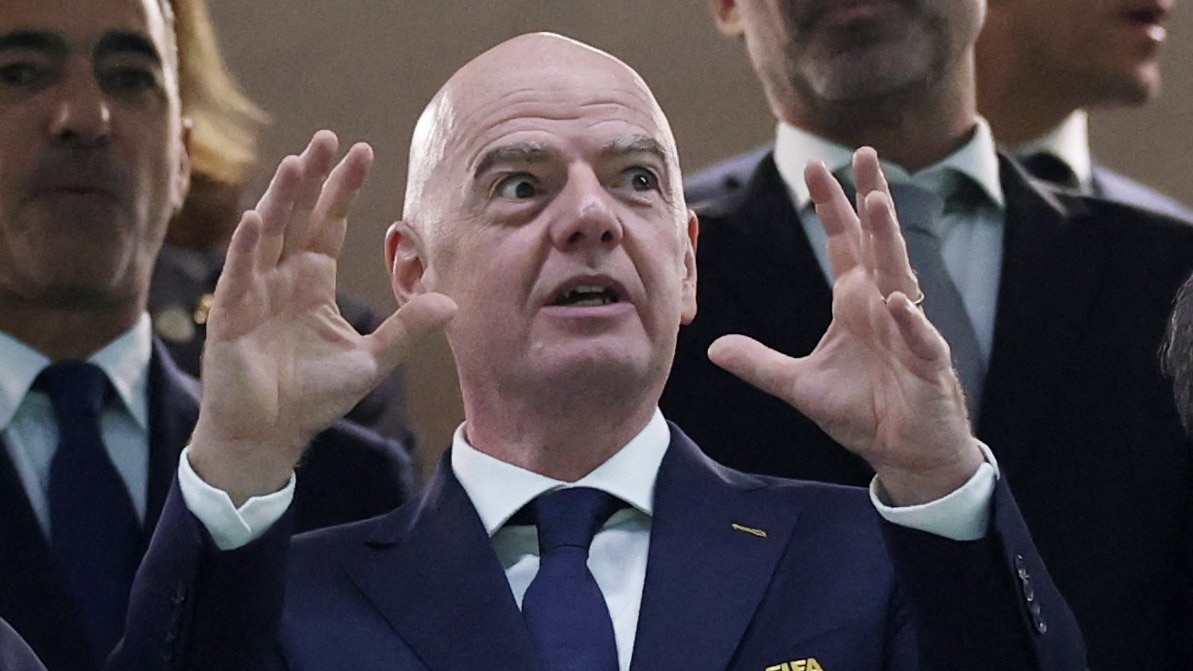
FIFA president Gianni Infantino has defended the controversial hydration breaks introduced at the 2026 FIFA World Cup, rejecting suggestions that the move was driven by commercial interests. The FIFA chief insisted the mandatory stoppages were implemented solely to protect players and maintain fairness across the tournament.
The three-minute breaks, taken in the 22nd and 67th minutes of every match, have become one of the most debated innovations of the tournament, drawing criticism from players, coaches and supporters alike.
“There is no additional revenue for FIFA, as all commercial agreements were signed well in advance. So, this is not a financial issue for us. For us, it is purely a sporting matter,” Infantino said in a statement on Wednesday. “The main reason is the heat, but we also have to understand that in a competition like the World Cup, played over 39 days, with teams potentially playing eight matches in those 39 days, having a moment to rest is extremely important.”
Infantino also argued that the breaks help ensure consistency across the competition, regardless of weather conditions at different venues.
“What matters even more to us is ensuring that all teams, in every match, are playing under the same conditions,” he said. “It’s very difficult to accept that a coach might have the opportunity to influence a match by making adjustments simply because it’s hotter, while in another match, where the temperature is slightly lower, the same coach doesn’t have the same opportunity.”
The FIFA president further maintained that the stoppages had not negatively affected the quality or intensity of matches, suggesting players have continued to perform at a high level despite the interruptions.
WHY HAVE HYDRATION BREAKS SPARKED CONTROVERSY?
The hydration breaks were introduced ahead of the tournament to help players cope with the intense summer conditions across North America. However, their implementation has generated widespread debate beyond player welfare concerns.
Critics have pointed to the additional advertising inventory created during the mandatory three-minute stoppages, with broadcasters inserting commercial breaks during the pauses in play. The development has led many fans to question whether commercial considerations played a role in the decision, despite FIFA’s repeated denials.
The breaks have also altered the flow of matches by providing coaching staffs with opportunities to deliver tactical instructions mid-game. Opponents of the measure argue that this fundamentally changes the rhythm and nature of football, a sport traditionally played in two uninterrupted 45-minute halves.
Among the most vocal critics has been England manager Thomas Tuchel, who said the additional stoppages “interrupt and change the identity of the football match.”
Uruguay head coach Marcelo Bielsa echoed similar concerns, arguing that dividing matches into shorter segments takes away one of football’s defining characteristics and risks changing the essence of the sport.
Not everyone, however, has opposed the move. Spain coach Luis de la Fuente and Netherlands captain Virgil van Dijk have supported the principle of hydration breaks in extreme temperatures but questioned the need for their universal application, particularly at cooler venues and stadiums with roofs.
With temperatures expected to remain a major talking point throughout the tournament, the debate over hydration breaks is unlikely to disappear anytime soon. For now, FIFA remains firm in its position that player welfare and competitive balance — rather than commercial gain — are the driving forces behind the policy.
FIFA World Cup | FIFA World Cup Schedule | FIFA World Cup Points Table | Football News
– Ends



