


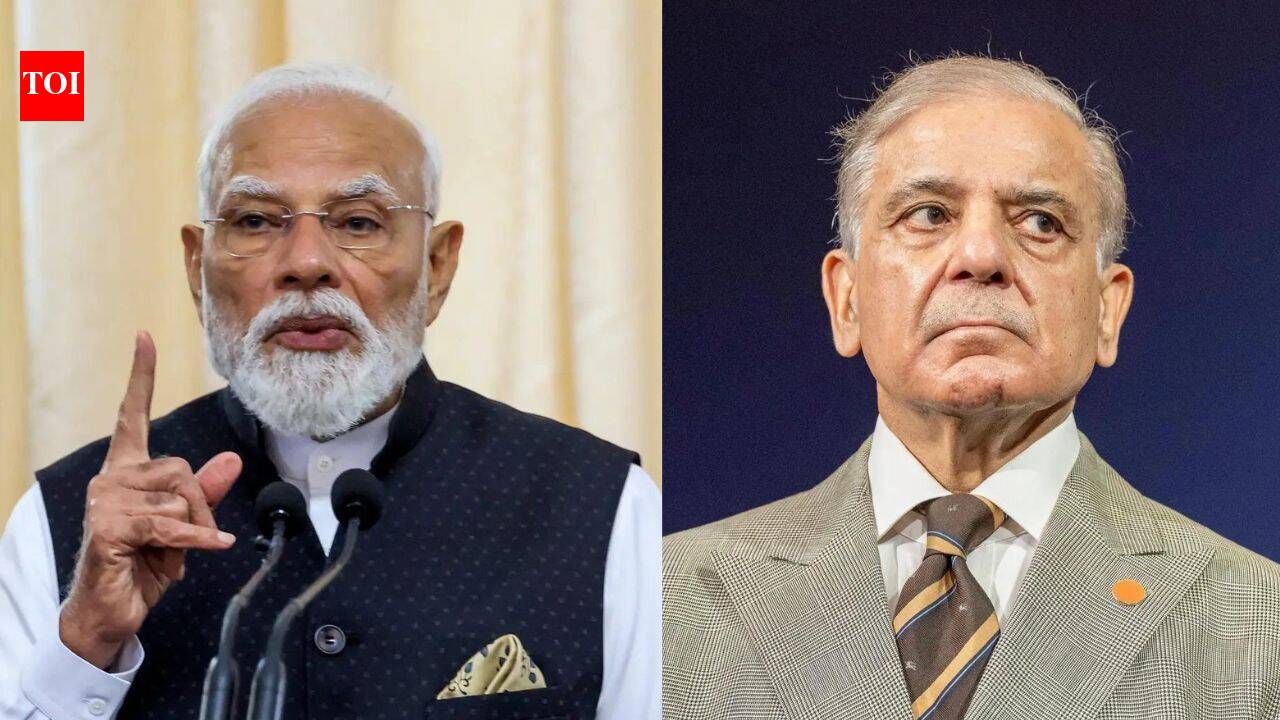
NEW DELHI: More than 100 prominent personalities from India and Pakistan, including former Jammu and Kashmir chief ministers Farooq Abdullah and Mehbooba Mufti, have jointly appealed to Prime Ministers Narendra Modi and Shehbaz Sharif to revive bilateral dialogue and restore normal ties between the two neighbours, The appeal came through an open letter dated June 30, coordinated by OP Shah, chairman of the Centre for Peace and Progress. Signed by 61 Indians and 55 Pakistanis, it urged both governments to take “meaningful and sustained steps towards restoring peace, normalcy, dialogue and cooperation in South Asia” and stressed that “sustained engagement and dialogue remain the only viable path to resolving differences”.Among the signatories are former RAW chief AS Dulat, Rajya Sabha MP Manoj Jha, moderate Hurriyat leader Mirwaiz Umar Farooq, former Union minister Mani Shankar Aiyar, former Pakistan foreign minister Khurshid Mahmud Kasuri, former diplomat Ashraf Jehangir Qazi, along with retired diplomats and members of civil society from both countries.
‘State and citizens are different’
Speaking to news agency IANS, Manoj Jha said the initiative was aimed at strengthening people-to-people ties while recognising the distinction between citizens and governments.“Our intention has always been consistent, and I have both written and spoken about it clearly. There is a difference between the state and the citizen. Music does not need a visa, films do not need a visa, and in the digital age, even cartoons do not need a visa.”“What I mean is that music, poetry and stories transcend borders. This distinction has been explained ever since the time of Partition by Mahatma Gandhi. In that context, we want people to understand the difference between citizens and the state. Engagement with the state is a matter between our government and their government, whether it concerns water-sharing, terrorism or other bilateral issues.”Jha also referred to developments following the Pahalgam terror attack and questioned the continuation of some forms of engagement.“We are still disturbed that after the Pahalgam incident, cricket was played in Dubai. Was the entire country not in pain? At the same time, track-two diplomacy is taking place in Colombo,”Referring to recent remarks by the RSS leadership, he added, “When we hear statements from the RSS, don’t we understand what they mean? We are simply urging better people-to-people contact between India, Pakistan, and Bangladesh to improve understanding, while core irritants should be addressed gradually.”
What RSS cheif said
The appeal comes days after RSS chief Mohan Bhagwat backed remarks made by the organisation’s general secretary Dattatreya Hosabale in favour of keeping channels of communication with Pakistan open. Speaking at an event in Thiruvananthapuram, Bhagwat said the RSS follows the Union government’s foreign policy and does not have an independent position on Pakistan.“But there are a lot of people in Pakistan who believe the partition of Bharat was wrong and many journalists there praise the RSS and its work. There is a distinct undercurrent there of people being anti-Pakistan and against the two-nation theory and they say living together was better,”Bhagwat also argued that India should continue to keep the possibility of dialogue alive.“In a future war, if India defeats Pakistan beyond repair, the people there will have to be brought into the fold of Bharat or they should be able to live peacefully in that country itself. For that, the doors of dialogue need to be kept open,”“We are not like Hitler. That is not our nature or our way. So we need to keep some doors open. We should vanquish injustice and tyranny, but we should also preserve what is good,”Besides calling for renewed political engagement, the signatories urged both countries to restore full diplomatic relations, appoint high commissioners, resume visa services and reopen a comprehensive dialogue covering all outstanding issues, including Jammu and Kashmir. They also sought the revival of trade, cross-border transport links, religious pilgrimages and greater exchanges among students, journalists, artists and business leaders.“The future of South Asia should be shaped not by division and conflict, but by peace, prosperity and shared progress,” the letter said, describing the initiative as a call to place the welfare of nearly two billion people above “conflict, confrontation and division”.



