



Temperature across the globe is rising, and Europe, too, is now bearing the brunt of global warming. Recent years have seen some of the highest numbers of warm days globally. The year 2024 was the warmest on record, surpassing 2023, which held the record earlier. Early signs suggest that 2026 is also following a similar warming trend. Consequently, countries across continents are increasingly experiencing heatwaves and high humidity conditions.
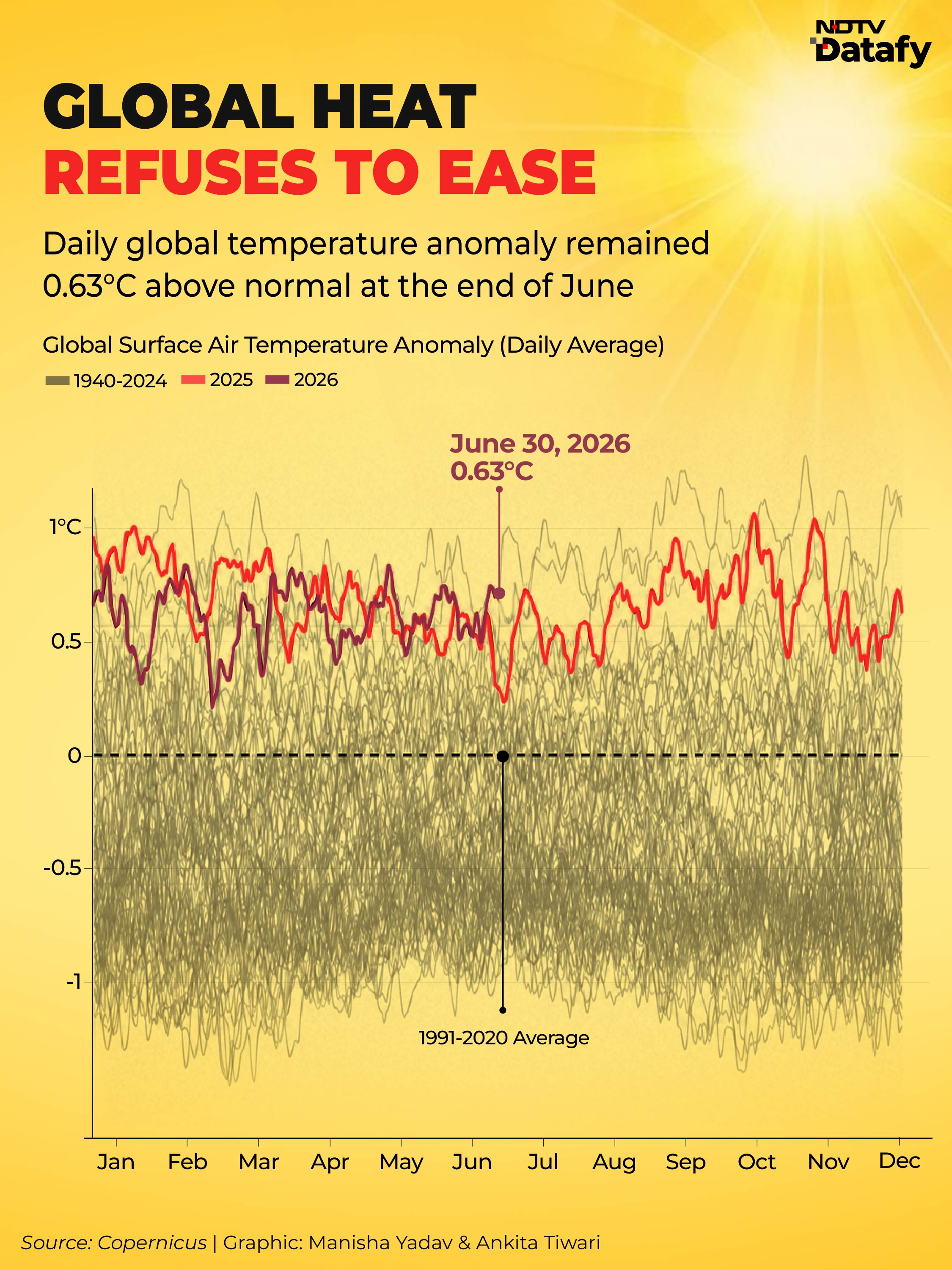
Global temperatures accelerated through June, with the daily average surface air temperature reaching 16.80 degrees Celsius on June 30, 2026, according to Copernicus’ ERA5 dataset. More significantly, the 2026 curve climbed above the corresponding 2025 trajectory during the final days of the month, reversing the pattern seen earlier in the year.
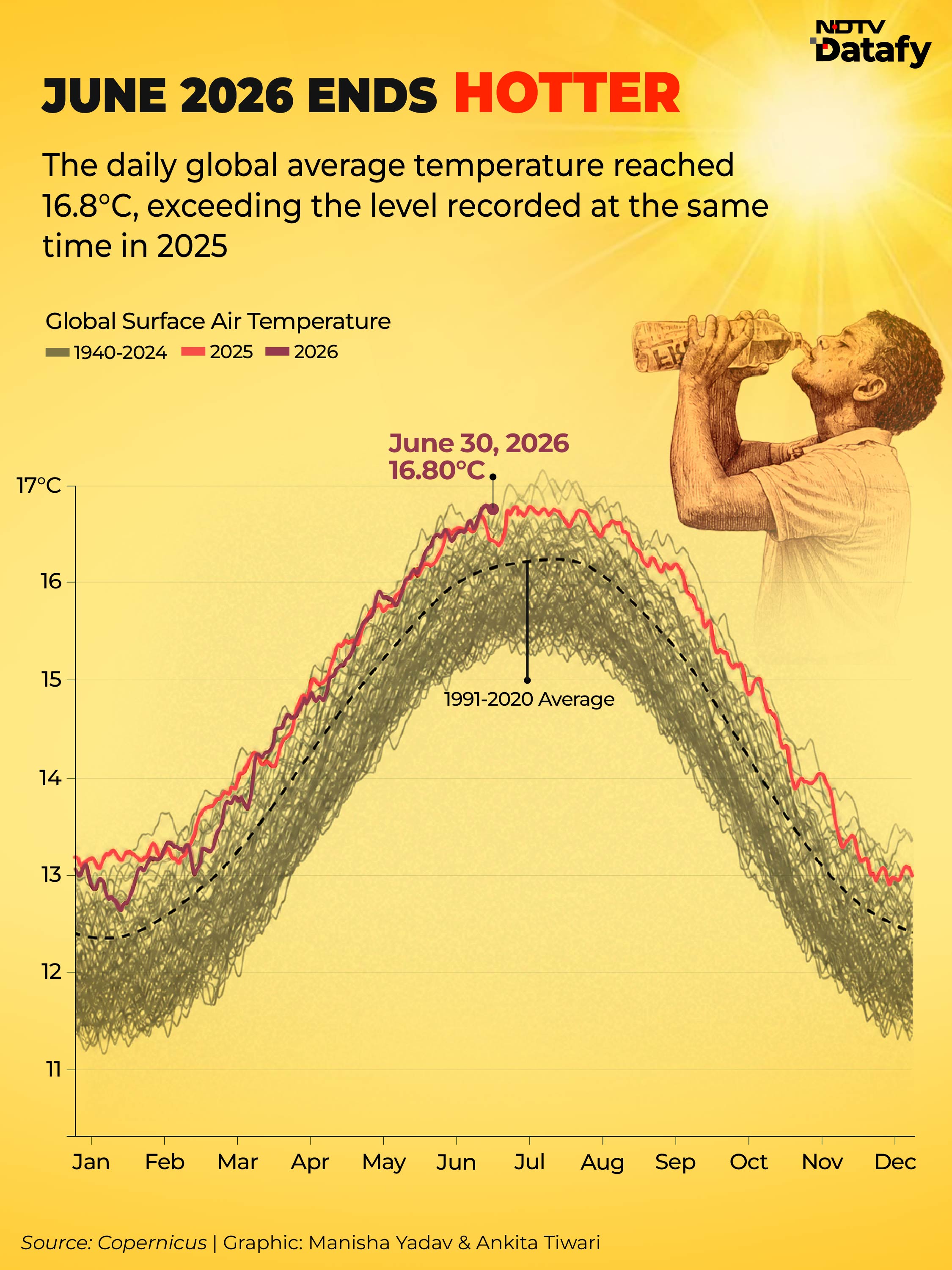
The daily temperature anomaly also rose to +0.63 degrees Celsius above the 1991-2020 average on June 30, with the anomaly curve similarly crossing above 2025, signalling a renewed intensification of global warming.
Global sea surface temperatures have reached record levels for this time of year, exceeding the highs seen in 2023 and 2024, according to Copernicus Climate and Marine Services.
On June 21, global sea surface temperature reached about 20.86 degrees Celsius, which is higher than the normal level for this time of year.
These record-high temperatures are being witnessed because the oceans are already very warm and a climate pattern called El Nino has started in the Pacific Ocean. Over the past three years, much of the global ocean has stayed warmer than normal, showing that the ocean is steadily heating up.
This extra ocean heat is very important because it does not stay only in the sea but it affects the whole climate system. Warm oceans release more moisture into the air through evaporation, which can make storms stronger and increase heavy rainfall in some places. It also adds more heat and humidity to the atmosphere, which leads to more intense heat conditions on land.
Which Continents Are Warming More?
Global temperatures are rising across all regions, but the rate of warming is different from place to place. While all major land areas are getting warmer, some are heating much faster than others. The strongest warming is seen in the Arctic region (covering parts of northern Canada, Greenland, Russia, Alaska, and northern Europe), along with faster increases in Europe and Asia. In contrast, regions like Australasia (Australia and New Zealand) are warming more slowly in comparison.
#Datafy | Arctic, Europe heating up fastest: Take a look at the 10-year average temperature anomalies across the world pic.twitter.com/MVniIA2t90
— NDTV (@ndtv) July 3, 2026
Over time, temperature rise has become steady, but clear regional differences are visible. Europe is one of the fastest-warming continents, while Australasia shows a relatively lower increase. The Arctic region stands out as the most rapidly warming part of the Earth, with temperatures rising much faster than the global average.
Dangerous Humid Heat Days Are On Rise
According to Climate Central data, the global dangerous humid heat days have increased over time, showing a clear upward trend in recent decades. In 1970, the world recorded about 12 such days, but this number fluctuated in previous years before rising more sharply after the 1990s.
The increase becomes more visible in the 2000s and 2010s, when several years consistently recorded higher counts than earlier decades. The most striking rise is seen in recent years, with 25 days in 2023 and a record 32 days in 2024, before slightly easing to 23 days in 2025.
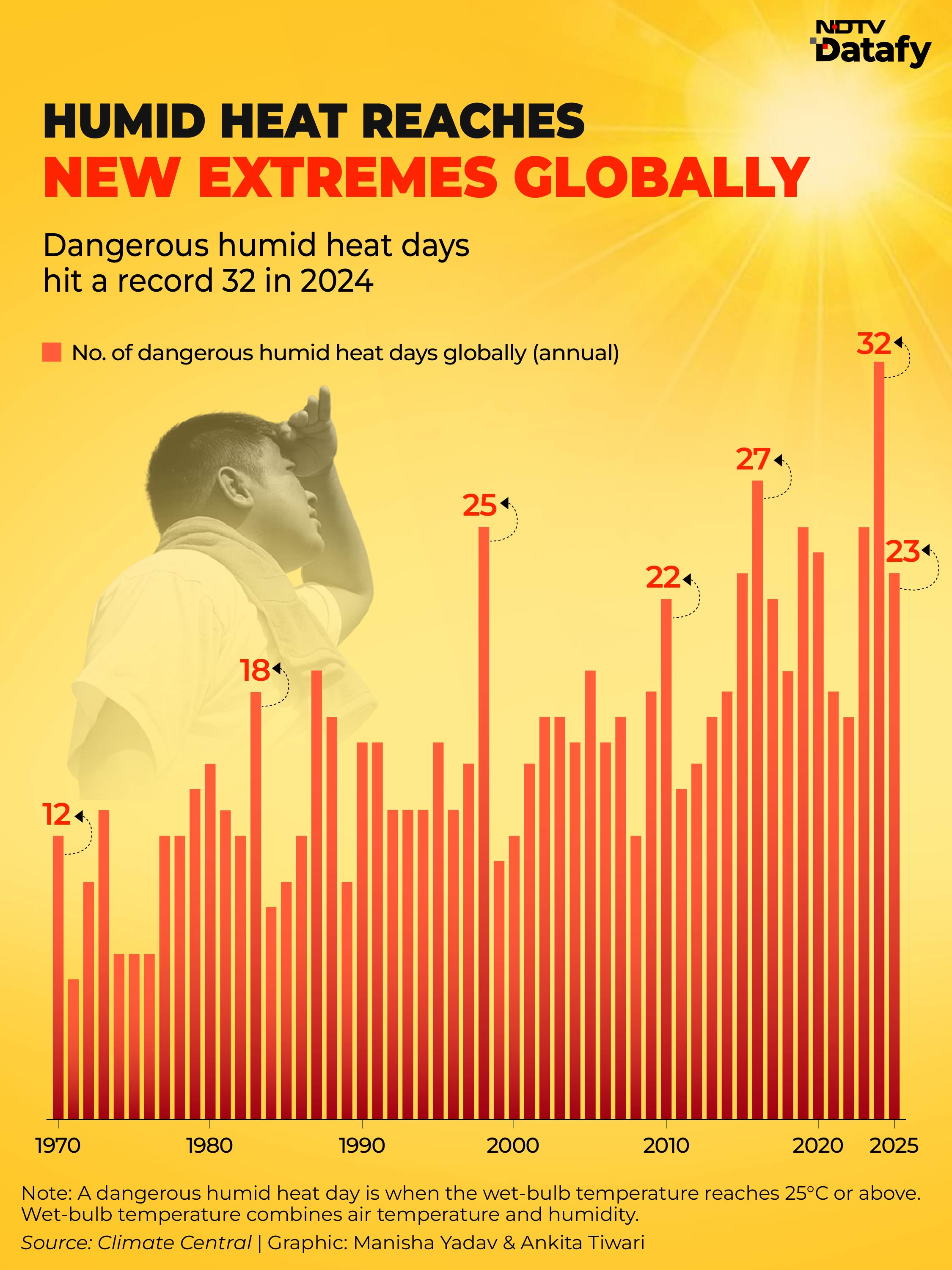
This shows that conditions combining heat and humidity are becoming more frequent worldwide, increasing the risk of heat stress.
A dangerous humid heat day is defined as a day when the wet-bulb temperature reaches 25 degrees Celsius or higher. Wet-bulb temperature is different from normal air temperature because it combines heat and humidity together.
For example, at 25 degrees Celsius air temperature with 50 per cent humidity, the wet-bulb temperature is about 18 degrees Celsius, which is not dangerous. But at 35 degrees Celsius with 60 per cent humidity, it rises to around 28 degrees Celsius, which becomes dangerous for the human body. Even at 40 degrees Celsius with 30 per cent humidity, it can still reach about 26 degrees Celsius wet-bulb temperature. This shows that humidity plays a key role in making heat conditions dangerous even when air temperatures look similar or not extremely high.
So, an air temperature of 35 degrees Celsius with high humidity (around 60 per cent) can feel much hotter and become dangerous, because the wet-bulb temperature rises to risky levels. In contrast, the same 35 degrees Celsius in dry air is less dangerous because sweat evaporates more easily and helps the body cool down.
The data shows that dangerous humid heat days have increased in every country between 1970-79 and 2016-25, reflecting a strong global rise in heat stress conditions.
Countries in tropical regions show the highest levels, with Malaysia rising from 145 to 277 days and Sri Lanka from 98 to 206 days, indicating very frequent exposure to dangerous heat-humidity conditions. African and South Asian countries like Nigeria (72 to 147), Ghana (90 to 214), and India (101 to 141) also show sharp increases.
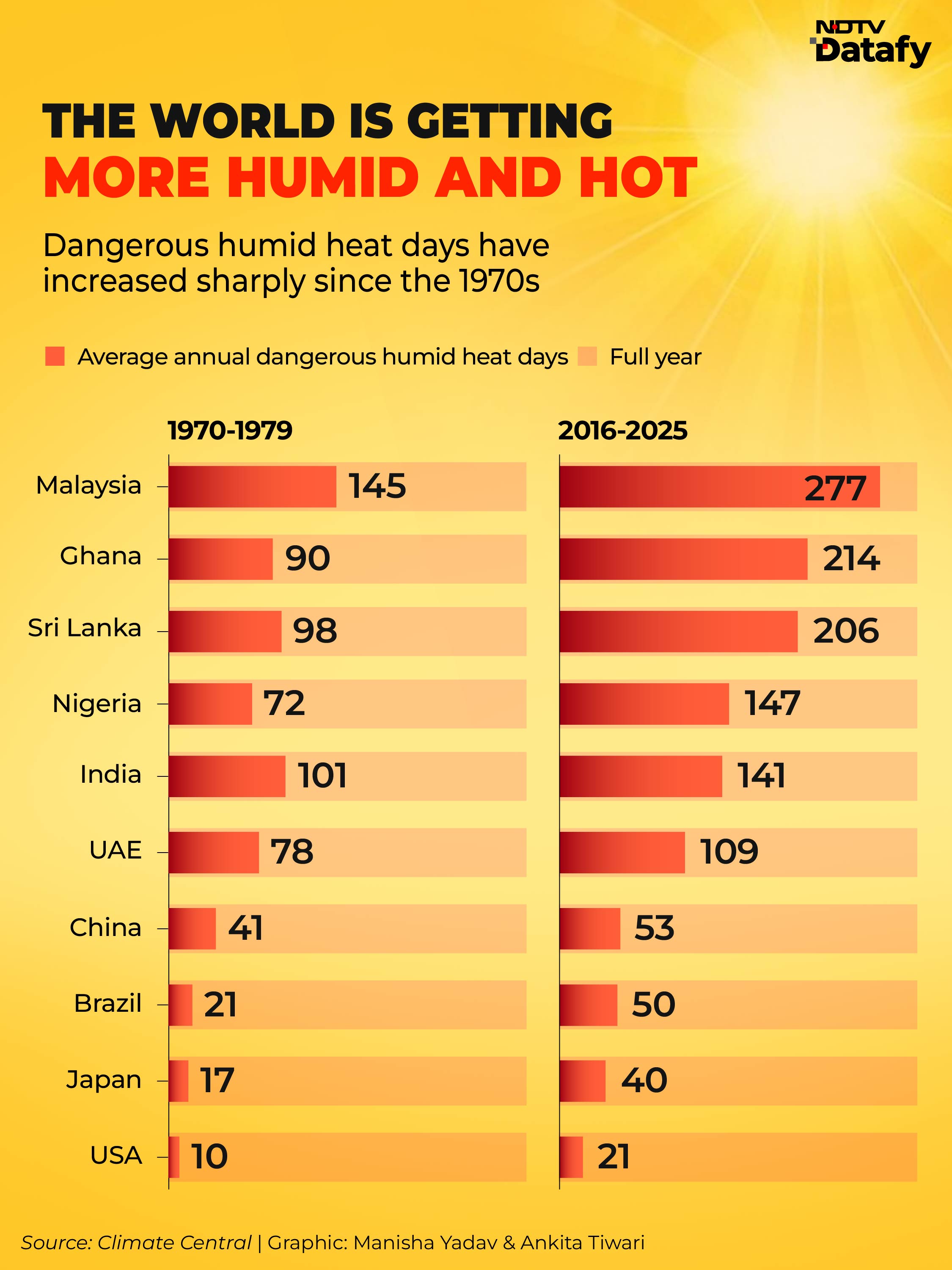
Even traditionally cooler or moderate regions such as China, Japan, the United States, and Brazil have seen their numbers more than double in many cases. Overall, the pattern clearly shows that humid heat stress is spreading and intensifying across both tropical and non-tropical regions, making extreme heat conditions a growing global risk.



