



HYBE has published its 2025 Sustainability Management Report, covering the K-pop giant behind BTS, SEVENTEEN, TOMORROW X TOGETHER, LE SSERAFIM, ENHYPEN, and its various sub-labels.
The 121-page document sets out a number of disclosures, including anti-counterfeiting measures, the company’s use of generative AI, and its expansion into physical retail.
Here are five things we learned…
1. HYBE removed 92,208 counterfeit listings from Amazon over four months
HYBE runs its response to intellectual property infringement through the IP Strategy Team within its Legal Affairs Department, and it has put figures to the work carried out in 2025.
The report states: “When it comes to the infringement of our intellectual properties, we take a diverse approach to addressing such issues through the IP Strategy Team under the Legal Affairs Department. The progress and results are shared with management and relevant departments every month.”
HYBE singles out a tie-up with Amazon. According to the report: “We have established a direct collaboration framework with Amazon to respond firmly to global artist IP infringement. Through a combination of AI-driven automated filtering and manual monitoring on the platform, enforcement against counterfeit goods has been intensified. As a result, over the four month period from September to December 2025, a total of 92,208 infringing listings were identified and removed on Amazon.”
Across e-commerce more broadly, HYBE says it removed counterfeit product listings totaling 12,959 cases in Korea and 273,512 cases overseas during the year.
“When it comes to the infringement of our intellectual properties, we take a diverse approach to addressing such issues through the IP Strategy Team under the Legal Affairs Department.”
The company also reports that it confiscated and destroyed 19,356 counterfeit items through crackdowns on suppliers in Seoul’s Namdaemun market and vendors around a j-hope solo concert venue, working with Korean law enforcement.
On the Namdaemun operation, the report says: “Through public-private cooperation with the Special Judicial Police of the Korean Intellectual Property Office, we identified a large-scale counterfeit supply source in Namdaemun Market. During the joint operation, about 20,000 counterfeit items infringing on artists’ IP were seized on site.”
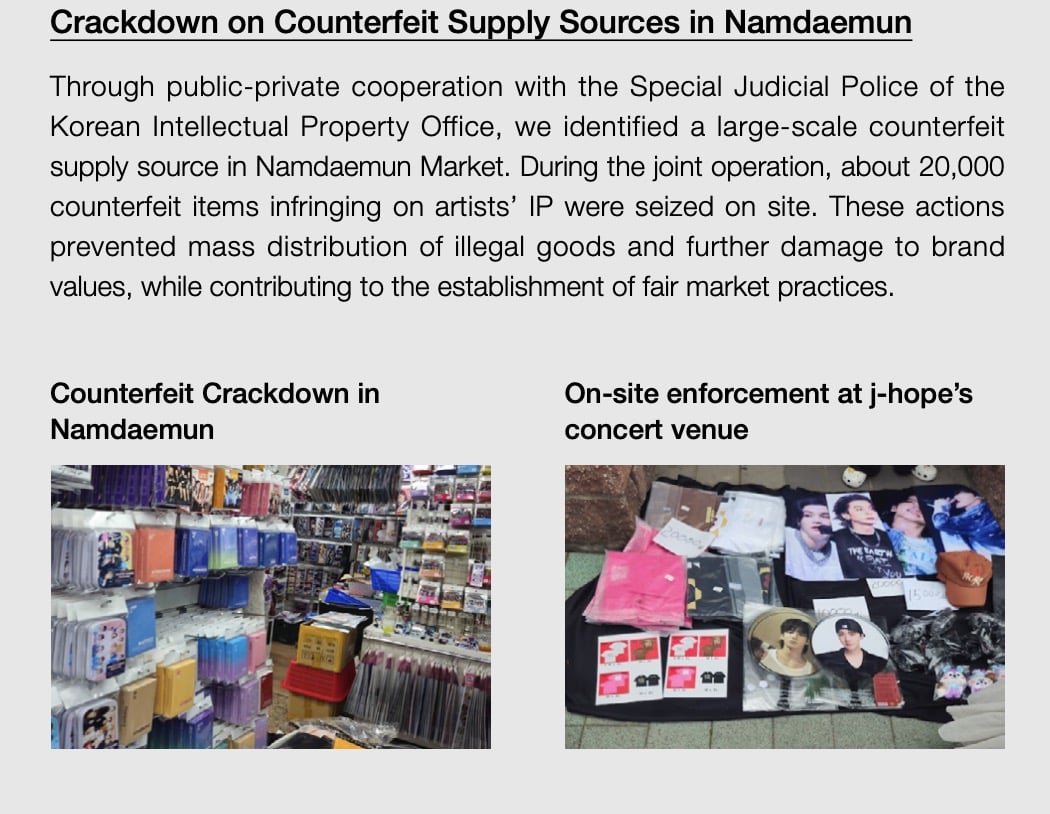
Further enforcement figures for 2025 include 64 customs cases covering 14,843 items intercepted at the border, 219 cases identified through internal and external report channels, 37,000 illegal DVDs confiscated through criminal enforcement action in Tokyo, and four infringing domains discontinued through UDRP filings.
HYBE says it also issued warnings and enforced shutdowns of 18 unauthorized pop-up stores and events in Indonesia, Mexico, Malaysia, China, and Brazil.
The company says it operates an internal system to register and protect its IP: “We operate a range of businesses based on artist IP, including official merchandise and content. Accordingly, we manage, register, and protect key intellectual property rights such as trademarks, design rights, and patents.” As of December 31, 2025, HYBE says its intellectual property rights totaled 5,143 (domestic and overseas combined), up from 4,944 a year earlier, and adds that it “had filed 1,167 applications, which are currently under review.”
The disclosures land as the wider music industry steps up legal action against counterfeit merchandise. In April 2026, HYBE, BIGHIT MUSIC and HYBE America filed a US complaint over bootleg merchandise ahead of BTS World Tour ARIRANG, citing an agreement between HYBE America and Amazon to sell official tour merchandise.
2. It escalated its response to deepfakes and online abuse
HYBE frames artist protection as covering “the distribution of malicious content, invasion of privacy, impersonation of artists, and unauthorized disclosure of personal data.”
On deepfakes, the report says: “Following the emergence of deepfake sexual exploitation content, a dedicated task force was established in 2024 as an immediate response, and have operated continuous monitoring and enforcement systems since the first quarter of 2025.”
It sets out cooperation with Korean police: “During the National Police Agency’s special crackdown period, we provided materials to multiple authorities to facilitate the apprehension of offenders. We have also entered into an MOU with the Gyeonggi Northern Provincial Police Agency, recognized for its strong performance in deepfake investigation.”
“We take a zero-tolerance approach to the illegal acquisition, sale, and purchase of artists’ flight information.”
HYBE signed a memorandum of understanding with the police agency covering expedited investigations and a reporting hotline. The partnership led to eight arrests in South Korea, with CEO Jason Jaesang Lee pledging a “zero-tolerance and no-settlement policy.”
The report also addresses social media platforms based outside Korea: “We pursue legal action against social media channels involved in defamation and obstruction of business targeting our artists. While identifying channel operators has been challenging in cases where platforms are operated by overseas entities, we now leverage evidence collection procedures through foreign judicial authorities to enable effective enforcement.”
On artists’ personal data, it says: “We take a zero-tolerance approach to the illegal acquisition, sale, and purchase of artists’ flight information.”
That mirrors measures HYBE label BIGHIT MUSIC set out over conduct targeting CORTIS, including the sale of flight information and the use of GPS trackers on vehicles carrying artists.
HYBE says it consolidated its reporting routes: “In order to enhance our response to copyright infringement, spreading of false information and defamatory posts targeting artists, we established the HYBE Protect Reporting Channel. Existing label-specific email reporting channels have been integrated into a unified reporting system.”
3. AI voice technology sits at the center of HYBE’s strategy — and it is building rules around it
The report positions Supertone, the voice AI company HYBE acquired in a $32 million deal in 2022, as a growth business.
It says: “Its AI-based audio solutions are changing the paradigm of the creative process by creating hyper-realistic voices that can sing and act, thus introducing a new kind of experience for fans. This technology is being expanded beyond music for application across various content areas, including movies, animation, and the metaverse.”
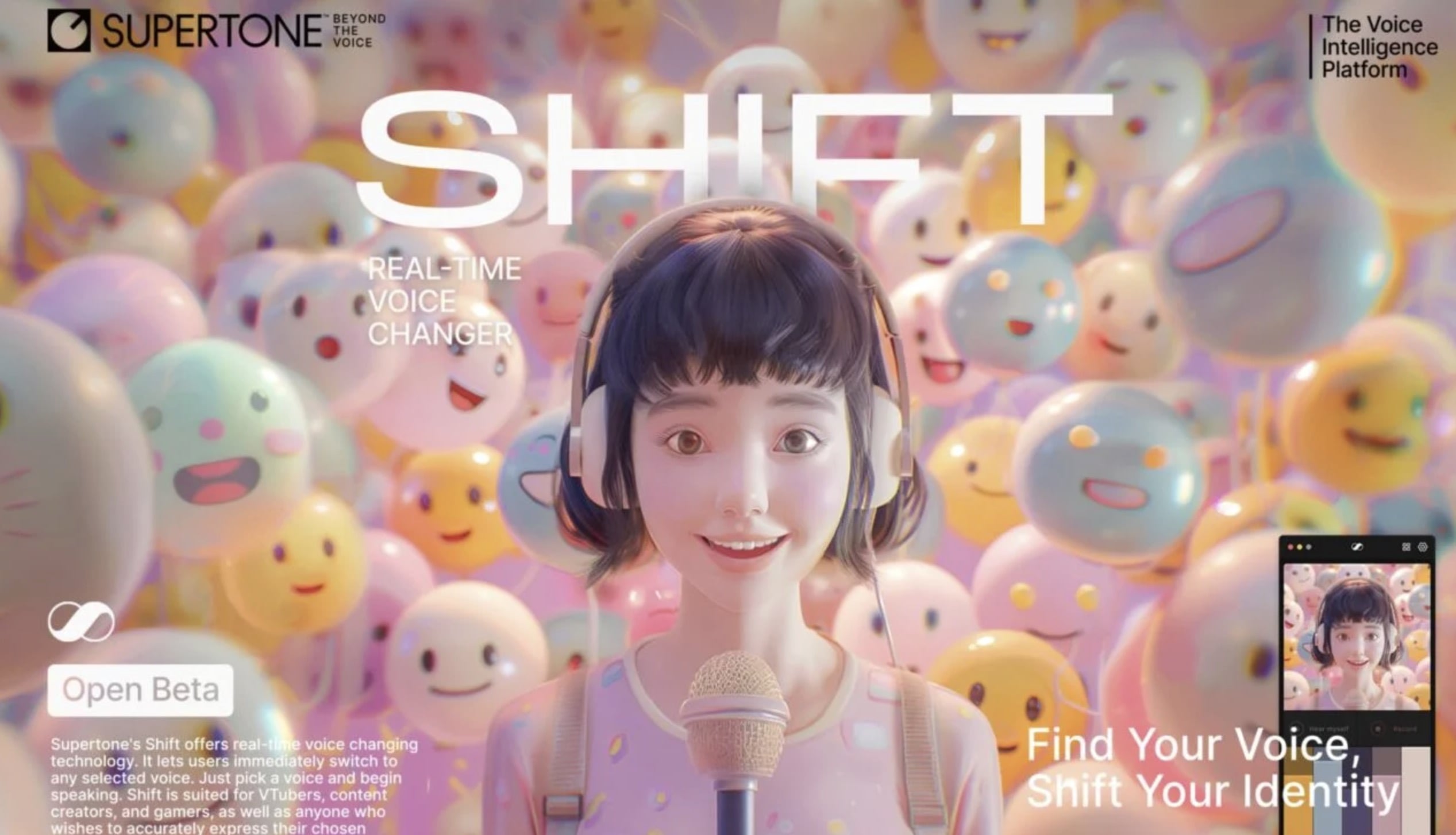
Supertone has since launched a text-to-speech tool, Supertone Play, and its technology was used by the group Big Ocean at the UN’s AI for Good Global Summit in 2025. HYBE has also used the technology to deliver earnings-call remarks in a clone of its then-CEO’s voice and to launch the virtual group SYNDI8.
The report pairs that with governance.
On generative AI across the company, it says: “In response to the rapid adoption of generative AI, we established company-wide principles for its use to prevent legal, ethical, and information security risks in AI-enabled work. These principles cover the protection of creative value, social inclusion, and privacy while distributing internal guidelines to enhance employee understanding and effective use.”
On Supertone specifically, it says the unit “operates its business based on voice AI technology and is committed to preventing potential risks associated with AI while advancing responsible AI development,” and that “since 2023, all employees, including new hires, have been required to sign a confidentiality agreement.”
4. Its ‘Face Pass’ entry system ran across 18 shows to block resale
The report describes a facial recognition system HYBE rolled out at concerts in 2025: “HYBE introduced ‘Face Pass,’ a facial recognition technology in 2025 to streamline identity verification at concert venues and prevent the resale of premium tickets.
The system enables audiences to enter via facial recognition without presenting identification or booking confirmations, replacing complex verification procedures.”
HYBE announced Face Pass in December 2024, built with the finance app Toss, operated by Viva Republica, and the ticketing platform Interpark Triple, following a memorandum of understanding signed with the two companies in August 2024. It had its first outing at the 42:Club fan meeting for the group TWS, held from February 14 to 16, 2025 in Seoul, and was made optional, with fans who do not register entering through a separate ID and ticket check.
Kim Tae-ho, HYBE’s Chief Operating Officer, said at the time: “With a one-time facial registration, fans can enter venues easily and conveniently, enhancing their overall experience.”
The announcement drew privacy questions over how biometric data would be stored, with the system’s terms retaining facial data for one year after a user ends the agreement.
The new report ties the system to a purchaser’s identity: “Face Pass is also designed to prevent ticket hoarding by restricting purchases beyond the permitted quantity per resident registration number or passport, making unauthorized resale virtually impossible unless another person’s ID is misused.”
On take-up, it says: “In 2025, it was implemented across 18 shows, with 39.5% of total ticket purchasers utilizing the service.”
5. Weverse has moved into physical retail — and it stocks competitors’ merchandise
HYBE’s fan platform Weverse has extended its commerce business from online into a permanent physical store. According to the report: “To enhance customer accessibility and convenience, Weverse opened the permanent Weverse Lucky Store at IPARK Mall in Yongsan in May 2025. Since its opening, the store has recorded over 10,000 visitors representing over 57 countries.”
The store stocks merchandise from HYBE’s competitors alongside its own acts. The report says: “Since opening, the store has offered merchandise from a wide range of labels, including HYBE, SM Entertainment, YG Entertainment, FNC Entertainment, and 3Y Corporation, with cumulative sales exceeding 80,000 items. These efforts expand distribution opportunities for artist-based and content-based products and strengthen the store’s role as a central distribution hub across K-POP.”
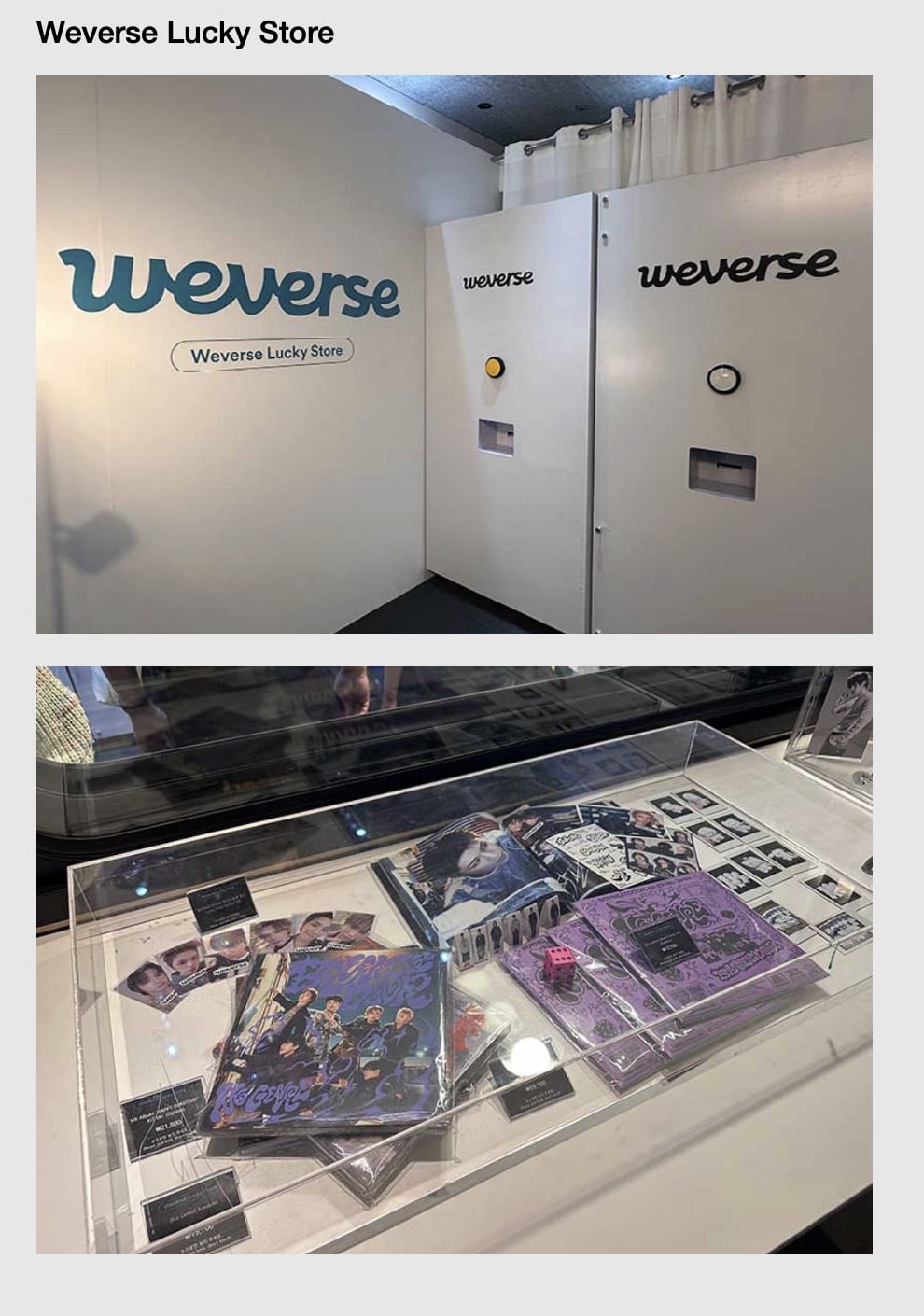
HYBE frames the move as a shift in how Weverse sells: “Weverse has extended its online-focused sales model to offline touchpoints, enabling fans to make purchase through direct interaction with products.” It says the store operates at “a compact size of 26m²” with reused fixtures, and provides tax refund services for international visitors.
The report says the range will widen: “In 2026, we plan to further enhance the in-store experience and viewing elements. The product offering will also expand beyond traditional album sales to include official merchandise, video releases, and licensed products.”
Weverse also extended merchandise sales into concert venues. The report says it ran a QR code-based pick-up service for fans who bought official merchandise within a 2.5 km radius of a venue, across 208 concerts in 2025 (Korea 62, Japan 139, US 7).
HYBE’s move parallels Universal Music Group‘s push into superfan retail.
UMG opened a four-floor store for superfans in Tokyo’s Harajuku district in 2023. In December 2025, UMG added stores in New York and London — the UMusic Shop NY at 2 Penn Plaza and UMusic Shop Camden.

Reservoir (Nasdaq: RSVR) is a publicly traded, global independent music company with operations across music publishing, recorded music, and artist management. Music Business Worldwide



