


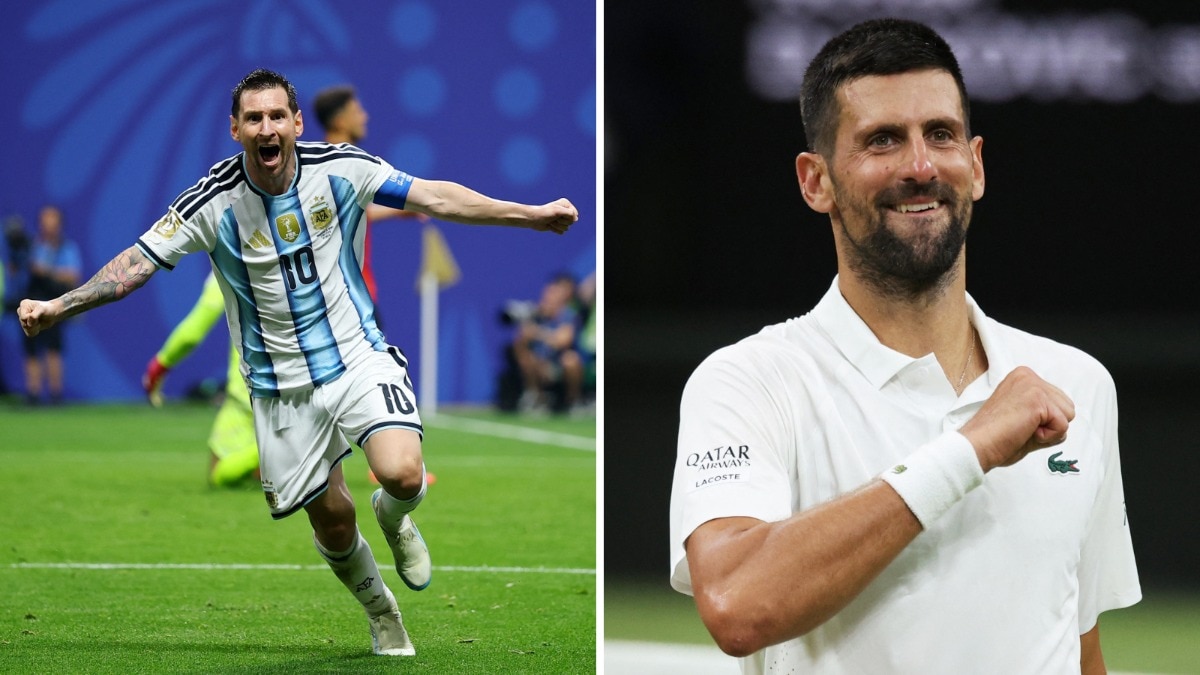
On a remarkable Tuesday evening that belonged entirely to the resilience of two 39-year-old athletes, Novak Djokovic and Lionel Messi provided the sporting world with twin masterclasses in longevity. Hours after Messi galvanised Argentina to a dramatic 3-2 comeback victory over Egypt in the FIFA World Cup Round of 16 in Atlanta, Djokovic was enduring a marathon of his own on the lawns of SW19.
The seven-time Wimbledon champion survived the longest quarter-final in the tournament’s history, outlasting Canada’s Felix Auger-Aliassime across five hours and 15 minutes of gruelling, high-octane tennis.
When the press corps in London later invited Djokovic to reflect on the synchronicity of two global icons defying Father Time on the same evening, the Serb offered a wry, instantly memorable response: “It would be nice to play 90 minutes like him.”
On the surface, it was a classic piece of Djokovic wit, delivered with the easy charm of a man who had just booked his place in yet another semi-final. Yet, beneath the humour lies a fascinating dual interpretation that captures the distinct realities of modern elite sport.
To take Djokovic literally is to understand the sheer physical toll of modern baseline tennis. After five hours of brutal lateral movement on a fading Centre Court grass, the concept of a definitive 90-minute whistle must feel like an absolute luxury. In football, the clock is an absolute boundary; in Grand Slam tennis, the boundary is only found when one man breaks. Djokovic’s quack was a nod to the gruelling, open-ended nature of his craft, where a single match can demand the physical output of three consecutive football fixtures.
However, there is a deeper tactical appreciation embedded in his words. To play 90 minutes like Messi is not merely about duration; it is about sustained, calculated intensity. Messi’s genius at 39 relies on the economy of movement—walking for periods to read the pitch before exploding into pockets of space with devastating precision.
For Djokovic, an athlete whose entire defensive mastery is built on perpetual movement and kinetic coverage, the ability to govern a game with such quiet, bursts of high-intensity authority is the ultimate sporting art form.
The triumphs in Atlanta and London were a poetic reminder of what remains when peak youth fades. Messi, facing an organised Egyptian side that threatened a historic upset, relied on pure footballing intellect and leadership to orchestrate Argentina’s escape. The defending champions eventually beat Egypt 3-2 to secure their passage into the quarterfinals, thanks to Messi’s assist and goal. Djokovic, facing an opponent 14 years his junior who possessed a booming serve and younger lungs, leaned on tactical flexibility and immense mental fortitude to cross the finish line.
Neither icon has anything left to prove to their respective disciplines. Their legacies were secured long before this July Tuesday.
Yet, as Djokovic packed his bags for the semi-finals and Messi turned his focus to the World Cup quarter-finals, they proved that greatness does not look at the birth certificate. Whether operating within the strict confines of 90 minutes or the infinite drama of a fifth set, they remain the standard by which all others are measured.
– Ends



