


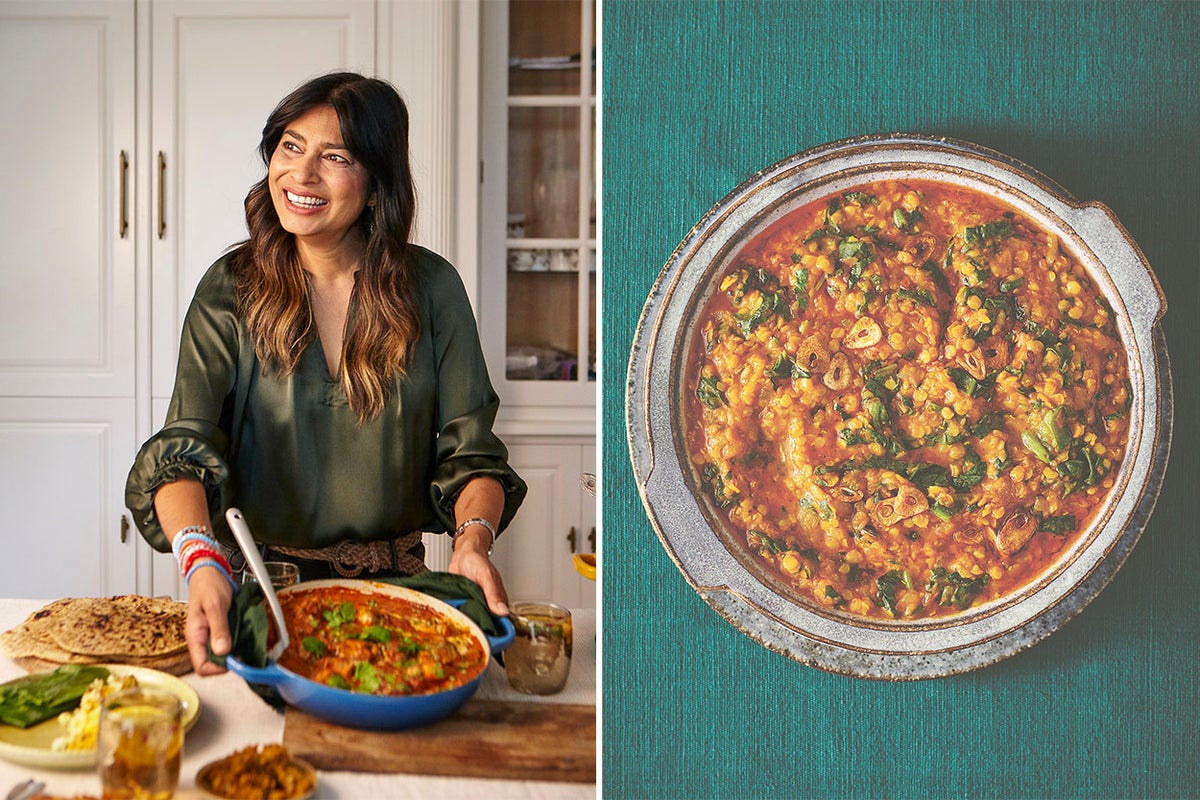
There was once a time when TV chef and restaurateur Nisha Katona was “ashamed” of curry.
Born to Indian parents who arrived in the UK in the Sixties, Katona remembers being were “pretty much the only Indians” in Ormskirk, Lancashire. “Everything about you was so other and so unfathomable, and so probably unwelcome, really, including the way your food smelt and tasted,” says the chef, who owns the restaurant chain Mowgli Street Food.
“So as you were, as a child, very ashamed of curry, and still, it’s ridiculous, I’m 54 and I still get embarrassed if I think my clothes smell of curry, or the outside of my restaurant smells of curry – when in fact, it’s the most delicious smell ever.”
As a child, it was perhaps indicative of the “tempestuous relationship I had with being Indian at all”, she says. “It was only when I got into my 30s that I really fell in love with curry and started teaching people how to cook it.
“I’ve got two daughters and when they were young, if people came home from school they would beg me not to cook curry. It’s the same thing, they were quite ashamed of it, because it’s other, isn’t it? It’s not nuggets and chips. And you don’t want to be ‘other’ when you’re growing up.”
Katona says Britain is “extraordinarily open-minded” when it comes to the world’s food though. Chicken tikka masala is almost an unofficial national dish at this point.
The chef, known for her TV work as a former judge on BBC’s Great British Menu and a guest chef on Channel 4’s Sunday Brunch and ITV’s Lorraine, has now released a cookbook – The Curry Bible – focused on the exact dish she’s had a difficult relationship with.
“So, now, am I proud of curry? It’s not even that I’m proud, I think it’s necessary. Curry is a necessary part of the repertoire of the nation,” she says. “It’s the easiest thing to cook in big quantities for a hungry crowd. It’s the most satisfying thing to eat.”
The success of Mowgli, with 27 restaurants across the UK, must tell Katona something about how much people like her curries too. “Once you have a restaurant, and people queuing to get in, that’s the ultimate acceptance,” she smiles, and sales of her sixth book are already putting her on bestseller lists.
“What that tells a little Indian like me is that people actually love curry as much as you do. It’s no longer something that’s unwelcome, you are no longer unwelcome, you know, it’s a very profound thing. Every time somebody comes to eat in my restaurant, every person that comes in and puts a fork to their mouth, I am grateful.”

At home, she noticed a shift too. These days Katona frequently posts recipes on Instagram – “It’s what I’m cooking in my own house, for my own family. I think my following when from 30,000 in September to 300,000 now, and that’s just because people want to know how to cook curry in a really simple, really authentic, really accessible, healthy way.”
Despite not having a background as a trained chef (she was a child protection barrister for 20 years first) Katona says the “whole point” of her life has been to “take ancient recipes, tried-and-tested spice formulas that have worked in India for her ancestors and bring them to the British public and to the world.
But that doesn’t mean it’s been easy. “When I wrote my first cookbook, and I went trying to speak to various friends’ parents about the way that they cook their dahl, or the way they do their chicken curry, and it would have been easier to try and extract a kidney than get the recipes out of an Indian,” she laughs.
“We feel as though our entire identity comes from the unique way that we can cook, and heaven forbid we should give that DNA to someone else. Heaven forbid another family could cook as well as we do. So part of it is that obfuscation that comes from us as Indians not giving all the ingredients, being a little bit proprietorial about recipes.”
“My parents have both gone, most of my elder relatives are dead. Thank God they gave me these recipes, and thank God I’m passing them on, because what’s the point of them going to the grave?”
It’s probably added to the misconception that curry is complicated, arduous and time-consuming to cook, which couldn’t be further from the truth, she notes.

Her recipes include British favourites like chicken korma, butter chicken, chilli paneer and lamb rogan josh, alongside some you might not know, such as the potato fenugreek curry, tangy mackerel curry or aubergine and poppy seed curry.
“This book is an embodiment of me, which is authentically Indian, authentically home-style, but also someone who was born and raised in Britain. I am basically a brown English person, and those things people like to eat in a curry house, I like as well.”
Plant-based curries – and other snacks and sides – feature heavily, because that’s what Katona grew up on. “My parents were Hindus – I’m Christian so I eat everything – but as Hindus are often very vegetarian, very vegan, so it’s a really authentic way of home cooking.”
Few curries will take more than 20 minutes, she insists. “Half an hour is the general time it takes for me to cook a curry.” And “don’t ever be afraid of layering spices. I’m not even asking you to do that, lump them in.”
Katona’s biggest tip for curry and spice at home is understanding that “every curry is predicated on three spices – two of which never change. The brother and father of the world of curry are turmeric and chilli and, depending on the genre of the ingredient [ie meat, fish, cheese, or veg] that third spice changes.
“If it’s meat, that third spice will be garam masala, if it’s brassicas it would be mustard seed, if it’s root vegetables it would be cumin – it’s that simple.
You must fry the spice in a little oil, she says, “They are dormant until fried. When you fry that seed spice, it releases a myriad of flavours, and that’s doing all the legwork for you, the spices will do the layering, you don’t worry about it.
“All that business about having to prep spices – it’s nonsense.”
Nisha Katona’s spinach dahl
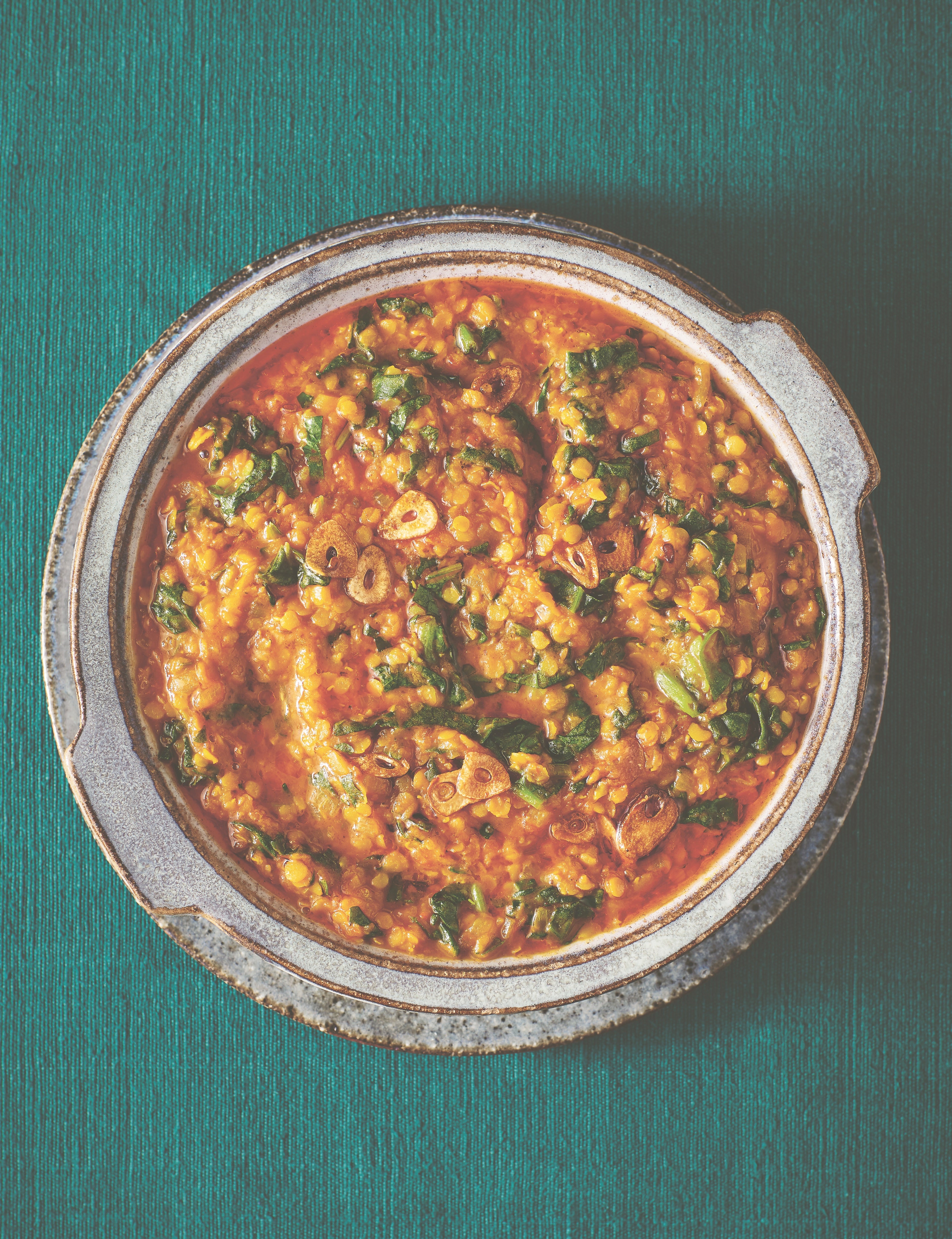
“Lightly cooked red lentils like this are a great vehicle for leafy greens and gentle vegetables,” says Katona. “I have used spinach in this recipe, but you could easily use green beans or even courgettes or marrow.”
Serves: 4
Prep time: 10 minutes | Cook time: 40 minutes
Ingredients:
3 tbsp vegetable oil
1 tsp cumin seeds
1 large green chilli, skin pierced
3 garlic cloves, peeled and thinly sliced
1 white onion, finely chopped
¼ tsp chilli powder
200g red lentils
200g tinned chopped tomatoes
2 tsp salt
½ tsp ground turmeric
125g spinach, washed and roughly shredded
1 tsp sugar
1 tbsp lemon juice
1 tbsp ghee
Method:
1. Heat the oil in a large sauté pan set over a medium-high heat. When hot, add the cumin seeds, green chilli, garlic, onion and chilli powder and fry for about 2 minutes.
2. Add the lentils, tomatoes, salt and turmeric, then add 1 litre of cold water and stir together. Bring to the boil, then reduce the heat to low, cover and simmer gently for 25-30 minutes, stirring occasionally and adding more water, if necessary, until the lentils are tender (they should easily break down when pressed between your fingers).
3. Add the spinach and stir until everything is well mixed. Bring to a simmer, add the sugar and lemon juice, then remove from the heat.
4. Add a splash more water, if required. The dahl should have the consistency of thick porridge. Finish by stirring in the ghee.
Nisha Katona’s beef Madras
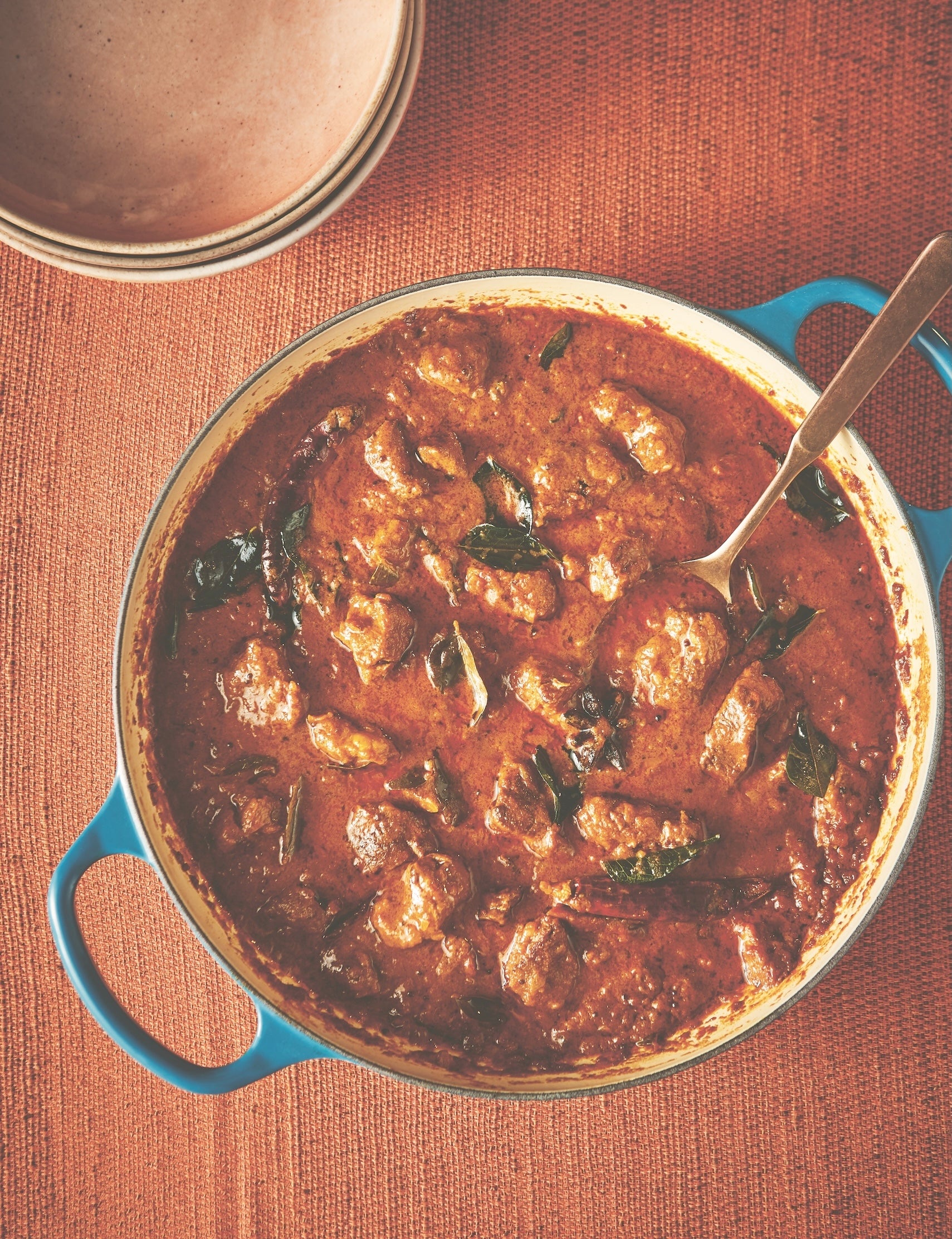
“Named for the city of Madras, now Chennai, this dish was invented at the time of the British Raj as a mild, simple curry for the Western palate. It is not known in the traditional Indian kitchen. It often uses curry powder, which – again – is not a spice blend that forms part of the usual Indian pantry,” says Katona.
Serves: 4
Prep time: 15 minutes | Cook time: 1½ hour
Ingredients:
4 tbsp vegetable oil
1 tsp black mustard seeds
3 star anise
2-3 whole dried red chillies
2 black cardamom pods
8-10 fresh curry leaves
2 large white onions, finely chopped
5cm piece of fresh root ginger (20g), peeled and grated
6 garlic cloves, peeled and minced
600g stewing beef, diced into 3-4cm cubes
1 tsp salt
1½ tbsp garam masala (see below, or shop bought)
2 tsp ground cumin
1 tsp chilli powder
1 tsp ground turmeric
200g tinned chopped tomatoes
1 tbsp tamarind concentrate
250ml coconut milk
1 tsp sugar
1 tsp freshly ground black pepper
2 tbsp chopped fresh coriander (stalks and leaves)
For the garam masala:
1 tbsp cumin seeds
1 tbsp green cardamom pods
2 tbsp coriander seeds
1 tsp black peppercorns
1 tsp whole cloves
7.5cm cinnamon stick
1 star anise
Method:
1. If making garam masala, toast the spices on a dry, hot pan for 3-5 minutes. Allow to cool and then grind all the ingredients to a fine powder in a pestle and mortar or spice grinder. Store in a clean airtight jar in a cool, dark place for up to three months.
2. Heat the oil in a large, heavy-based saucepan over a medium-high heat. Add the mustard seeds and let them crackle, then add the star anise, dried red chillies, cardamom pods and curry leaves, followed by the onions, ginger and garlic. Cook for 8-10 minutes, or until the onions are soft and golden brown.
3. Add the diced beef and fry for 5 minutes, stirring well.
4. Stir in the salt, garam masala, ground cumin, chilli powder and turmeric, and fry for 1 minute.
5. Add the chopped tomatoes along with 350ml water and bring to the boil, then cover and simmer for 45 minutes over a low heat. Keep stirring intermittently.
6. Add the tamarind, coconut milk and sugar, and cook for a further 30 minutes.
7. After this time, check the tenderness of the beef and cook for longer, if needed. Add more water, if required, to bring the sauce to your desired consistency.
8. Finish with the black pepper and chopped coriander before serving.
Goan fish curry
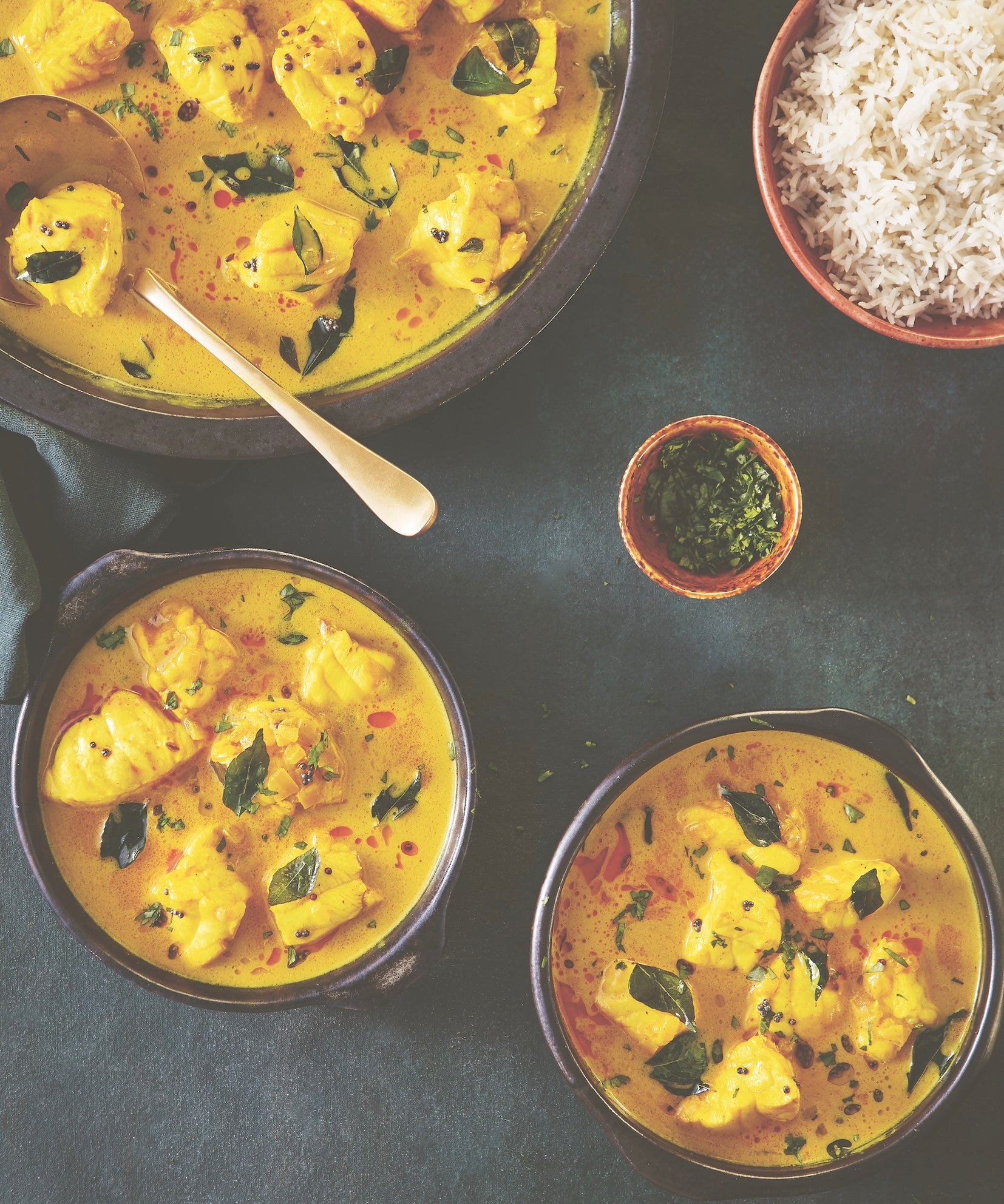
“I have used meaty monkfish in this dish as it keeps its form and can take well the South Indian spicing of curry leaves and mustard seeds,” explains Katona. “It also absorbs beautifully the fruity tang of the tamarind.”
Serves: 4
Prep time: 10 minutes | Cook time: 25 minutes
Ingredients:
1 tbsp lemon juice
1 tsp ground turmeric
600g monkfish tail, cut into 3cm pieces
4 tbsp vegetable oil
½ tsp mustard seeds
6-8 curry leaves
1 white onion, finely chopped
¼ tsp chilli powder
½ tsp ground coriander
300g coconut cream
½ tsp sugar
1 tsp salt
1 tbsp tamarind concentrate
2 tbsp chopped fresh coriander (stalks and leaves)
Rice, to serve
Method:
1. In a bowl, mix together the lemon juice and half of the turmeric. Add the fish pieces and gently toss to coat in the mixture, then cover and place in the refrigerator while you prepare the rest of the ingredients.
2. Heat the oil in a large, heavy-based pan over a medium high heat. Add the mustard seeds and curry leaves and allow to crackle for 15 seconds, then add the onion and cook for 6-7 minutes, or until starting to turn golden.
3. Add the remaining turmeric, along with the chilli powder and ground coriander and cook for 2 minutes.
4. Add the coconut cream along with 60ml water (or more if you prefer a saucier curry) and bring to the boil, then reduce to a simmer, add the marinated fish pieces and cook for 10 minutes.
5. Stir in the sugar, salt and tamarind concentrate, then taste and adjust the seasoning.
6. Finish with the chopped coriander and serve with rice.
‘The Curry Bible’ by Nisha Katona (Penguin Michael Joseph, £28).



