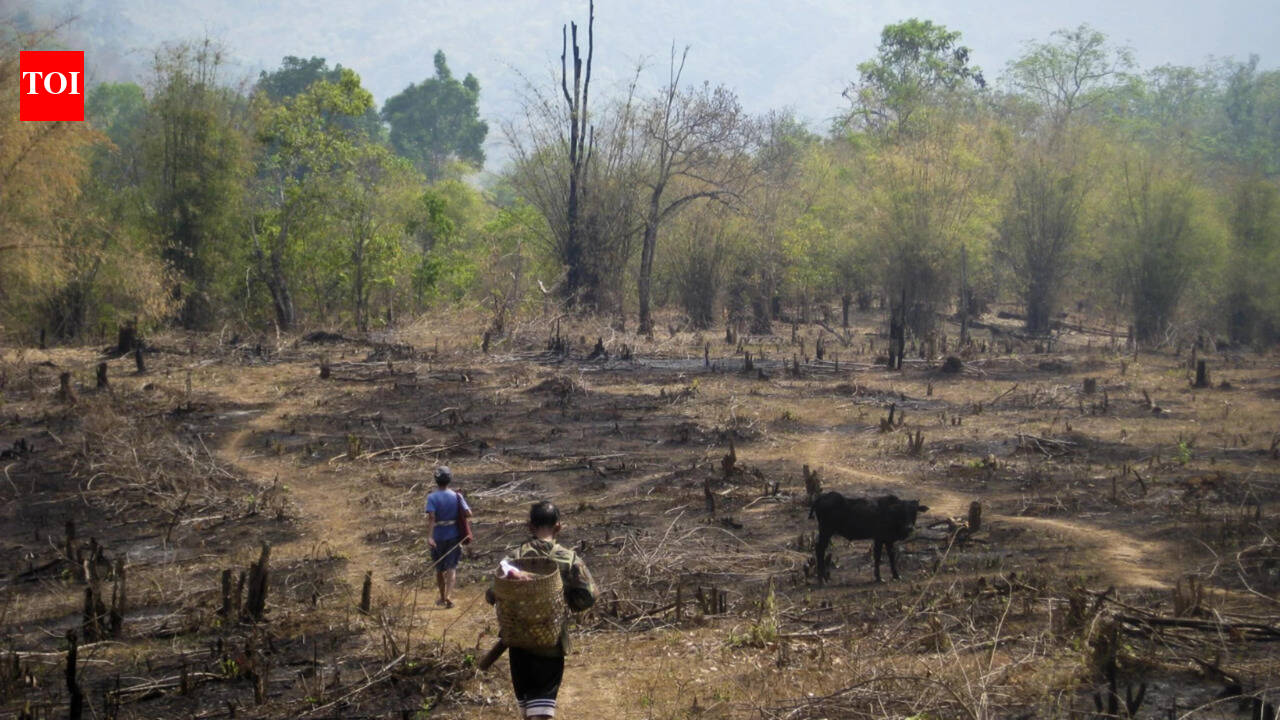




















Slash-and-burn farming was blamed for destroying rainforests, but a study of 18,000 forest patches found community rules can limit clearing and allow trees to return.Published in the Proceedings of the National Academy of Sciences, the research shows that unwritten social rules in small communities keep land use under control, providing food while protecting long-term forest health.The global study was led by Sean Downey, an associate professor of anthropology at The Ohio State University. It looked at swidden agriculture, one of the oldest ways humans farm. For about 10,000 years, villagers in warm climate zones have cut down small plots of trees, burned the dry branches to feed the soil, and grown crops until the land needed a break.Many critics have long argued that this practice ruins entire rainforests, but satellite images and computer models show a different picture.
CJP Jantar Mantar Protest Updates
How unwritten rules protect trees
The research team brought together experts in anthropology, physics, math, and satellite imagery to study farming spots across Central and South America, sub-Saharan Africa, and parts of Asia. They tracked how people choose land and share daily work.In traditional villages, a farmer cannot clear a plot alone and needs help from neighbors. This reliance on local help keeps farmland sizes small.“If a farmer asks for too much—say, a 20-acre (8-hectare) field instead of a 2-acre (0.8-hectare) field—fewer people show up to help,” Downey said.Without enough help, the farmer cannot clear the large plot. Over time, this unwritten social rule teaches everyone to ask for smaller fields, keeping the total amount of cut forest low.This shared sense of right and wrong guides everyday actions. The process fits the work of Nobel Prize–winning economist Elinor Ostrom, who proved that small towns can protect shared nature through peer pressure and refusing to help, rather than relying on official laws or police.“Until now, there haven’t been many formal models that can show how small-scale swidden communities regulate land without top-down rules,” Downey said.When farmers work together through these local habits, the forest forms a patchy mosaic pattern that avoids permanent damage.
Patchwork forests along the border
Downey began looking closely at Belize in the early 2000s. Satellite maps showed a clear difference at the country’s border with Guatemala. On the Guatemalan side, vast stretches of forest were completely cleared for cattle fields. On the Belizean side, where Mayan villages live, a healthy mix of small fields and growing trees covered the map.In Belize, the farming steps follow a simple pattern. Farmers chop down a small area and let the wood dry. Burning the dry wood puts carbon back into the dirt, acting as a natural fertilizer.Crops like corn are planted when the rains start and harvested for a year or two until the soil loses its strength. The field is then left alone, giving the forest time to grow back.“It’s a cyclical pattern of reciprocal exchanges of agricultural labor, social norms that help regulate land use, and fire and ecosystem services that regenerate the fertility of cleared forest patches,” Downey explained.
Clearing small areas helps wildlife
The study revealed that this farming style does not automatically ruin the soil. Clearing small areas can actually bring in a wider variety of plants and animals than leaving an old forest completely untouched.“When you create swidden patches, you create new ecosystem niches during the fallow stage where different species thrive,” Downey said, “and you end up with higher levels of biodiversity across the landscape than you do in a mature forest alone.”Cutting down too much land will turn a thick forest into open grassland. However, taking breaks between small harvests gives various plants and wildlife new places to grow.
Helping rural communities protect land
These findings give clear ideas for global climate policies and environmental protection. They show that legal bans and government laws often miss how well local customs already work.“The takeaway for policymakers is that small-scale rural communities have the ability to manage community forests in sustainable ways, and they need to be supported to solve problems using their own customary practices,” Downey said. “It’s going to look different in Belize than it does in Africa or Indonesia.”
More about slash-and-burn
Slash-and-burn farming, or shifting cultivation, is an ancient agricultural technique used by roughly 200 to 300 million people globally, primarily in tropical forest regions. The process begins during the dry season when farmers clear small plots of forest trees and wild vegetation. This cleared material, called “slash,” is left on the ground to dry out before being burned just as the rainy season arrives. The resulting layer of ash acts as a rich, natural fertilizer, pumping essential nutrients like potassium, calcium, and phosphorus into the tropical soil. Additionally, the high heat from the flames kills off weeds, fungal spores, and harmful insect pests in the topsoil, allowing crops such as corn, rice, and cassava to thrive without synthetic chemicals.Because tropical soils quickly lose their fertility, crops can usually only be harvested on a freshly burned plot for two or three years. Once soil nutrients run low, farmers abandon the site and leave it “fallow” for 5 to 20 years. During this rest period, native seeds take root, deep tree roots draw up minerals from underground, and natural wild vegetation returns to fully replenish the soil. When practiced with sufficiently long rest cycles, this rotation allows forest soil to recover naturally, enabling farming families to return to the same plot decades later without permanently destroying the surrounding land.