


The escalating dispute between FIFA and UEFA over Gianni Infantino’s controversial World Cup investment proposal is no longer just a governance battle. If FIFA presses ahead with the plan and UEFA follows through on its boycott threat, an unprecedented scenario could unfold at the 2030 World Cup, with co-hosts Spain and Portugal potentially absent from the tournament they are due to stage.The prospect has emerged after UEFA unanimously declared that none of its national teams would participate in FIFA competitions “for so long as these proposals remain alive”, while FIFA has insisted it will continue consulting its 211 member associations on plans to establish FIFA Forward Enterprise (FFE), a new commercial subsidiary that would sell a minority stake in the governing body’s commercial rights to private investors.Although no decision has yet been taken and FIFA maintains that the proposal can still be approved, amended or rejected, the standoff has raised fresh questions about what the 2030 World Cup could look like if neither side backs down.
UEFA’s boycott threat carries major implications
UEFA’s warning followed an emergency meeting of its 55 member associations, which unanimously rejected FIFA’s proposal.“The World Cup cannot be treated as an investment product,” UEFA said in its statement.“It is one of football’s greatest sporting legacies. It has been built over generations by players, national teams and supporters across every continent. No part of it should ever be surrendered to private investors.“The World Cup is not for sale.”The confederation later confirmed that none of its national teams would take part in FIFA competitions while the proposal remained under consideration, extending the position to both the men’s and women’s World Cups.
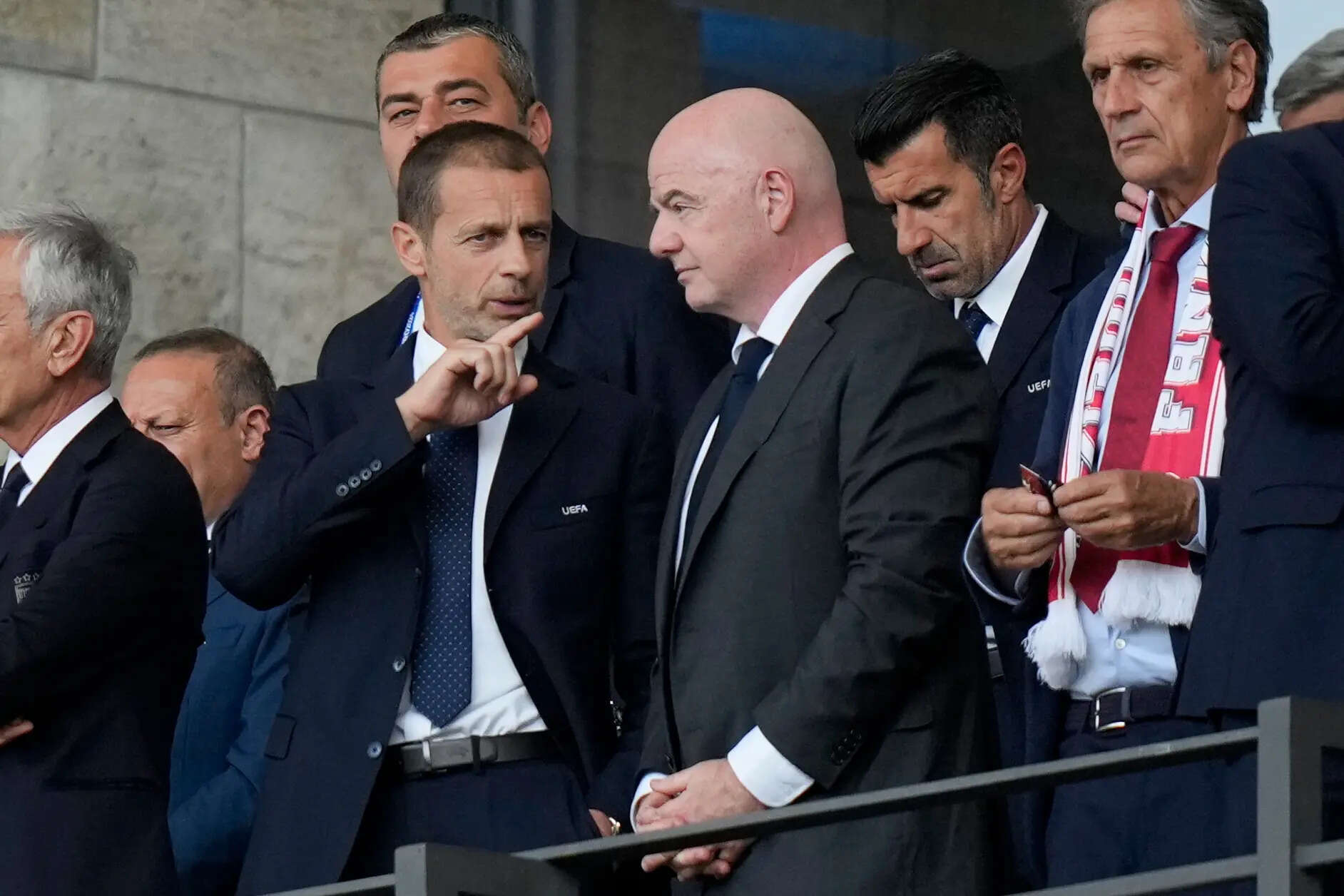
FILE – UEFA President Aleksander Ceferin, left, talks to FIFA President Gianni Infantino before a round of sixteen match between Switzerland and Italy at the Euro 2024 soccer tournament in Berlin, Germany, Saturday, June 29, 2024. (AP Photo/Matthias Schrader, File)
UEFA vice-president Laura McAllister described the proposal as “catastrophic” and accused FIFA of using “a form of blackmail financially” through the funding package being offered to member associations that support the initiative.
Why Spain and Portugal are at the centre of the debate
The implications are particularly significant because the 2030 World Cup is scheduled to be hosted primarily by Spain, Portugal and Morocco.The tournament will also feature one centenary match each in Uruguay, Argentina and Paraguay to commemorate the 100th anniversary of the inaugural FIFA World Cup, making it the first edition to span multiple continents in this way.If UEFA ultimately honours its boycott and Spain and Portugal remain bound by the confederation’s position, the two European co-hosts would not participate in the tournament despite hosting the majority of the competition.Such a situation would be unprecedented in World Cup history, with principal host nations absent not because they failed to qualify, but because of a dispute between football’s governing bodies.
Morocco’s position remains unclear
Unlike UEFA, Concacaf and the Asian Football Confederation (AFC), the Confederation of African Football (CAF) has not formally declared its position on FIFA’s investment proposal.CAF initially indicated it was open to the consultation process, while Morocco, one of the three principal hosts for 2030, has not publicly stated whether it supports or opposes the creation of FIFA Forward Enterprise.South America’s governing body, CONMEBOL, has likewise not taken an official position on the investment proposal. However, its president, Alejandro Domínguez, has previously backed expanding the 2030 World Cup to 64 teams.That leaves the positions of two of the six host nations and their confederations unresolved as FIFA’s consultation process continues.
Expansion plans add another layer of uncertainty
The political uncertainty comes as FIFA has simultaneously accelerated work on a possible expansion of the 2030 World Cup from 48 to 64 teams.Internal documents seen by multiple media outlets show FIFA has begun seeking an independent assessment of the sporting, commercial and operational consequences of a larger tournament, with the governing body expecting the study to be completed before member associations vote on the FFE proposal in September.If both developments were ultimately approved, the World Cup would expand to 64 teams just one edition after increasing from 32 to 48 teams in 2026.Also read: Leaked FIFA document reveals 64-team World Cup expansion plan amid Infantino crisisThe combination of a significantly larger tournament and the possible absence of UEFA nations would fundamentally reshape the competition. Spain and Portugal would not only lose the opportunity to compete on home soil, but FIFA would also face the prospect of staging its centenary World Cup without many of the sport’s most successful national teams.While CONMEBOL has backed further expansion, others have expressed reservations. AFC president Sheikh Salman bin Ibrahim Al Khalifa has previously warned that another increase could create “chaos”, while Concacaf president Victor Montagliani has questioned whether such a move would benefit the wider football ecosystem.
FIFA insists consultation remains open
Despite the growing backlash, FIFA has shown no sign of abandoning the proposal.Responding to criticism on Friday, the governing body insisted that “nobody is selling football” and rejected suggestions that the World Cup was being privatised.FIFA said FIFA Forward Enterprise had been proposed to allow member associations to benefit from football’s commercial opportunities while preserving the governance of the game, adding that “everyone has the right to express their opposition” but that “no single entity can claim to represent all 211 Member Associations around the world.”The organisation also stressed that the proposal remains part of an ongoing consultation process and that member associations retain the power to approve, amend or reject it. It added that if a majority does not support the plan, FIFA’s commercial operations will remain unchanged and FIFA Forward Enterprise will not be established.
Pressure continues to build on Infantino
The dispute has intensified rapidly over recent days.Concacaf rejected the proposal shortly after UEFA, while the AFC became the third confederation to oppose it, saying confidence in FIFA’s governance had been “undermined”.FIFA has also suffered an internal blow after senior adviser Carlos Cordeiro resigned with immediate effect, saying he opposed the proposal “unequivocally” and describing it as “a bad deal for football”.With more than 100 national associations now represented by confederations that have publicly rejected the proposal, the debate has evolved far beyond a commercial restructuring plan. If FIFA proceeds and UEFA follows through on its threat, the consequences would extend beyond governance, potentially reshaping the composition of the 2030 World Cup and leaving Spain and Portugal absent from the very tournament they are due to co-host.



