


“Precision beats power and timing beats speed.” — Conor McGregor.
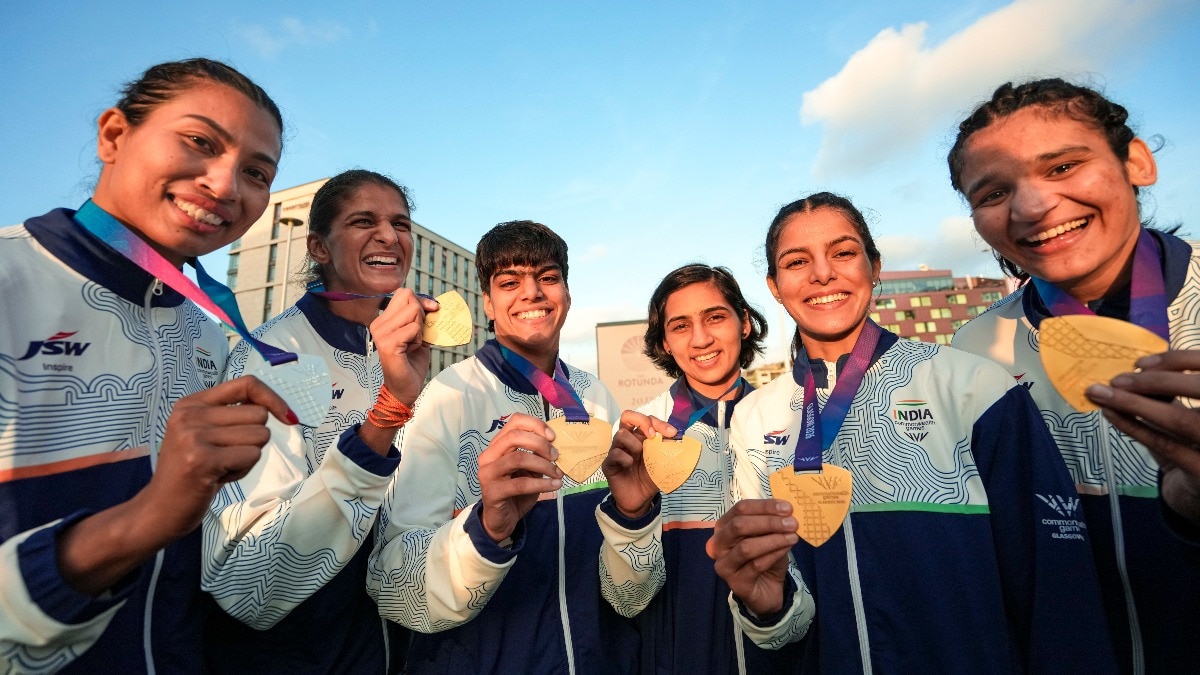
That quote probably fits India’s boxers perfectly after their record-breaking showing at the Commonwealth Games 2026. This wasn’t about punching above their weight. It was about finally delivering on their potential and making it count when it mattered.
There may be talk about India competing in a weakened field, but even before the boxers stepped into the ring on Saturday, August 1, 10 medals had already been assured for India. That, in itself, was a rare feat for Indian boxing.
Then came the gold rush.
India finished with seven gold and three silver medals, completing one of its most dominant boxing campaigns at the Commonwealth Games.
At Gold Coast in 2018, India had won three gold, three silver and three bronze medals. Four years later in Birmingham, the tally stood at three gold, one silver and three bronze.
So, anything less than seven gold medals this time around would arguably have felt like an underachievement.
But starting with the women, the Indian boxers stepped up one after another.
So, what exactly has changed compared to previous editions? Has Indian boxing genuinely taken another step forward? And, more importantly, can this level of performance become the new normal when India walks into the ring at major multi-sport events?
BEST IN THE WORLD?
If we look at the women’s boxing contingent, India now has a pool of fighters who can genuinely hold their own against the best.
Sakshi Chaudhary, who stepped in for Nikhat Zareen in the 51kg division, along with Preeti Pawar, Jaismine Lamboriya and Lovlina Borgohain, gives India a formidable group of medal contenders across major multi-sport events.
Together, they underline the depth of a women’s boxing unit that can go toe-to-toe with some of the strongest teams in the world.
Add Priya Ghanghas to that mix and the lineup suddenly looks like one many countries would be envious of.
Jaismine, the reigning champion in the 57kg category, showed exactly why she belongs in that conversation when she took on multi-time Commonwealth Games medallist Michaela Walsh.
On the men’s side, Sachin Siwach, Jadumani Singh and Ankush Panghal possess the confidence — and a little bit of panache — that you want to see from boxers when they step into the ring.
The 54kg category, meanwhile, is arguably one of the most competitive divisions within Indian boxing itself. That makes Preet’s performance even more significant.
Commonwealth Games medallist and Jadumani’s coach, Sarita Devi, told India Today that the change in Indian boxing has been evident since the last Olympics. She also believes the current crop is more focused and willing to put in the hard yards.
“Medals have become possible because there are more weights.”
“Last Olympics, if we talk, our women’s boxing has gone very high, and at that level, our position has come to a very good level. And one more thing, the children who are playing now are working very hard. And they are focusing much better. They work harder than before,” said Devi.
She also attributes the change to better facilities and the growing role of sports science.
“The government is giving facilities. Training facilities are very good. They are giving such good training facilities and taking them abroad for training, and continuously keeping foreign camps.”
“On top of that, our sports science has also gone quite ahead. What was there in India before? Recovery path, what is it, we didn’t have that much knowledge, we didn’t have that much experience. So when we slowly started getting experience and India started moving towards sports science, then I retired. In the last 6-7 years, the improvement in Indian sports, in sports science, has been quite good,” said Devi.
CALM IN THE EYE OF THE STORM
The gold-medal bout involving Ankush Panghal offered a glimpse into another major change in the Indian boxers’ approach: patience.
Ankush started a little too confidently and found himself losing the opening round. But instead of panicking or trying to force the fight, he went back to his corner, listened to his coaches and gradually worked his way back into the contest.
There was no wild swinging. No desperate attempt to land the big punch.
Instead, Ankush slowly pushed his opponent towards the corner, waited for the opening and then picked him apart.
And it wasn’t just Ankush.
Across the Indian contingent, there was a striking sense of composure. Even when a fighter lost an early round, there was no visible rush to make up for it immediately. The approach was simple: stay calm, stick to the plan and take the fight one round at a time.
Sarita Devi attributes that to the sheer willpower within the Indian boxers.
She believes the fighters already possess the hunger. Sometimes, all they need is the right push from the corner.
“Our child has a lot of will power. All our Indian boxers have it. But if you motivate them a little, and if they motivate properly and change the game plan, they will get the win,” said Devi.
That ability to adapt inside the ring could prove to be one of India’s biggest strengths going forward.
ASIAN GAMES: THE BIG TEST
Now that the celebrations have somewhat subsided, it is time to get back to reality.
The Commonwealth Games haul was spectacular, but the field in Glasgow was not the toughest test India could have faced.
Only two men and three women from the entire Indian boxing contingent had competed at the Olympics. At the World Championships, the numbers were six men and six women.
The medal trends also tell their own story.
At Paris 2024, Commonwealth nations won a combined five boxing medals. That number stood at 10 at Tokyo 2020.
Asian countries, meanwhile, won 13 boxing medals in Tokyo. That figure jumped to 22 in Paris.
The Asian Games, therefore, will provide a far sterner examination of how far Indian boxing has really come.
And Sarita Devi knows exactly why.
Powerhouses such as China, Uzbekistan and Kazakhstan, who were absent from the Commonwealth Games, will be part of the Asian Games field in Japan.
“Uzbekistan and Kazakhstan have quite good boxers. Uzbekistan has quite a good team. So when these come in Asia, these people are not participating in the Commonwealth Games.”
“In the Commonwealth Games, some countries that are participating are a little… I mean, they don’t look that strong, from my observation. Some countries have come newly. And among them, from the beginning, the England team is quite good,” said Sarita Devi.
So, what will India’s boxers need to do if they want to replicate their Commonwealth Games success at the Asian Games?
The technical work will continue, but Devi believes the first priority should be something much more basic: recovery.
She also wants the boxers to resist getting carried away by the celebrations and attention that will inevitably follow their success.
“I want to tell all the boxers, you have to take 5-6 days of good rest. With the Asian Games, we are getting back-to-back competitions. So recovery is the first part. Recovery should be good for the body because boxing is such a game that whether you win, you will also take punches, whether you lose, you will also take punches. So I feel, first of all, focus on your recovery.”
“And whatever medal you have won, celebrate, but it should not be over. Because we have the next competition, we also have to save ourselves for that. And as the whole village, every village, every state, the whole of India is happy that the boxing team has done well and come back with good results, they should not become arrogant.”
“The focus that we have now, the performance we have done in the Games, the focus that the coaches and players kept, the hard work they did they should continue that,” said Sarita Devi.
The legendary boxer also believes the Indian boxers already have the stamina and strength required to compete at the highest level. The focus now, she feels, should be on polishing the finer details.
CONFIDENCE IS THE NEW CURRENCY
There is one thing India’s boxers will carry from Glasgow that cannot be measured in medals: confidence.
The Commonwealth Games have given this group proof that the work being done behind the scenes is producing results.
Devi feels that confidence will travel with the team to Aichi Prefecture and Nagoya, Japan.
“Asia will be stronger. But we will do well. The Indian team boxers are right now in full swing, and on top of that, there is full confidence in the coach and the federation. The confidence that has been built inside the players, that is not easily going to break. They will do well in the Asian Games also,” said Sarita Devi.
The benchmark has been set in Glasgow.
But for Indian boxing, the real challenge now is not to celebrate seven gold medals. It is to make seven gold medals feel less like a stunning achievement and more like the beginning of a new standard.
The long-term target remains LA 2028. And the road to Los Angeles starts with a much more immediate challenge — taking the confidence, composure and hunger from Glasgow to the Asian Games and proving that this wasn’t a one-off.
– Ends



