


Ankara:
Turkish Foreign Minister Hakan Fidan said the recently signed Mecca Joint Defence Agreement between Turkiye, Saudi Arabia and Pakistan is not directed against Iran, stressing that the alliance is defensive in nature and is not intended to attack or eliminate any country.
During an interview with Anadolu Agency on Saturday, Fidan said Saudi Arabia had no strategy to attack or eliminate Iran and instead wanted an end to the violence surrounding the Strait of Hormuz.
Fidan said Riyadh had conveyed to the United States that military intervention against Iran would not provide a solution and favoured resolving the issue through dialogue and an agreement.
He added that Saudi Crown Prince Mohammed bin Salman had reiterated the position during their recent meeting in Mecca and that the same message had been conveyed during discussions with US President Donald Trump.
“You have to be deterrent enough not to be attacked. But problems need to be managed in different ways,” Fidan told Anadolu Agency.
Fidan said the Saudi-Iran issue could not be viewed merely as a dispute between the two countries, arguing that the involvement of the United States and Israel had also contributed to the emergence of the problem.
He said Turkiye had been discussing regional issues with Iranian officials for more than two years and maintained that Iran could play a constructive role in regional cooperation once it addressed its regional challenges.
“Two years ago — we have been discussing this in the region. There were also periods when we discussed these issues with the Iranians. When Iran solves its own problems in the region, when it needs to contribute to the region’s constructive policies and enter that collective sphere, their role is also needed. We always tell them this; the Iranians are not unfamiliar with this issue,” Fidan said.
The Turkish Foreign Minister stated that the agreement does not identify any specific country as a common threat and rejected suggestions that Iran was the target of the arrangement.
“There is no common threat that we have put in writing,” Fidan said, adding that the agreement does not target any country that does not attack its signatories.
He said Turkiye, Saudi Arabia and Pakistan were not expansionist countries and that their foreign policy positions were focused on their borders, domestic challenges, development and positive relations with neighbouring countries.
“Saudi Arabia, Pakistan and Turkiye, when you look at their foreign policy positions, are not countries that have expansionist policies. They are countries concerned with their own borders, their own problems and their development, and, if possible, they want to contribute positively to their environment through good relations and good neighbourliness,” he said.
Fidan said the three countries have different capabilities and approaches but that their coming together would result in a defence-orientated organisation rather than an offensive alliance.
“Now, when we come together with these countries, naturally we are becoming a defence-orientated organisation. It is not an approach of going on the offensive and saying, ‘Let’s do this or that together.’ Therefore, unless it is attacked by a country, whether from inside or outside the region, this alliance cannot have any dispute with any country. But, of course, the power composition we have put forward will make a constructive contribution to regional stability,” he added.
Fidan also said the agreement had been examined from legal, political and strategic perspectives and that Turkiye saw no issue with its framework.
The Foreign Minister further compared the Mecca Joint Defence Agreement to NATO’s Article 5 on collective defence, noting that it was technically similar, under which an armed attack against one member is treated as an attack against all.
He said Turkiye’s experience as a NATO member since 1952 would provide an important reference for the new alliance, particularly in terms of deterrence and institutional practices.
Fidan said the alliance would draw lessons from existing models, with NATO providing the most significant example of a large-scale and enduring defence organisation.
He explained that the pact’s collective defence mechanism would require practical decisions by the alliance’s relevant political and military bodies if a member were attacked.
According to Fidan, a country facing an attack would need to request assistance and determine the kind of support it required. Such assistance could include intelligence, logistics, ammunition or, depending on the scale of the threat, military units.
He said the alliance would have political and military committees comprising foreign and defence ministers and chiefs of general staff. These bodies would translate decisions taken by the leaders into measures within the alliance, while a secretariat would oversee implementation.
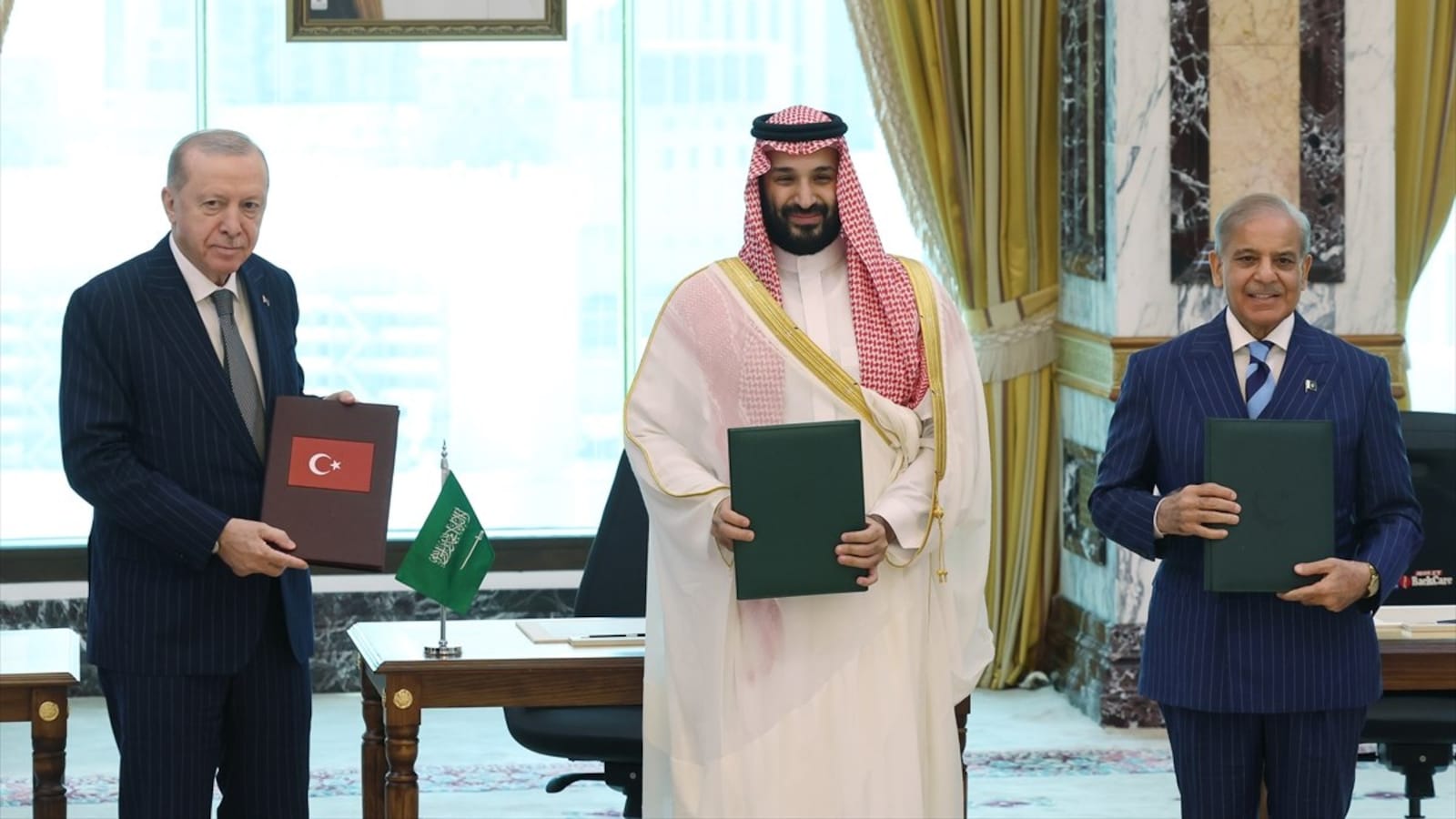
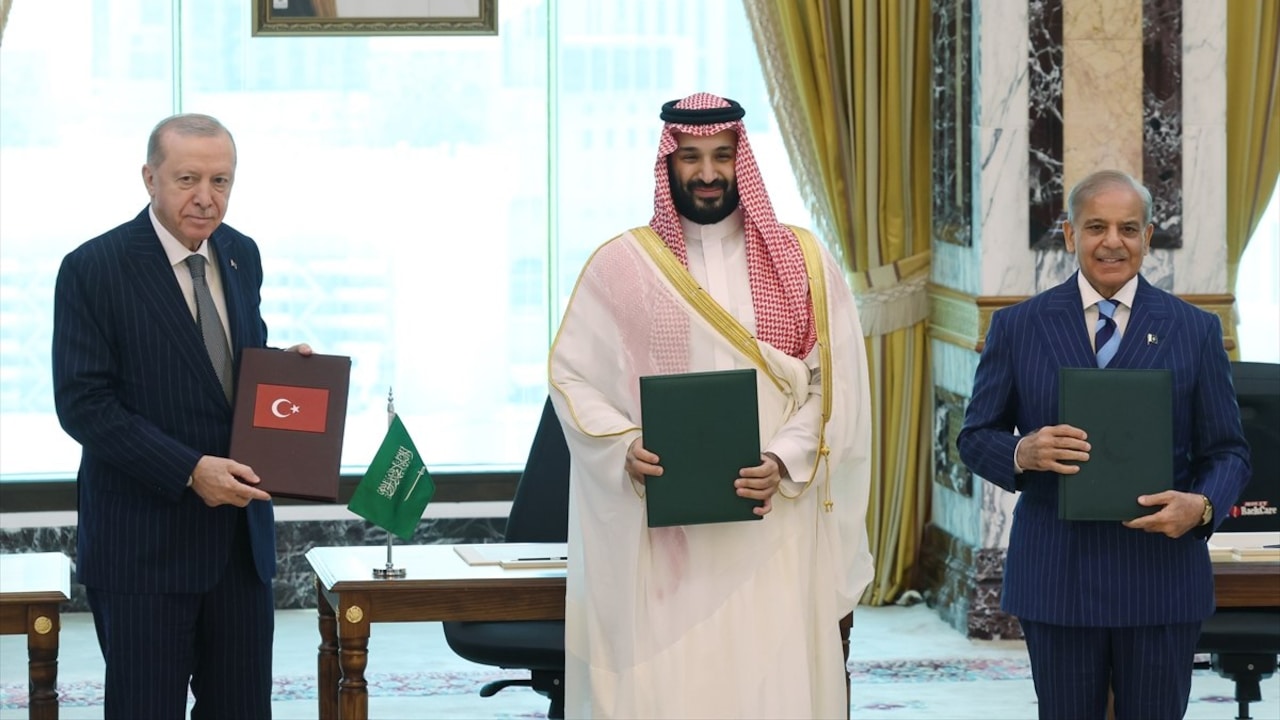
Pakistan, Saudi Arabia and Turkiye signed the Mecca Joint Defence Agreement on Friday amid escalating tensions and conflict across West Asia.
The agreement seeks to strengthen defence cooperation and collective deterrence among the three countries. According to the summit statement, an armed attack against any one of the three signatories would be regarded as an attack against all three.
“The Agreement is intended to strengthen collective deterrence against any act of aggression, and stipulates that any armed attack against any one of the three States shall be regarded as an attack against them all. It further provides for the enhancement of all aspects of defence cooperation among the three States,” the summit statement said.
While the pact does not specify detailed operational or military commitments, it establishes a framework for enhanced defence cooperation and identifies peace, stability and security in the region and beyond as its broader objectives.
Fidan said the initiative had been under discussion before the current conflict environment and that Turkiye had anticipated changes in regional security dynamics and the continued importance of counterterrorism.
He said the agreement was intended to create greater deterrence and mutual security commitments among the signatories, rather than serve as an instrument for offensive military action.
“The Mecca Agreement is the most important step toward bringing lasting stability to this region,” Fidan said.
Fidan also said the alliance could eventually be expanded beyond the three founding members.
“Under our president’s vision, we should not remain limited to three countries. We should grow and, if necessary, bring all countries under this umbrella,” he said.
(Except for the headline, this story has not been edited by NDTV staff and is published from a syndicated feed.)



