


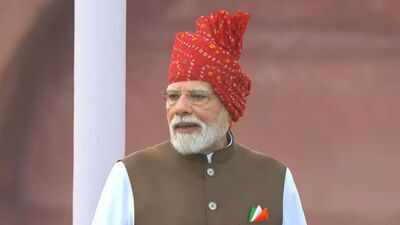
NEW DELHI: To mark India’s 80th Independence Day, Prime Minister Narendra Modi arrived at the Red Fort on Saturday wearing a striking red tie-and-dye turban with a long trailing end, as he delivered his 13th consecutive Independence Day address from the historic ramparts.The turban featured intricate red, green and white patterns, reflecting styles associated with Rajasthani and Gujarati traditions. He paired it with a white kurta-pajama and a brown jacket, completing the look with three pocket squares in saffron, white and green—the colours of the national flag.For more than a decade, PM Modi’s Independence Day appearances at the Red Fort have featured a closely watched visual tradition: the turban. Since his first address as Prime Minister in 2014, he has chosen safas and turbans in a wide range of colours, patterns and regional styles, often bringing India’s rich textile heritage and craftsmanship into focus.From Rajasthan’s bandhej and leheriya to tricolour-inspired designs, his choice of headgear has evolved from year to year while retaining its traditional character. Here is a look back at the distinctive turbans that have become a recognisable feature of Modi’s Independence Day appearances.
2025: Saffron takes centre stage
For the 79th Independence Day, Modi opted for an all-saffron safa, paired with a white kurta and churidar, a saffron bandhgala jacket and a tricolour stole.The saffron turban marked his 12th consecutive Independence Day address from the historic Red Fort.
2024: A wave of Rajasthan
In 2024, Modi chose a leheriya-print turban featuring bold orange, dark green and yellow streaks, with a long, deeply pleated tail.Leheriya is a traditional Rajasthani tie-dye textile known for its wave-like patterns, inspired by the movement of desert winds.Also read: 80th Independence Day: ‘Vande Mataram’ played for first time as PM Modi addresses nation
2023: Bandhani makes a colourful return
Modi wore a multicoloured Rajasthani-style bandhani turban in 2023, featuring shades of yellow, green and red. The Prime Minister paired it with an off-white kurta-churidar, a black V-neck jacket and a geometric-patterned pocket square.
2022: A tricolour-inspired turban
In 2022, Modi aligned his Independence Day attire with the Har Ghar Tiranga campaign, wearing a white turban decorated with saffron and green stripes. He paired it with a white kurta-churidar and a baby-blue Nehru jacket.The headgear mirrored the colours of the national flag while retaining the traditional format associated with his Independence Day appearances.
2021: Saffron, red and a flowing trail
During the Covid-19 pandemic in 2021, Modi wore a saffron turban featuring bold red patterns and a long pink trail. He paired it with a white kurta, fitted churidar, deep blue jacket and a white scarf edged with a saffron border.The long trailing end remained a prominent feature of the headgear, continuing the distinctive visual style of his earlier Independence Day turbans.
2020: A safa doubling as a mask
At the height of the Covid-19 pandemic, Modi chose a saffron-and-cream turban with an extended tail. He wore it with a white kurta and churidar, along with an orange-and-white stole that also served as a protective face covering.The ensemble combined his recurring use of traditional headgear with a practical response to the public-health circumstances of the time.
2019: A nod to Rajasthan’s textile heritage
In 2019, Modi wore a multicoloured safa featuring Rajasthan’s traditional leheriya wave pattern. The design created a ripple effect across the headgear and continued his use of regional textile traditions for the Independence Day occasion.
2018: Saffron with a long trail
In 2018, Modi returned to saffron, wearing a bright turban decorated with red patterns and a long trail that extended almost to his ankles.He paired the headgear with a white stole featuring a broad geometric-patterned border.
2017: A flamboyant yellow turban
Modi chose a vibrant yellow turban in 2017, featuring intricate traditional and geometric patterns woven across the fabric.The headgear combined bright red and yellow with a subtle golden criss-cross design.
2016: Pink, yellow and bandhej
In 2016, Modi embraced the classic tie-and-dye technique with a vibrant bandhej turban in bright pink and yellow. The headgear featured distinctive patterns and a long trailing end.
Share your thoughts in the comments
Be respectful · TOI community guidelines
The festive design reflected the Prime Minister’s preference for colourful traditional headgear during the Independence Day celebrations.
2015: A criss-cross Rajasthani design
In 2015, Modi wore a sunny yellow turban covered in a multicoloured criss-cross pattern combining red and deep green. The headgear featured a long trail extending towards his ankles, giving the traditional Rajasthani-style turban a prominent silhouette.It marked another early example of Modi using Independence Day attire to foreground Indian textile traditions.
2014: The tradition begins
For his maiden Independence Day address as Prime Minister in 2014, Modi wore a bright red Jodhpuri bandhej turban with contrasting green accents.The Rajasthani-style headgear featured vivid orange, yellow and green tones and traditional patterns. That first Red Fort appearance established the colourful turban as a recurring element of Modi’s Independence Day wardrobe, a tradition that has continued through successive addresses.


