


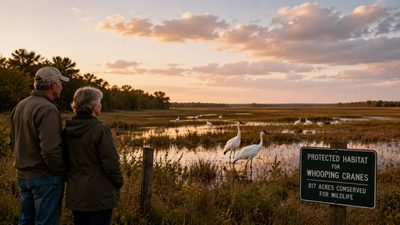
In 1999, Al and Diane Johnson thought they had finally found the place where they could build a home and settle down. They had bought 828 acres on Texas’ Lamar Peninsula, a broad stretch of marsh, grassland and live oak woodland near Rockport. Then they noticed two very large birds walking across their newly acquired land. They were whooping cranes, one of North America’s most endangered birds, and at the time only around 180 were believed to remain in the wild. The discovery left the couple unsure what it might mean for their plans, but it also changed the way they looked at the property. Rather than treating the cranes as an obstacle, they began asking how the land could be kept suitable for them. With help from conservationists, the Johnsons eventually protected 817 acres, while keeping just 10 acres for their home and other buildings. More than two decades later, the property remains a winter refuge for the cranes.
How a Texas couple discovered endangered whooping cranes on their new 828-acre property
The Johnsons had spent nearly all the money they had managed to put together to buy the property, which lies roughly 20 minutes north-east of Rockport. Al was a home builder, and Diane was a stay-at-home mother, and they intended to create a permanent home on the Lamar Peninsula. The presence of the cranes brought an immediate complication. These were not ordinary large birds passing through. The whooping crane was an endangered species, and the couple initially worried that having the birds on their land could interfere with their plans to build. According to Undark magazine, the pair were struck by the birds’ size and appearance, but were also uncertain about what their presence would mean for the property.The Johnsons soon began watching the cranes more closely. They were using the marshy parts of the property as winter habitat, part of a much larger seasonal range along the Texas coast. The birds belonged to the only naturally occurring wild whooping crane flock in the world, travelling roughly 2,500 miles between breeding grounds in Canada and their wintering grounds around the Texas coast. The Johnsons contacted Tom Stehn, a biologist at the nearby Aransas National Wildlife Refuge, after deciding they wanted to understand how they could live alongside the birds while protecting the habitat they relied upon.
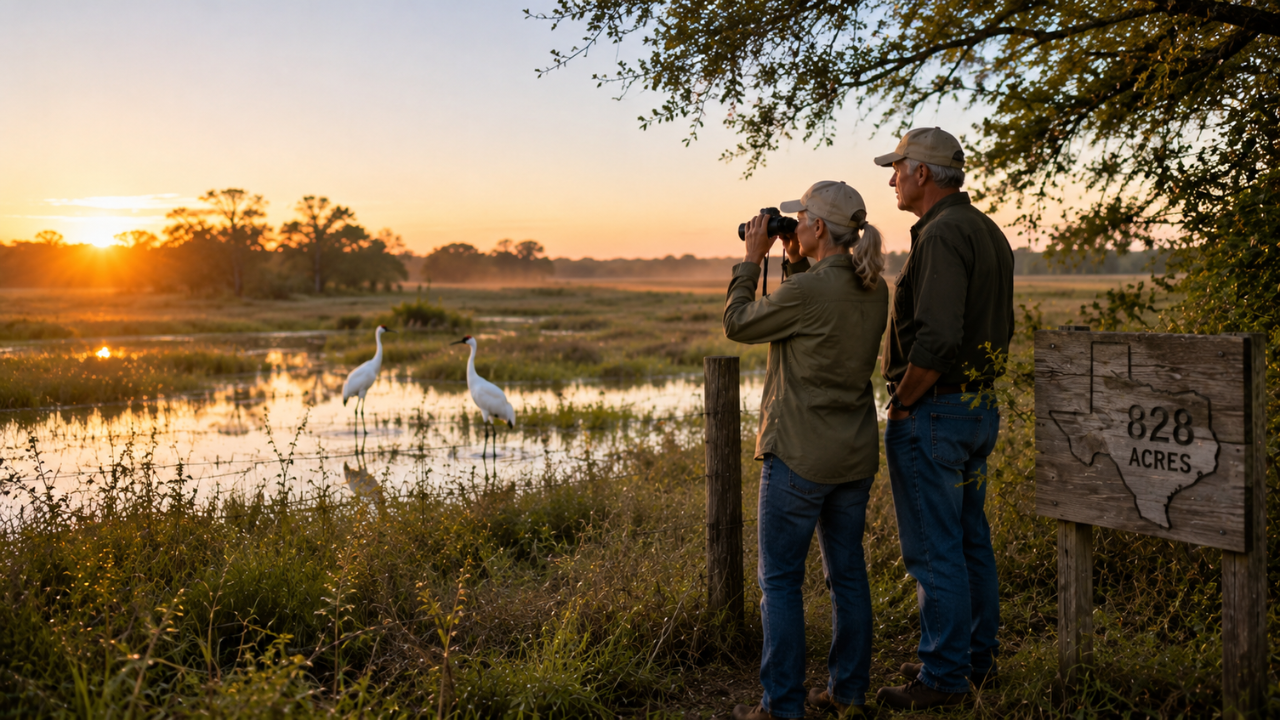
Image AI generated
Texas couple protects 817 acres of their 828-acre property for endangered whooping cranes
Stehn connected the couple with The Nature Conservancy, which helped turn their concern into a long-term arrangement. The proposal involved selling 244 acres so the land could become part of the Aransas National Wildlife Refuge. Another 573 acres would be placed under a conservation easement, giving the Johnsons a tax benefit while permanently preventing that part of the property from being developed. They kept 10 acres for their house and other structures. The result was unusual in its scale: almost the entire tract would remain available to wildlife even though the Johnsons were still able to build the home they had originally wanted.That decision left 817 of the original 828 acres protected in one form or another. The remaining land became the Johnsons’ home, including a studio and other buildings, while the surrounding wetlands, uplands and live oak habitat remained open. The property has since become a regular winter territory for a pair of cranes the Johnsons call Yay and Nay. The arrangement also meant the family was living inside the habitat rather than simply looking at it from a distance. Over the years, the Johnsons learned how the cranes used their ponds, grassland and marshes, even receiving advice from conservationists on practical details such as mowing and the design of artificial ponds.
Whooping crane population recovers from 16 birds, but the endangered species still faces threats
The Johnson property sits within a landscape that has become increasingly important to the recovery of whooping cranes. Decades ago, the species had fallen to roughly 16 birds in the wild. Protection of wintering habitat, environmental laws, captive breeding and sustained conservation work helped the population recover. The latest survey put the Aransas-Wood Buffalo flock at more than 550 cranes, alongside more than 270 birds living in zoos or experimental release programmes. That is a dramatic improvement from the species’ low point, but the birds remain endangered.The Texas coast remains a difficult place for them to live. Development has broken up open habitat, while freshwater shortages and rising sea levels are changing the wetlands where the cranes feed and drink. Their food includes blue crabs and wolfberries, both of which depend on the condition of the coastal estuary. During the severe drought of 2008 and 2009, 23 whooping cranes died, likely from starvation, and the wild population fell to 247 birds. Conservation scientist Liz Smith described the different pressures facing the cranes as interconnected problems, with human activity sitting behind many of them.
Why protecting large areas of Texas habitat matters as endangered whooping crane populations grow
The Johnsons’ property is now one of the private pieces of habitat used by wintering cranes on the peninsula. Yay and Nay have established their own territory there, and their behaviour can be distinctly territorial. Diane Johnson has described how the pair reacts when other cranes approach, with the resident birds driving them away rather than readily sharing the space. That behaviour is more than a curiosity. As the available habitat becomes increasingly fragmented, keeping sizeable pieces of suitable land intact becomes important because cranes cannot simply be expected to move elsewhere when their preferred territory disappears.The Johnsons’ decision also came to represent a broader question facing the Texas coast: what happens when land that still supports endangered wildlife becomes attractive to developers? The couple have encouraged other landowners to consider conservation easements, but they have also watched nearby properties become residential developments. Diane has argued that the cranes will need more land as their population grows, at a time when large, undeveloped parcels are becoming harder to find. Their 1999 purchase began as a search for a home. More than two decades later, most of that original 828-acre property remains undeveloped, giving the cranes a place to return to each winter.


