


New Delhi:
Former Chief Economic Adviser (CEA) Krishnamurthy V Subramanian backed India’s Gross Domestic Product (GDP) growth figure of 7.8 per cent for the April-June 2026 quarter after the Congress doubted its accuracy, saying it was calculated using the cutting-edge “double deflator” methodology.
He dismissed the Opposition’s charge that the government deliberately revised last year’s GDP numbers downward to inflate this.
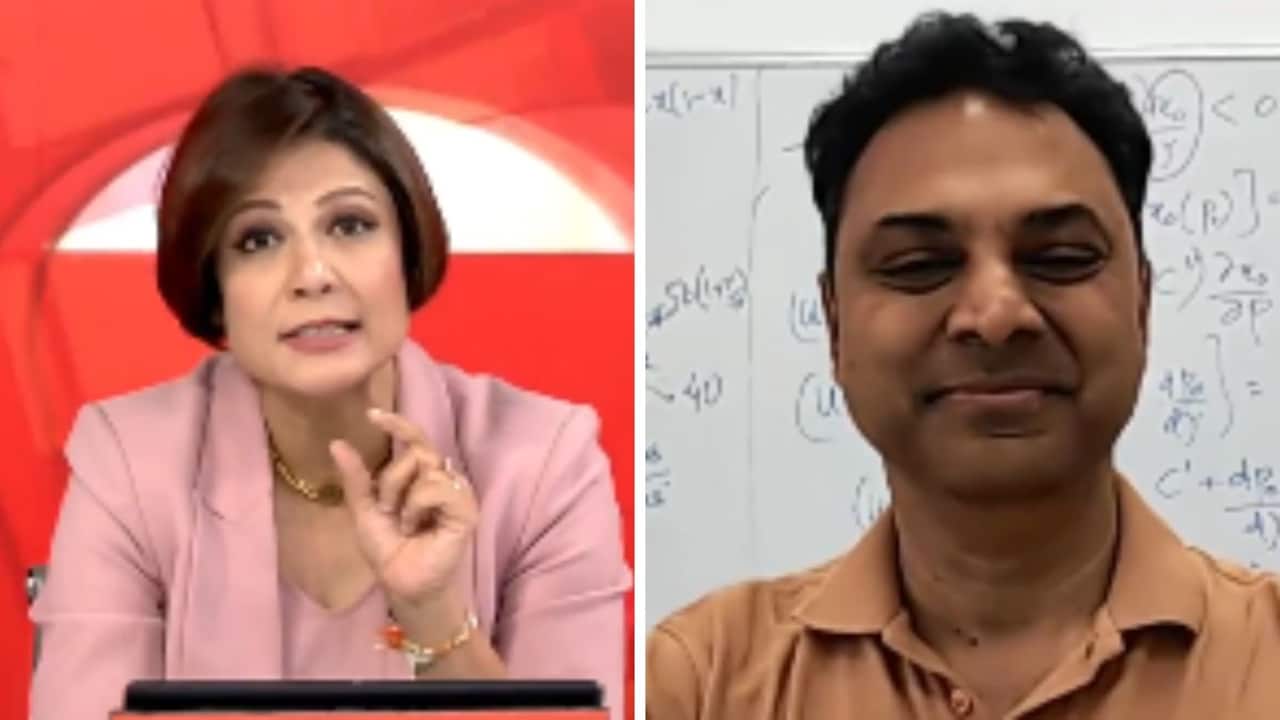
“What India actually had done last year was to move to the methodology that is, that is actually the cutting edge methodology of the double deflator,” he told NDTV Managing Editor Padmaja Joshi.
He used the analogy of khichdi to explain the methodology.
“So think about just a simple example. Let’s say I make Khichdi and I sell Khichdi. To make Khichdi, I need to use rice and lentils. Now, suppose basically Khichdi price goes up by 10 per cent, but dal and chawal prices go up by 5 per cent. Then, you know, because we actually use the actual prices that are paid, the nominal quantities from there to infer real prices, what actually gets done in this case, if you look at the value added through Khichdi, what the statistical office will do is it will deflate that actual nominal price by 10 per cent for the price of the Khichdi, which is the output. And it will deflate the price of the input, which is, in this case, rice and dal, by 5 per cent. So, you know, the double deflator is actually you deflate the output at the price level, change in the price level of the output, and you deflate the input at the price level of the input so that you get, arrive at real quantities, and then you do arithmetic with the real quantities, So that’s what the 7.8 per cent that we’ve got actually is the double deflator method,” he said.
Also read: “Sure Sign Of Intellectual Dishonesty”: SBI Research On Doubts Being Raised On GDP Growth Data
He said the double deflator is a better methodology.
Asked about the Opposition’s allegation that economic indicators like employment and foreign investment are not proportionately increasing with the GDP growth, he said, ” You know, for a long time, we were worried about private investment not picking up. But now I think these signs are clearly there that private investment is picking up.”
“This year, if you see Q1, the gross fixed capital formation, which is basically technical jargon for investment in the economy, has grown by 12 per cent. Private capital expenditures of listed companies- and this is a city report; this is not the Government of India that actually, you know, people may use- that has grown by 11 per cent. So private investment actually clearly seems to be going up. You know, when you put that together with bank credit, that is RBI data, which is actually July to July- has grown at about 20 per cent. And finally, one more statistic, if you want to use it actually: look at the IIP for capital goods, because when companies want to invest, what will they do? They’ll actually, of course, purchase more capital goods, right? And that has grown by over 15 per cent. So when you put it all together, I think the data clearly says that investment is picking up,” he added.
Also read: ‘7.8% Growth Very Strong Amid Challenges To World Economy’: PM’s Adviser Sanjeev Sanyal
He acknowledged the tepid pace of employment generation.
“Now, as for employment, and I think that is where, if you look at the data and the PLFS data shows very clearly, from 2018 onwards, the unemployment rate has declined. That said, though, and I think this is something which we have to acknowledge, that overall, you know, the rate of employment creation, especially in the formal sector, you know, is actually not as high as the GDP growth. And that’s an aspect that actually needs to be worked on,” he said.
Earlier today, Union Commerce and Industry Minister Piyush Goyal hit out at Opposition leaders and former officials questioning India’s growth figure for the April-June 2026 quarter, accusing them of comparing an old data series with a new one.
“I see on TV some of the Opposition leaders, even possibly a former finance secretary or a former RBI (Reserve Bank of India) governor, both of whom could not complete their tenure in India… They don’t even know [that they should] compare apples with apples. They are trying to misguide the people of India, comparing growth rate [based on an] old series with a new series where the base year itself has changed,” he said.


