


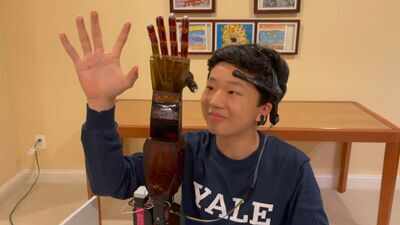
Each one of us spent the pandemic doing something that we normally wouldn’t have the time to. While some picked up numerous indoor hobbies, others studied hard enough to change career pathways. Benjamin Choi, a then 17-year-old kid, put his spare time during the phase to design an accessible device that does not require brain surgery.When he was in third grade, Choi watched a “60 Minutes” documentary about a mind-controlled prosthesis. Researchers implanted tiny sensors into the motor cortex of the brain of a patient who moved a robotic arm using her thoughts. “I was really, really amazed at the time because this technology was so impressive,” he said to Smithsonian Magazine. “But I was also alarmed that they require this really risky open brain surgery. And they’re so inaccessible, costing in the hundreds of thousands of dollars.”Years later, when the pandemic hit in 2020, Choi, a tenth grader living in Virginia found himself with ample free time. The lab in which he’d planned to spend his summer researching aluminium fuels had shut down. But the documentary he had seen years earlier stuck with him, and he decided to use his spare time to build a less-invasive prosthetic arm himself.He formed a makeshift laboratory on the ping-pong table in his basement and designed the first version of his robotic arm using his sister’s $75 3D printer and some fishing line. The printer couldn’t build pieces over 4.7 inches in length, so Choi printed the arm in tiny pieces and bolted and rubber-banded it together. In total, it took about 30 hours to print. This version worked using brain wave data and head gestures, and Choi posted instructions online for anyone to build their own.He had some previous experience building robots and coding from participating in competitive robotics at the elementary, middle school and high school levels, even going to the world championships several times. Starting in ninth grade, he taught himself the computer programming languages Python and C++ by watching videos on Stack Overflow, a website for programmers.After more than 75 design iterations, Choi’s non-invasive, mind-controlled robotic arm could be made from engineering-grade materials, able to withstand weights up to about four tons. It operates using an algorithm driven by artificial intelligence (A.I.) that interprets a user’s brain waves. And it only costs around $300 to manufacture—a huge savings compared to what’s currently on the market. A more basic, body-powered upper limb prosthesis costs about $7,000. As of 2015, the very advanced, full-arm Modular Prosthetic Limb, which has 26 joints, hundreds of sensors and can curl up to 45 pounds, cost about $500,000. This prosthesis, paired with a surgery to reroute nerves that once controlled the arm, allows patients to command the limb with their thoughts and even feel texture through it.Choi’s arm uses electroencephalography, or EEG, to avoid the invasive techniques of other prostheses. EEG devices record the brain’s electrical activity using sensors placed on the head. They are often used in medicine to diagnose epilepsy or other brain disorders. His system uses two electrodes: a baseline sensor that clips onto the earlobe and another on the forehead that collects EEG data. The forehead electrode picks up brain wave information, which is sent to a microchip in the prosthetic arm via Bluetooth. An A.I. model that Choi created, also embedded in the chip, deciphers the data and converts it into a prediction of what the brain is thinking. The arm also moves using head gestures and stops with intentional blinks.The invention earned Choi a spot in the top 40 finalists of 2022’s Regeneron Science Talent Search, America’s oldest and most prestigious science and math competition for high school seniors. “It means a lot to me to see that my work is recognised like this,” Choi said at the time. “I’m definitely very grateful to be a finalist.” The young inventor went on to win funding from the Massachusetts Institute of Technology in 2021 to continue his research and work with experts at the university. For about six months, he experimented with cloud computing to make the arm internet-compatible. To create his A.I. model, he worked independently with six adult volunteers for about two hours each, collecting their brain wave data at his school and home. While collecting the data via an electrode on the forehead, he asked each participant to focus on clenching and unclenching their hand. He trained the A.I. to distinguish between the brain signals, and the A.I. model continuously learns from a user’s brain waves. In total, the algorithm has over 23,000 lines of code, with 978 pages of math and seven completely new sub-algorithms. Choi’s algorithm performs with a mean accuracy of 95 per cent. He said the previous gold standard for a similar artificial neural network was 73.8 per cent.In 2021, he was selected as a Simons Fellow at Stony Brook University, where he worked remotely with Ji Liu, a professor in the department of electrical and computer engineering, on the machine learning algorithm of his AI. Choi has also won awards in the Regeneron International Science and Engineering Fair, the Microsoft Imagine Cup, and the National At-Home STEM Competition. He received a manufacturing grant in October 2020 from PolySpectra, Inc., a company that produces durable 3-D printed materials, to produce his arm.Over the past few years, Choi has only furthered his achievements. In 2023, he did machine learning research at The Johns Hopkins University Applied Physics Laboratory. From August to December 2024, he worked as a researcher with NASA and currently works as an AI researcher at the Kempner Institute at Harvard University. He is about to graduate with a degree in applied math and a concurrent master’s in computer science from the Harvard John A. Paulson School of Engineering and Applied Sciences.The bionic arm, whose underlying signal processing he continued developing at Johns Hopkins, was the foundation of Choi’s interests. But his time at SEAS, whether with the Weber Group or Kempner Institute, has both broadened and refined his understanding of machine learning. Now set to enter the workforce, Choi is fully ready to continue what he’s always done: find ways to apply his research in the world around him.


