


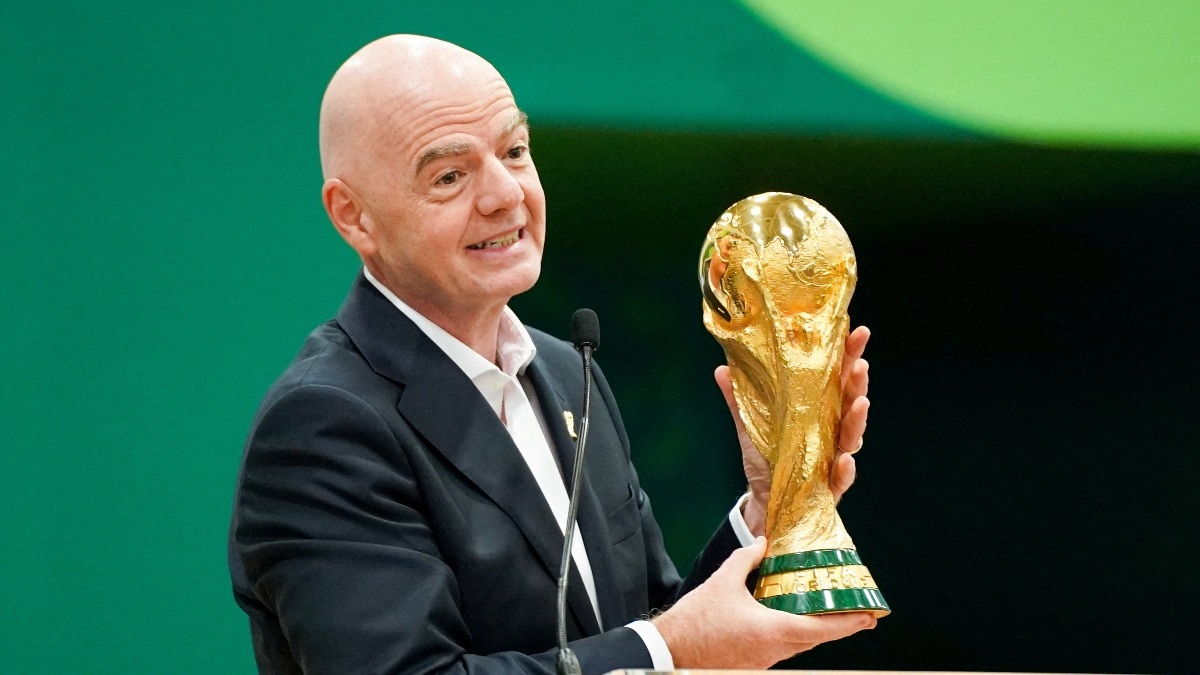
FIFA’s plan to bring private investors into the commercial heart of world football is facing growing resistance, with Europe, Asia and North and Central America now united in their concerns over a proposal that could fundamentally alter the way the game’s biggest competitions are run.
The backlash has come from three of FIFA’s six continental confederations, with UEFA taking the strongest stand so far by unanimously rejecting the proposal and threatening a boycott of FIFA competitions if the plan is not abandoned. The Asian Football Confederation (AFC) has also expressed “great concern and disappointment” over the lack of consultation, while CONCACAF has questioned the due process surrounding the plan.
WHAT IS FIFA’S NEW WORLD CUP PLAN?
At the centre of the storm is FIFA Forward Enterprise (FFE), a proposed new FIFA-owned subsidiary that would bring the governing body’s commercial and event operations under one structure. FIFA says FFE could be valued at $20 billion and raise up to $4.2 billion by selling minority, non-controlling stakes to external investors. FIFA insists it would retain control over the enterprise and all football governance, competition and sporting decisions.
But for the confederations, the problem is not simply the money. It is how the proposal has been brought to the table.
ASIA HIT BACK AGAINST FIFA
The AFC said it was not consulted at any level before FIFA publicly announced the plan and had not received detailed governance, financial or legal analysis of its potential impact. It said such a move was “totally unacceptable”, warning that FIFA’s unilateral approach risked undermining the foundations of continental football built on solidarity, cooperation and transparency.
The Asian body also questioned the compressed timeline for a decision, arguing that a proposal with such wide-ranging implications should not be rushed through without proper legal and governance scrutiny.
“The AFC has always welcomed efforts to explore innovative approaches that can contribute to the continued development, growth and sustainability of football globally,” the confederation said.
But it made clear that innovation could not come at the expense of consultation.
EUROPE LEADS THE CHARGE AGAINST FIFA
The concern is particularly significant because FFE could affect more than FIFA’s own commercial operations. The AFC wants to understand what the proposal could mean for the sustainability of continental and member association competitions, as well as the wider commercial landscape around Asian football.
That concern is shared in Europe, though UEFA has taken the opposition several steps further.
UEFA’s 55 member associations unanimously rejected FIFA’s proposal and said they would boycott future FIFA competitions if private ownership remains part of the plan.
“The World Cup cannot be treated as an investment product,” UEFA said. “The World Cup is not for sale.”
The European governing body accused FIFA of conceiving the proposal in secret and bringing it close to approval without meaningful consultation with the bodies responsible for running football across the world.
UEFA’s objection goes beyond process. It fears that allowing outside investors to acquire stakes in FIFA competitions could fundamentally change the priorities of the sport.
Its argument is straightforward: once private investors have money at stake, commercial returns inevitably become part of the decision-making process.
That could affect everything from the international calendar and competition formats to the future direction of FIFA’s tournaments.
DO ARGENTINA, BRAZIL AGREE WITH FIFA?
CONCACAF (Confederation of North, Central America and Caribbean Association Football), meanwhile, has stopped short of the UEFA boycott threat but has also rejected the process surrounding the proposal.
Its 41 member associations expressed “deep concerns” about the lack of due process, the artificially short deadline and the absence of review or approval from the relevant FIFA governance bodies. They also questioned why private equity investment was necessary to fund new and existing FIFA Forward programmes after what FIFA described as its most profitable World Cup in history.
Together, UEFA, AFC and CONCACAF represent 143 of FIFA’s 211 member associations.
That makes their opposition difficult for FIFA to ignore.
Yet FIFA is not backing down.
FIFA FORCED TO ISSUE CLARIFICATION
On Friday, FIFA said it would continue with its consultation process despite the growing backlash, arguing that reports about the proposal had created confusion and insisting that every member association should have the opportunity to examine the plan and vote on it. FIFA also rejected the suggestion that it was selling football.
“Nobody is selling football,” FIFA said, adding that the proposal would preserve its control over the game and that the final decision would remain with FIFA’s member associations and Council.
FIFA’s argument is that the proposal is ultimately about putting more money into football.
Under the plan, every one of FIFA’s 211 member associations could receive an additional $20 million in exceptional funding for special projects, while regular Forward funding would also rise substantially in future cycles. FIFA says the additional money could be used for infrastructure, coaching, national teams, competitions, grassroots football and the women’s game.
But the opposition has made clear that the argument is no longer simply about how much money FIFA can distribute. It is about who gets to shape football’s future.
For the AFC, that means transparency and consultation before a decision with global consequences is made. For UEFA, it means preventing the World Cup and other FIFA competitions from becoming financial assets for private investors. CONCACAF has similarly questioned whether FIFA has followed the governance processes expected of the game’s global custodian.
The next battle will therefore be over whether Infantino can convince enough of FIFA’s 211 member associations that the money on offer is worth accepting a fundamental change in how football’s biggest competitions are commercially structured.
For now, three of the game’s most powerful confederations are saying they are not convinced. And Europe has already drawn its line.
– Ends



