


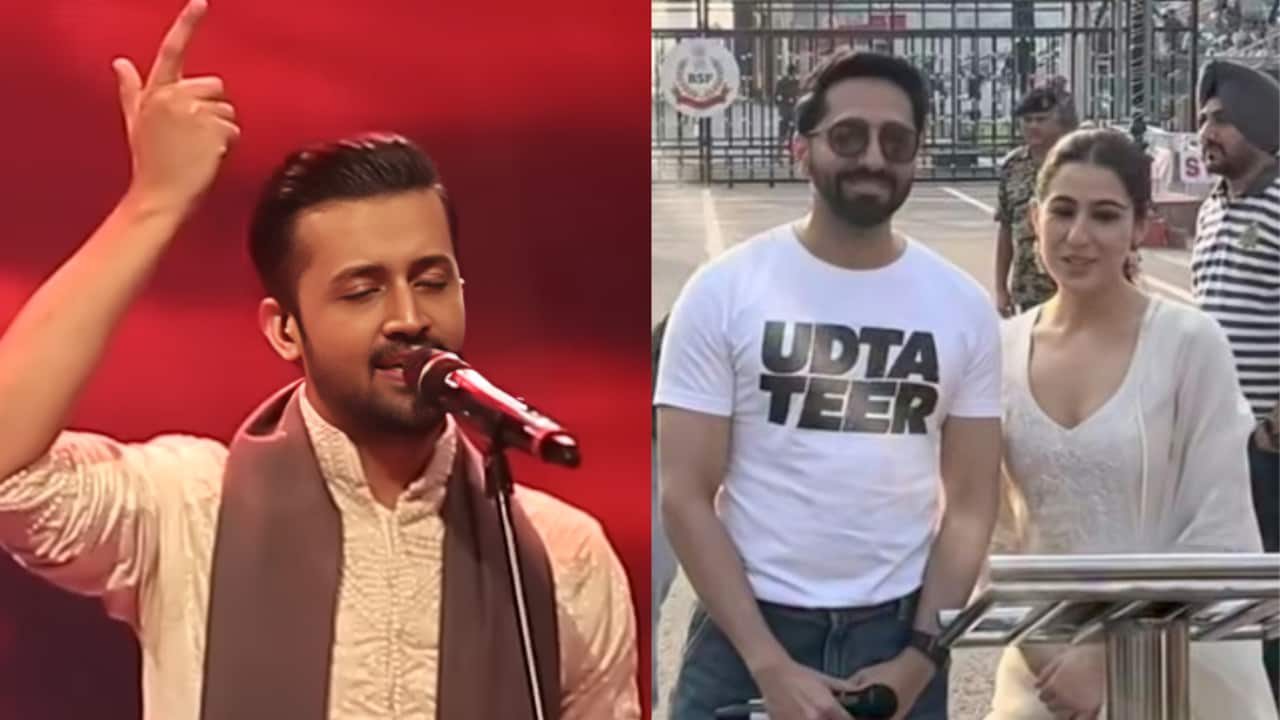
Some songs need no introduction, only a few seconds of their opening notes. Atif Aslam’s Tajdar-e-Haram is one of them. A voice rises, the music gathers momentum, and suddenly, a song released more than a decade ago finds itself back in the middle of a conversation that has little to do with its original purpose.
The qawwali has recently returned to the spotlight after Bollywood actors Ayushmann Khurrana and Sara Ali Khan’s visit to the Attari-Wagah border to promote their upcoming film, Udta Teer.
Music playing from the Pakistani side reportedly drowned out their promotional message, with videos of Atif’s rendition of Tajdar-e-Haram circulating widely on social media.
Bollywood actors Ayushmann Khurrana and Sara Ali Khan faced an unexpected interruption while promoting their upcoming film Udta Teer at the Wagah-Attari border. Their message was drowned out by loudspeakers playing Atif Aslam’s rendition of Tajdar-e-Haram from the Pakistani side. Clips of the incident have since gone viral on social media.
— NDTV Profit News (@NDTVProfit) October 21, 2026
The moment has brought renewed attention to a song that has long transcended geographical boundaries. But while its haunting melody is instantly recognisable, the meaning of its lyrics is equally compelling.
Moving between Urdu poetry, Persian expressions and Arabic invocations, the qawwali explores helplessness, longing, faith and the search for compassion.
Originally performed by the Sabri Brothers, the composition received a new lease of life when Atif Aslam rendered it for Coke Studio Pakistan in 2015. Nearly 11 years later, its emotional appeal remains undiminished.
Here’s a closer look at the lyrics and what they mean.
‘Kismat Mein Meri Chain Se Jeena Likhde’
The song opens with a deceptively simple request: let me live peacefully. The speaker asks the writer of destiny to grant them a life free from constant turmoil and to ensure that their boat never sinks.
The boat is an important image here. It represents a life navigating uncertain waters, vulnerable to storms that may arrive without warning. Asking for the boat to remain afloat is therefore a plea for stability, protection and the ability to make it through life’s difficulties.
The verse then introduces a more profound longing. Even paradise would be acceptable, the speaker says, but they want Medina written into their destiny.
Medina holds deep significance in Islamic devotional tradition because of its association with Prophet Muhammad. The desire to reach the city is therefore not merely about travelling to a particular place. It represents a longing for spiritual closeness and fulfilment.
The opening establishes the emotional foundation of the entire song: the speaker wants a peaceful life, but peace alone is not enough. There is a deeper destination they long to reach.
‘Tajdar-e-Haram, Ho Nigaah-e-Karam’
The refrain is the emotional centre of the qawwali. Tajdar-e-Haram translates approximately to ‘King of the Holy Sanctuary’, while nigaah-e-karam means a compassionate or benevolent glance.
In this devotional context, the title is an honorific address to Prophet Muhammad. The speaker asks for mercy, believing that even a moment of compassion could transform the lives of those who are poor, distressed or powerless.
The striking part is the scale of the request. The speaker asks for a glance, yet hopes for an extraordinary change in circumstances. There is no claim to deserve special treatment; the appeal rests on the belief that compassion can reach people even when they have little else to rely on.
The refrain also explains why repetition is so important to the song. Each time it returns, it follows another expression of fear, grief or longing. The words remain the same, but the emotional weight behind them grows.
In Atif’s rendition, the repeated appeal becomes almost meditative, drawing the listener back to the same central feeling: the hope that someone will listen.
‘Haami-e-Bekasaan, Kya Kahega Jahan’
This verse addresses the Prophet as the protector of the helpless. The speaker wonders what the world would say if those who arrived at his door seeking refuge were turned away empty-handed.
The question is an appeal built on trust. The speaker invokes the beloved’s reputation for generosity and compassion as a reason to believe that those who are suffering will not be abandoned.
The verse also broadens the song’s perspective. The opening is deeply personal, centred on the speaker’s own destiny. Here, the plea encompasses everyone who feels powerless or has nowhere else to turn.
The underlying thought is simple: what is the point of seeking refuge if the vulnerable are denied help when they arrive?
Rather than presenting faith as a detached declaration, the lyrics express it through an expectation of compassion. Hope emerges from the belief that the helpless deserve to be heard.
‘Koi Apna Nahi, Gham Ke Maare Hain Hum’
The qawwali becomes more intimate as the speaker describes a condition of profound loneliness. There is no one to call their own, and grief has become an overwhelming presence in their life.
They arrive at the revered threshold carrying their troubles, seeking the compassion they feel they cannot find elsewhere. The imagery is vivid: a person who has exhausted their options stands at a door, hoping that someone will respond.
The following lines intensify that vulnerability. The speaker imagines remaining at the threshold, repeating the beloved’s name even until death if their appeal goes unanswered.
The door is more than a physical setting. It represents the final place of refuge for someone who feels they have run out of choices. The threshold becomes a space between despair and hope, where the speaker has little control over what happens next but refuses to give up.
This is among the song’s most affecting passages because it makes the abstract experience of helplessness tangible. The speaker is not trying to appear strong or unaffected. They acknowledge their grief openly, and that honesty gives the verse its emotional force.
‘Kya Tumse Kahoon, Aye Arab Ke Kunwar’
In this passage, the speaker addresses the beloved as the Prince of Arabia and suggests that words can scarcely express the feelings they carry. The beloved, they believe, already knows what lies within their heart.
The verse explores the pain of separation. Time seems to slow down, nights become difficult to endure, and longing begins to overwhelm ordinary awareness.
The speaker is so consumed by devotion that the usual boundaries of daily life appear to dissolve. Their attention is fixed on the one they long to reach, leaving little room for anything else.
Although the passage belongs to a devotional tradition, its emotional language will feel familiar to anyone who has experienced intense longing. There are moments when explaining a feeling becomes almost impossible, particularly when the person or presence one misses seems impossibly far away.
The speaker’s plea to be heard makes the separation even more poignant. The feelings are already overwhelming, yet the desired response remains out of reach.
‘Aapke Darr Se Koi Na Khaali Gaya’
This verse returns to the idea of refuge, but with a greater sense of reassurance. The speaker invokes the belief that no one who has approached this revered door seeking help has left empty-handed.
The image of a supplicant having their garment filled suggests receiving generosity or having one’s needs answered. The speaker is effectively reminding themselves that those who seek compassion have reason to hope.
The verse also introduces an important contrast with the earlier descriptions of grief. The speaker has already admitted to loneliness and desperation, yet continues to believe that the appeal is not futile.
That tension gives the song its emotional complexity. The speaker is vulnerable enough to acknowledge suffering, but their vulnerability does not eliminate hope.
Instead, the belief in compassion becomes the reason to keep asking.
‘Maikashon Aao, Aao Madine Chalen’
The song then shifts from an individual plea to a collective invitation. The speaker calls upon others to journey to Medina, turning private longing into a shared aspiration.
The word maikashon is associated with wine drinkers. In the context of devotional and Sufi-influenced poetry, wine can also function as a metaphor for spiritual intoxication: a state in which love and yearning overwhelm ordinary consciousness.
The invitation is therefore not simply about travelling to a city. It is about moving towards a place that represents spiritual fulfilment and closeness to the beloved.
The change in perspective is significant. Until this point, the speaker has largely been describing personal suffering. Now, the longing expands beyond the individual, inviting others to share in the journey.
The repeated call to go to Medina gives the passage a sense of momentum. After so much uncertainty, the speaker imagines a destination towards which everyone can move.
‘Tajalliyon Ki Ajab Hai Fiza Madine Mein’
The description of Medina becomes more luminous in this passage. The lyrics evoke an extraordinary atmosphere of radiance, a place where longing reaches its fullest expression and the anxieties of life seem to recede.
The word tajalliyon refers to manifestations or expressions of radiance. In the devotional setting, the imagery creates a sense of spiritual illumination, contrasting sharply with the storms and uncertainty described elsewhere in the song.
Medina becomes an imagined space of peace, belonging and fulfilment. The speaker longs to offer a prayer of love there and experience a closeness that ordinary life has not provided.
The references to life’s sorrows and the fear of death are best understood as expressions of devotional idealisation, rather than a literal promise that visiting a city will eliminate every hardship.
The passage captures the emotional destination of the qawwali. The speaker begins by asking for a life free from turmoil, but gradually reveals a more profound desire: to reach a place where the heart can finally feel at rest.
‘Dast-e-Saaqi-e-Kausar Se Peene Chalen’
This passage continues the imagery of spiritual intoxication, invoking the cupbearer associated with Kausar, a river or fountain of abundance in Islamic tradition.
Within the song’s poetic framework, the imagery of drinking evokes the desire to receive a spiritual blessing. It builds on the earlier invitation to journey to Medina, suggesting that the destination offers something deeper than physical arrival.
The following appeal warns against losing the opportunity for a compassionate glance. The empty cups represent those who are still waiting, hoping to receive what they have come seeking.
The imagery works because it combines vulnerability with possibility. The speaker recognises that they have little to offer, but believes that what they seek can still be granted.
The wine and cupbearer references also demonstrate how devotional poetry can borrow familiar images from the wider poetic tradition and transform them into expressions of spiritual longing.
‘Khof-e-Toofan Hai, Bijliyon Ka Hai Darr’
After imagining the radiance and peace of Medina, the song returns to the storm.
The speaker describes the fear of tempests and lightning, asking where they can possibly turn if the one they are addressing does not come to their aid.
The imagery echoes the boat in the opening verse. What began as a request for a life that would not be overwhelmed by danger has become a more urgent description of the storm itself.
The speaker is not merely worried about the possibility of hardship. They feel surrounded by it, uncertain about where safety might be found.
This return to danger is important because the song does not move in a straight line from suffering to peace. Even after imagining a destination filled with radiance, the speaker finds themselves confronting the same fears.
The refrain becomes especially powerful here. It is the response the speaker returns to whenever uncertainty threatens to overwhelm them.
The repetition does not erase the storm. Instead, it expresses the hope that the storm need not be faced without compassion.
‘Ya Mustafa, Ya Mujtaba, Eraham-Lana’
The final stretch of the qawwali draws on Arabic and Persian expressions, alongside the Urdu poetry heard throughout the performance.
The opening invocation addresses the Prophet using revered names and asks for mercy. The subsequent phrases describe the speaker as weak, sinful and without support, appealing for someone to understand their condition.
The language changes, but the emotional thread remains intact. The speaker continues to acknowledge their vulnerability and ask for compassion.
One of the most evocative images in this passage is the appeal to a breeze or messenger to carry greetings to the Prophet’s resting place.
The idea is tender because it acknowledges the distance between the person longing to make the journey and the destination they wish to reach. If the speaker cannot personally arrive in Medina, perhaps their greeting can travel there in their place.
The image gives physical form to an otherwise abstract emotion. Longing becomes something that can be carried across distance, even when the person who feels it cannot make the journey themselves.
The multilingual passage also reflects the layered nature of qawwali compositions, which can bring together verses and expressions from different poetic traditions. The Sabri Brothers’ performances and Atif Aslam’s arrangement do not contain precisely the same material, so individual lines and their attribution should be considered in the context of the version being discussed.
Why Is ‘Tajdar-e-Haram’ Trending Again?
Atif Aslam’s rendition of Tajdar-e-Haram was released as part of Coke Studio Pakistan’s eighth season in August 2015. It paid tribute to the celebrated Sabri Brothers composition and became one of the platform’s most recognisable performances.
The immediate reason for the renewed attention is the incident at the Attari-Wagah border.
On October 21, Ayushmann Khurrana and Sara Ali Khan visited the border to promote Udta Teer, which was scheduled for theatrical release on October 23.
Reports said Atif Aslam’s rendition was played loudly from the Pakistani side while the actors were addressing the crowd, making their message difficult to hear. Videos of the moment circulated widely online.