


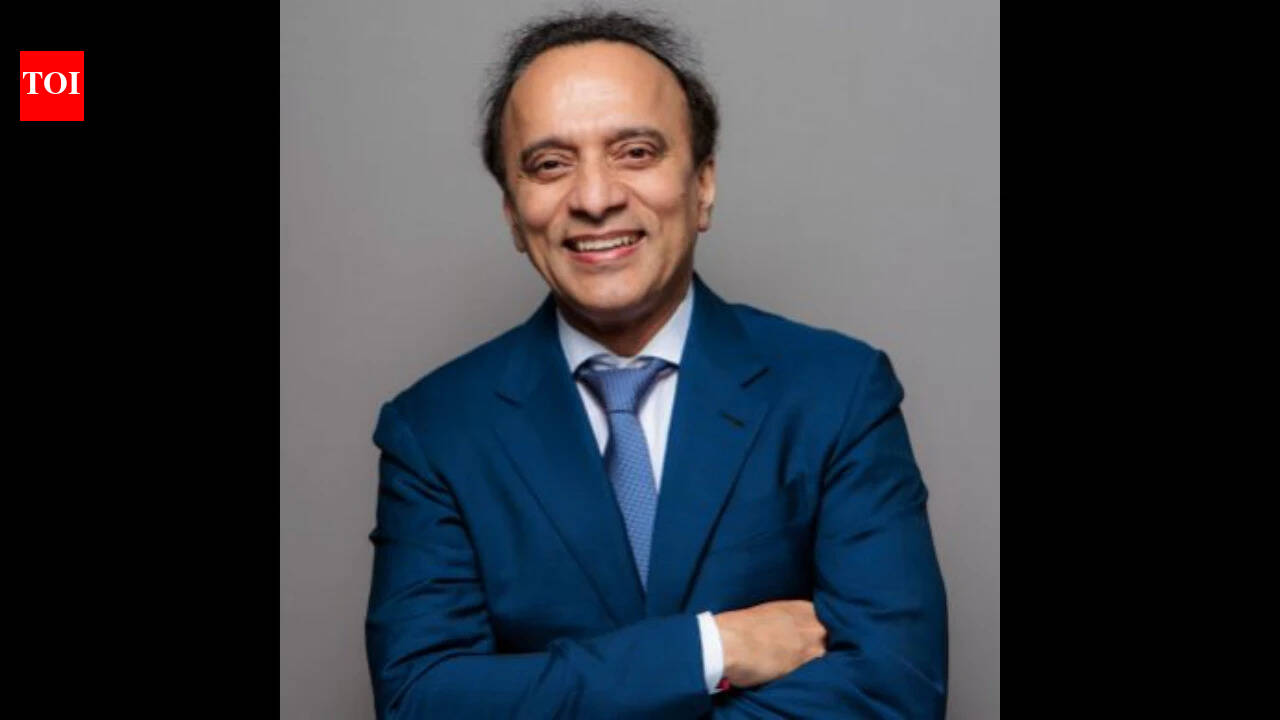
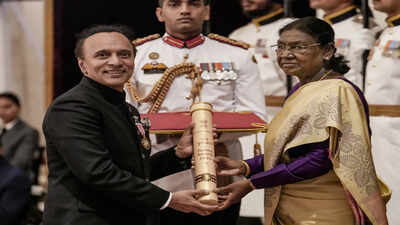
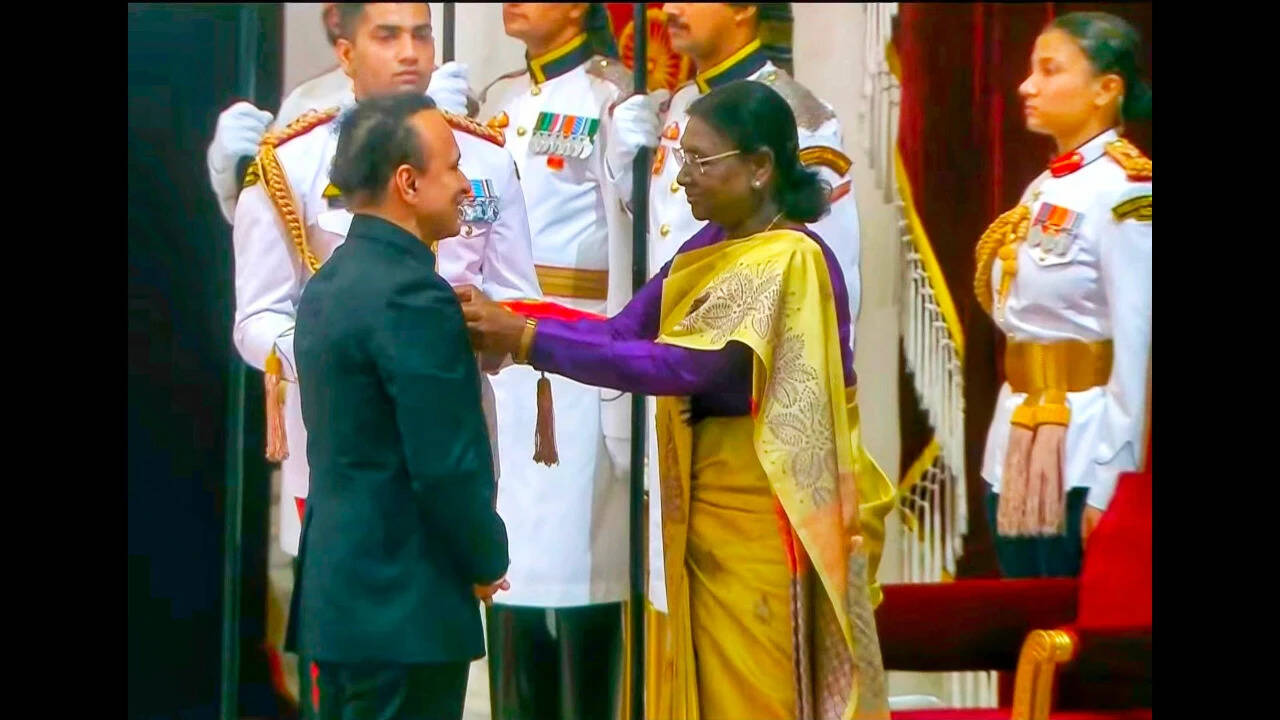
The story of Dr Prateek Sharma, one of the world’s leading gastroenterologist, educator, professor, researcher and doctor extraordinaire, is the story of discipline, curiosity, community and an abiding belief that success is meaningful only when it fulfills the soul. But mostly it’s the story of the hopes and dreams of the Indian middle class. And by Indian middle class we don’t mean just an economic strata. Rather the idea of the middle class when times were simple. Back when Dr Sharma was growing up in Vadodara as the younger son of parents, who were both doctors. Back when the only currency that mattered were the values inculcated by our elders — be it family, academic teachers or sport coaches.Last evening, when Dr. Prateek Sharma walked up to receive the Padma Shri, one of India’s highest civilian honours (in the field of medicine), from President Droupadi Murmu at the Rashtrapati Bhawan, he carried with him a story that stretches from the quiet lanes of Vadodara, Gujarat, to the bustling boulevards of Kansas City, and ultimately to the forefront of global medical research.Long before he became one of the world’s leading authorities on gastroenterology and digestive cancers, Dr Sharma was a schoolboy in Vadodara whose life revolved as much around football fields as textbooks. Raised alongside his elder brother in a family where medicine was a profession but never an obsession, he grew up in what he describes as a typical middle-class household. His father, Professor SN Sharma, founded the Department of Plastic Surgery at Baroda Medical College, creating the first such department in Gujarat. His mother, Nirmal Sharma, an obstetrician-gynaecologist, belonged to a generation of pioneering women doctors who forged careers at a time when professional women were still uncommon in India.The story of Dr Prateek Sharma is not merely of professional achievement, though there has been plenty of that. It is a story of a life shaped by values inculcated by his family at a time when middle class meant having a happy childhood, where education was of premium value – but did not have the weight of the world attached to it. “My brother, two years older than me, and I were both in Rosary High School, in Vadodara. And you wouldn’t believe how much I loved playing. Could be cricket, could be football, but that constituted a very important phase in my life,” says Dr Sharma, and adds almost sheepishly that he was a class topper too throughout his school life, only when prodded. These days, he plays pickleball.“My father was the first plastic surgeon in those times (1970s), in a small city, and my mother, an OB-GYN (Obstetrician-Gynecologist), opened up her private practice. She was also ahead of her times. I remember when my mother would drive her Fiat to go to work, people would stare,” says Dr Sharma. She also raised two boys. One followed his father’s footsteps and is also a plastic surgeon. The second son is Dr Prateek Sharma, the Indian American gastroenterologist and academic today known the world over for his work on esophageal diseases, GERD, Barrett’s esophagus, and advanced endoscopic techniques. He has been the professor of medicine at the University of Kansas School of Medicine for almost two decades, and has been at the forefront in improving diagnosis and management of GI diseases and cancer for the same amount of time.
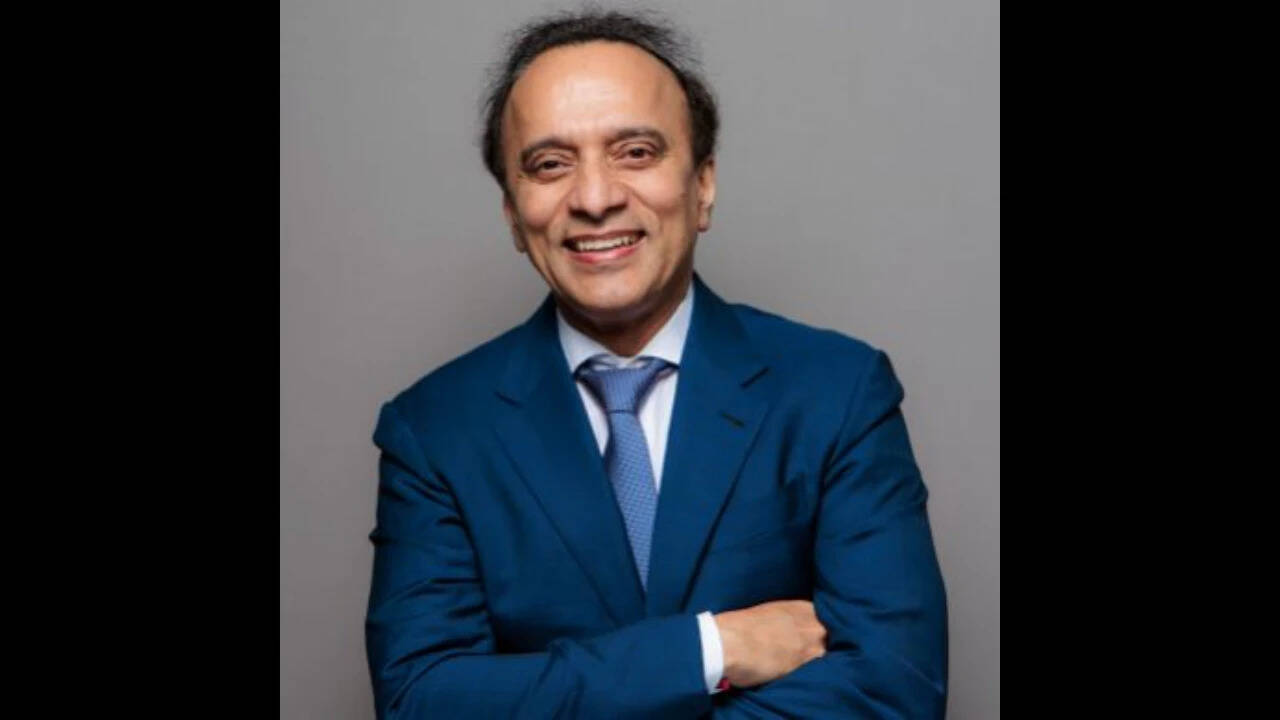
The story of Dr Prateek Sharma is not merely of professional achievement, though there has been plenty of that. It is a story of a life shaped by values inculcated by his family at a time when middle class meant having a happy childhood, where education was of premium value – but did not have the weight of the world attached to it.
Yet for all the medical pedigree around him, conversations at home rarely revolved around medicine. Instead, the family valued hard work, integrity and self-discipline. His father, who spent his entire career in government service, became an enduring influence. Whenever young Prateek proudly announced a high score in an examination, his father would often respond with a smile and a question: “Where did the remaining marks go?”It was never about perfection though. It was about cultivating the habit of striving a little harder with none of the pressure that parents or students go through in today’s world. “I lost my dad five years ago. I wish he too were here, but everyone else is here with me in India right now,” says the Kansas resident.
“I do the elliptical thrice a week and play a lot of pickleball”
At Rosary High School, Sharma developed into the kind of student teachers remember for decades. He excelled academically while simultaneously representing his school and state in football. “These days, I play a lot of pickleball with friends back in Kansas,” he adds, offering a glimpse into the workout warrior in him. “I do the elliptical thrice a week, and have a trainer in the gym, where I go thrice a week.” The sport and fitness enthusiast in him is not just alive, but asks for new challenges every day. Just like the professor in him challenges his students at the University of Kansas School of Medicine.But back in his childhood, in an era when students were often expected to choose between sports and studies, he managed to do both. He ranked among the top students in Gujarat’s state board examinations, yet even then the future was not entirely mapped out. Computer science was becoming fashionable around the late 1990s, and many of his peers were gravitating toward it. Medicine remained a possibility rather than a certainty at that time.But some callings in life are quietly inherited. With two doctor parents and an elder brother already pursuing medicine, Dr Sharma eventually chose the profession that had surrounded him all his life. What followed was a journey that would take him far beyond India. Today, he also serves as the president of the American Society for Gastrointestinal Endoscopy and chair of the ASGE Artificial Intelligence Institute.
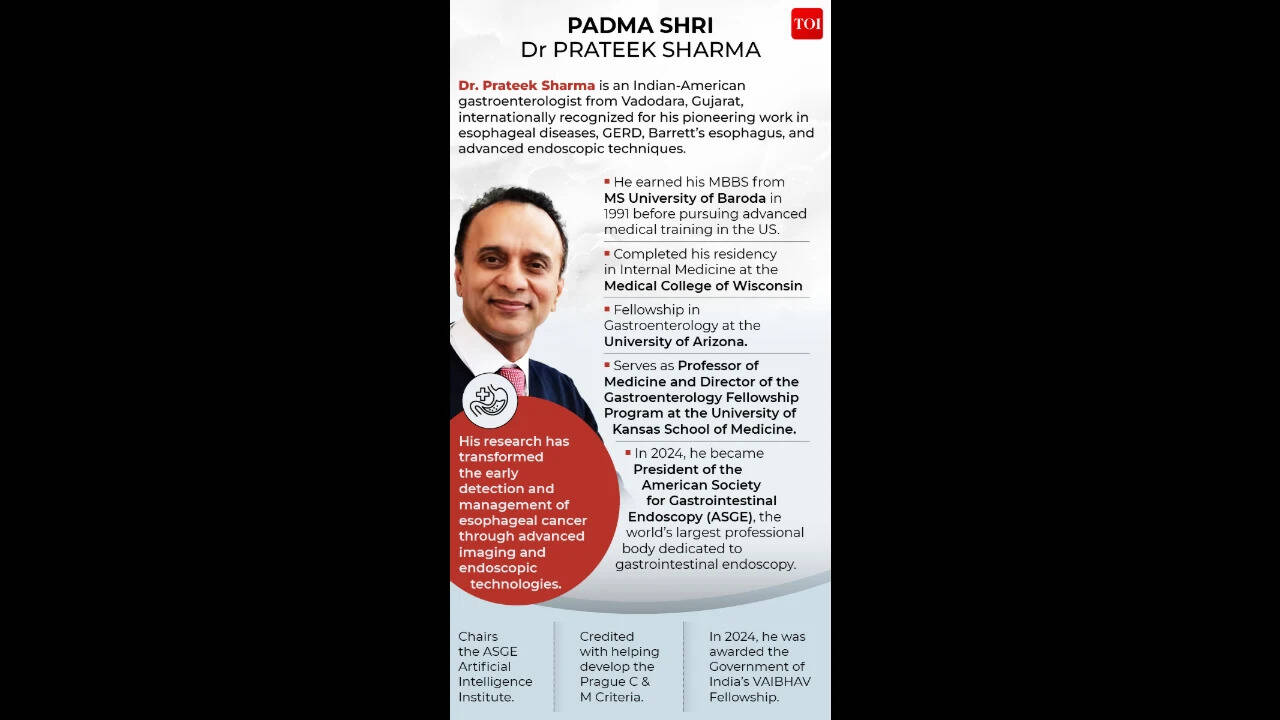
Padma Shri Dr Prateek Sharma – key milestones
Back when he was a student, his move to the United States was not accompanied by the certainty that hindsight often imposes on success stories. He arrived carrying a single bag and a 500 dollars of Thomas Cook traveller cheques; leaving behind not only his family but also the only city he had ever known. “I had never been anywhere, except Baroda, when I came to the US. That was my biggest challenge.” The transition was difficult. Homesickness, cultural adjustment and the challenge of proving oneself in a highly competitive medical environment were tall asks. For an international medical graduate, entry into specialised training programmes was far from guaranteed in the US. He had already graduated with an MBBS from MS University of Baroda in 1991. In the US, he completed his internal medicine residency at the Medical College of Wisconsin, in Milwaukee.Then came the specialization question. The field that eventually captured his imagination was gastroenterology. During his medical training, he encountered mentors whose enthusiasm transformed what could have been another speciality into a lifelong passion. He enrolled with the gastroenterology fellowship at the University of Arizona, in Tucson. There doctors and mentors demonstrated how endoscopy could move medicine beyond diagnosis into intervention, allowing physicians to detect cancers earlier, remove precancerous lesions and save lives before disease became irreversible. Sharma was fascinated by the combination of science, technology and direct patient impact. “It was a time when gastroenterology was big in the US, but the gut was not at the forefront of medicine in India, or anywhere in Asia. One of his most fascinating research papers is titled, ‘The rise of acid reflux in Asia’. It’s one of about 500 papers or research that he has written in two decades.At the University of Arizona, he went on to train under some of the leading figures in the field and developed a particular interest in oesophageal diseases, Barrett’s oesophagus and acid reflux, areas that would later define much of his research career. One of Dr Sharma’s top mentors was the late Dr. Richard E. Sampliner, internationally recognized, award-winning gastroenterologist, widely celebrated for his pioneering research on Barrett’s esophagus. He revolutionized how pre-malignant lesions are treated to prevent soft-tissue cancers. Apart from Dr Sharma’s dad, brother and all his teachers, it is Dr Sampliner, who saw the enthusiasm and academic brilliance and pushed Dr Sharma to dive deeper in his chosen subject: gastroenterology.Over the years, Dr Sharma has followed in Dr Sampliner’s footsteps, and become one of the most influential voices in gastrointestinal medicine. He has published hundreds of scientific papers, led major research initiatives and mentored generations of physicians. His work has shaped understanding of digestive diseases across continents and helped establish standards of care that influence medical practice worldwide.
Of love, bike rides and Rs 5 bread omellets
Yet the story of Dr. Prateek Sharma cannot be told solely through academic milestones. Running parallel to his professional journey was a personal one. Of two-hour bike trips during his college days to Fatehgunj to have Rs 5 bread omelette with his friends. Of him meeting his future wife, Priyanka, while studying medicine in Baroda. Their relationship survived years of long-distance separation while he trained in the United States and she pursued her own medical path in Baroda. It involved long distance phone calls of a young couple going through the trials and tribulations of preparing for a future together. At times when things would seem hard, from a phone booth somewhere in the US to Baroda, Dr Singh would hum ‘Jab koi baat bigaad jaaye’… they would be married in three years from the time Dr Sharma left for the US.Today, she is an accomplished oncologist specializing in breast cancer, and a professor in her own right. Together, they built a life in Kansas City, where Sharma has lived for more than two decades and where they raised their son, Paranjay, who is now studying medicine and is in his second year in medical, making him part of the fifth generation of physicians in the family. “When Priyanka and I got married and moved to the states, we made friends with the Indian community here. At that time a lot of my friends were single. Eventually between studying, becoming professors, we saw our friends getting married. We would have get-togethers, and in those days none of us had much money. So, I remember everyone pitching in. If my wife and I would go on any professional trip somewhere, we came back to find our refrigerators stocked. In fact, my son Paranjay, and all the children of our friends, have been raised by our community. Everyone was always more than eager to lend a hand.”
At the University of Arizona, Dr Sharma trained under some of the leading figures in gastroenterology, and developed a particular interest in oesophageal diseases, Barrett’s oesophagus and acid reflux, areas that would later define much of his research career.
Like they say, it takes a village to raise a child. It also takes a community to preserve the values that shape a life. For Dr Sharma, those years in Kansas City recreated the ethos of the middle-class India he grew up in – where neighbours became extended family, success was measured not by wealth but by relationships, and helping one another was simply a way of life. Those values, he believes, have remained the strongest foundation beneath every professional milestone that followed.
“I love Gen Z. I think they are very misunderstood.”
What stands out most in conversations with Dr Sharma is not just the scale of his accomplishments but the absence of self-importance. He maintains virtually no social media presence, prefers discussing mentors over personal achievements and speaks with equal warmth about scientific breakthroughs, football matches, old friends and roadside omelette stalls from his college days. And Gen Z.“I love Gen Z. I don’t understand why a lot of people find them difficult,” he adds with a smile and enthusiasm of a Gen Z student. “I think people misunderstand them a lot. It’s true they are not the most patient. They want their answers to be given in simple points. I can do that easily.” It’s probably the reason why his son Paranjay’s friends find Dr Sharma to be “Daddy Cool”. It takes a special kind of rootedness and adaptability to talk and explain with ease groundbreaking research at top-most medical conferences around the world, and be equally friendly and talk in the language of 20-somethings from across the globe. But that’s the most important trait of an educator. It’s about what they can offer to this world as service. Though Dr Sharma, calls it fulfillment.In a column written exclusively for the Times of India, in February—after the announcement of his Padma Shri award—he wrote: “I have spent most of my life doing what many professionals do: showing up, focusing on the work, trying to do it well, and then doing it again the next day. Medicine trains you that way. There is not much room for spectacle. There is only the patient in front of you, the decision you must make, and the consequences that follow. What these last few days have taught me is something simple: When you dedicate yourself sincerely to an area, when you serve others well over a long enough arc, the meaning accumulates, even if you do not notice it happening. Recognition may come early, or it may come late. Sometimes it does not come at all in obvious ways. But fulfillment arrives earlier than recognition does. And when the fulfillment is real, others can feel it, even if you never speak about it.”The values instilled by his parents remain visible in the way he measures success. His father often reminded him that earning money could never be life’s ultimate goal; service was what mattered. That philosophy appears to have resonated far beyond his family. When news of the Padma Shri reached Kansas City, members of the Indian-American community organised a large felicitation ceremony attended by hundreds of people, including the mayor and governor of the state, and community organisations. For Dr Sharma, the response was almost overwhelming. The celebration, he has said, seemed less about his achievements and more about the collective pride of a community that had watched his journey unfold over 25 years.The Padma Shri recognises an extraordinary physician and researcher, but it also honours a life built on quieter virtues: discipline without ego, ambition without vanity and achievement without losing sight of one’s roots. From the football fields of Vadodara to the world’s leading medical institutions, Dr. Prateek Sharma’s story is ultimately about the enduring power of excellence anchored in fulfillment of the soul. As India celebrates his contribution, it is this simplicity, perhaps more than any title or award, that defines the man behind the honour.(The Padma Shri is the fourth-highest civilian award of the Republic of India, after the Bharat Ratna, the Padma Vibhushan and the Padma Bhushan. Instituted on January 2, 1954, the award is conferred in recognition of distinguished contribution in various spheres of activity including the arts, education, industry, literature, science, acting, medicine, social service and public affairs. )



