


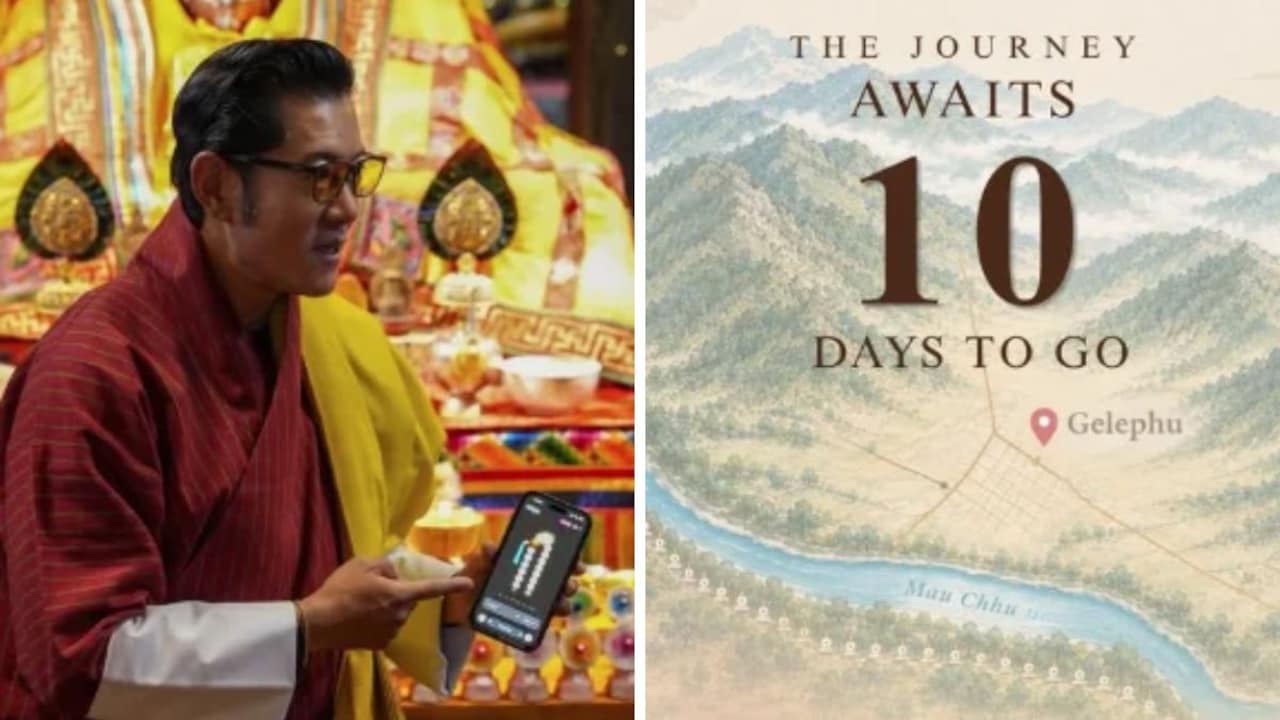
Gelephu Mindfulness City (GMC) is getting ready for one of the most important events in its history. On November 1, lakhs will come together for the raising and consecration of the 108 Jangchub Chortens. More than 121,000 Bhutanese attendees have registered for the event. Over a thousand international guests and tourists will join the ceremony, along with more than 60 spiritual leaders from abroad and 100 Bhutanese spiritual leaders.
In a world troubled by conflict, Bhutan presents this as a sacred gesture of peace. For the first time in human history, 108 stupas – each15 metres tall – are being raised together, in one day. Known as the Jangchub Chorten (stupa of enlightenment), the stupas are aligned in an auspicious constellation where the mighty ridges of the Himalayas meet the vast Indo-Gangetic plains, at Gelephu Mindfulness City.
A Royal Initiative, A Grand Vision
Gelephu Mindfulness City (GMC) is King Jigme Khesar Namgyel Wangchuck’s global vision to establish an oasis of mindfulness and prosperity amidst increasing global uncertainties and geostrategic challenges. It seeks to offer the world a different path of development, one where traditional Bhutanese values of spirituality and harmony with nature blend with innovation, technology and economic vibrancy.
Gelephu Mindfulness City, a special administrative region (SAR), is now widely accepted as a unique interpretation of 21st-century urban life. Two years after it was announced, the city is growing at a phenomenal pace, with a world-class international airport being constructed, monumental spiritual establishments taking shape, and international investors starting work on major global ventures.
READ | Bhutan’s ‘Gateway To World’ Takes Shape With Gelephu Airport Construction
Why The Stupas (Chortens)
In Himalayan Buddhist traditions, stupas were built to commemorate major events in the Buddha’s life. They are sacred structures that hold prayers, blessings, and spiritual texts within their core. The Jangchub Chorten is generally considered one of the most prominent of eight types of stupas. It commemorates the enlightenment of the Buddha – a moment when the full weight of suffering was met, understood, and transcended.
On February 21, 2026, the King announced the Royal initiative to build 108 Jangchub Chorten (stupas of enlightenment). His Majesty described it as an ambitious undertaking that demands courage, unity, and deep commitment: “We must do it to prove to ourselves that, as we face the challenges ahead, there is no limit to what we can achieve when we stand together,” the King said.
Gelephu Mindfulness City is envisioned as a centre for wellbeing, mindfulness, and harmony between humanity and nature. The stupas embody these ideals in their most compassionate form and offer not only spiritual significance, but also emotional refuge, which is why the event is being billed as one of the most significant
The Significance of 108
The reason why it was decided to build 108 stupas was the spiritual centrality and completeness of the number 108. It is a powerful and profoundly auspicious number, carrying liturgical and cosmological symbolism, recurring in Buddhism, Hinduism, and other spiritual traditions. In Vedic astronomy, it connects the movements of the sun and moon. In science, it signifies mathematical dimensions. In tenses, it records the division of time. In human traits, it reflects mind practices, faculties, and behaviour.
The collected teachings of the Buddha – known as the Kangyur – are preserved in 108 volumes; practitioners count 108 beads on a mala, circumambulate sacred sites 108 times, and ring temple bells 108 times.
The constellation of the 108 stupas forms a vital landmark in GMC, creating energy dynamics along the topography of the mighty Himalayas as ridges taper and rivers flow into the vast Indo-Gangetic plains. Such a landscape amplifies the spirituality of sacred places, enhancing the harmonious balance of the cosmic system.
READ | Bhutan’s Gelephu City Announces Policy For Family Offices, Investment Funds
Why On A Single Day – Historic Parallels
Inspired by GMC, the sacred Bhutanese tradition of zhapto (voluntary communal work as an offering) has escalated to new proportions and already stirred interest worldwide. Now, the professional builders, engineers, technicians, artisans, and experts of all specialities working on the projects are a tiny minority. The Royal vision of raising 108 stupas in one day is a collective effort beyond scale or spectacle. When thousands of minds and hands work with a shared purpose, the result becomes more than a physical structure.
The world has heard, and has come, to Gelephu. Not just a plane-load of Bhutanese diaspora who arrived on a chartered flight from Australia, but also international public servants, in-service and retired, contributors in cash and kind. And there are global personalities who recognise GMC as a reminder that the world is changing fast, not all of it for the better.
This 21st-century phenomenal event is not without historic parallels. History has chronicled events of legendary and mythological proportions. King Songtsen Gampo of 7th century Tibet’s commissioned 108 temples (including Kyichu and Jambay lhakhangs in Bhutan) that were placed at precise geographical points across the Himalayan landscape to anchor the dharma.
Inspired By The Past, Vision For The Future
The 108 stupas will be a powerful and visible landmark in GMC, already growing as the Buddhist capital of the 21st century. It will be built by Bhutan and friends of Bhutan in an act of collective merit-making and a sacred act in the interest of global well-being and happiness.
The Gelephu Mindfulness City is a legacy of the fifth Monarch of Bhutan, as it evolves from a Royal vision into a transformative experience for Bhutan and for humanity. This act of prayer and spiritual practice comes in a period that Buddhist masters have described as degenerate times. For the global masses, it is a reminder of the need for peace and spiritual protection in a world dealing with endless turmoil.
On 22 October 2026, the King became the first person to enter the digital prayer room on yoeja.com, bringing Bhutan’s centuries-old tradition of Yoeja into the digital age. Rooted in Bhutan’s Buddhist heritage, Yoeja is a living tradition of spiritual offerings that sustains prayers, generates collective merit and nurtures values of generosity, mindfulness and compassion.
As Bhutan prepares for the inauguration of the 108 Jangchub Chortens in Gelephu Mindfulness City on 1 November 2026, the digital platform offers a way to carry this tradition beyond borders, connecting prayers and shared intentions for peace and wellbeing across the world.