


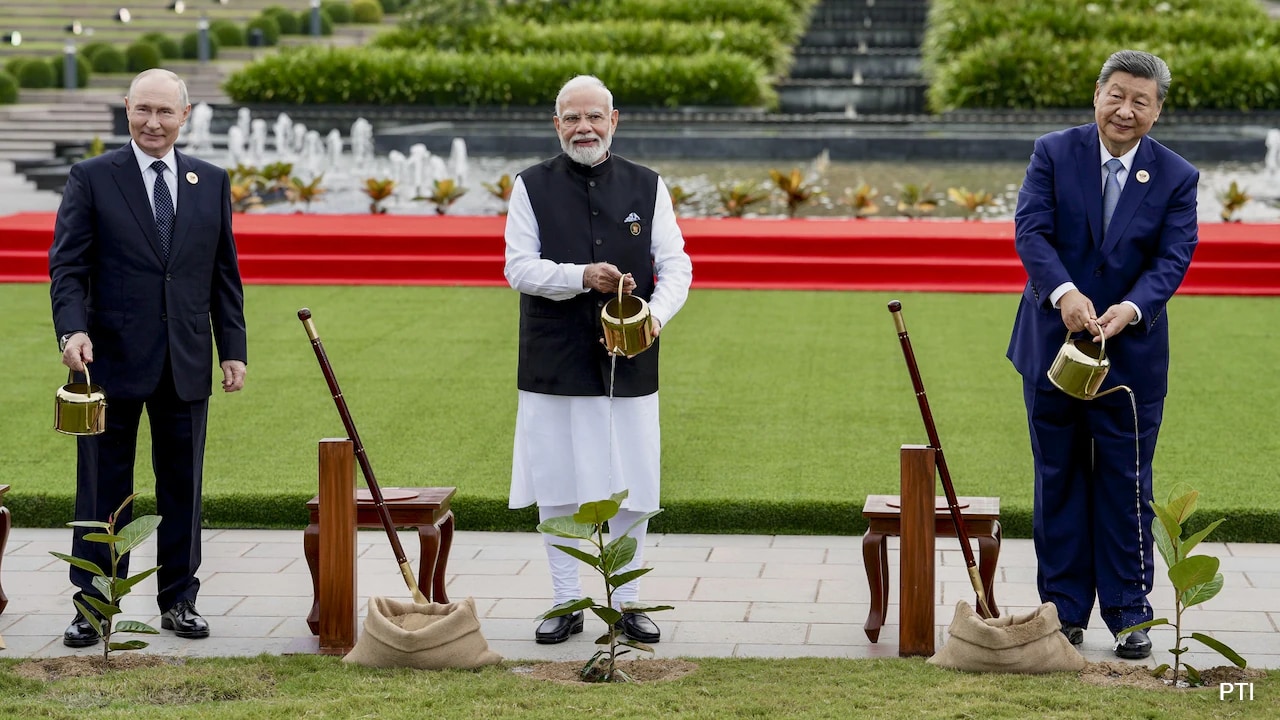
The 18th BRICS Summit in New Delhi is taking place at a critical juncture for global geopolitics. Coming two decades after the founding of the original grouping, this gathering carries heightened weight as the expanded alliance- encompassing eleven full member states including the United Arab Emirates, Iran, Egypt, Ethiopia, Indonesia, and a half-in-half-out Saudi Arabia – attempts to define its operational identity and institutional power in an increasingly fragmented world order.
Under India’s chairmanship, the summit brings together a complex array of world leaders for high-profile bilateral engagements, highlighted by interactions between host Prime Minister Narendra Modi, Russian President Vladimir Putin, Iranian President Masoud Pezeshkian, and Chinese President Xi Jinping, but also with other states represented at the level of Head of State or Government, including such key partners as Egypt and South Africa.
Advertisement – Scroll to continue
For India as the host nation, chairing the summit tests the core tenet of its modern foreign policy: strategic autonomy. India sits at the intersection of rival global blocs, holding active membership in Western-leaning security groupings like the Quad (with Australia, Japan and the US) and I2U2 (with Israel, the UAE and the US) while simultaneously steering major Global South alliances like BRICS and serving as a full member of the Shanghai Cooperation Organisation led by China and Russia. The summit provides a rare venue for high-level personal diplomacy. Prime Minister Modi’s bilateral meeting with Xi Jinping, during the Chinese leader’s first visit to India in seven years, signals ongoing efforts to stabilise the Line of Actual Control and normalise trade and investment ties following years of border friction. At the same time, talks with Russia centre on strategic energy partnerships and military-technical cooperation as well as enhanced commercial links, amid ongoing trade restrictions and shifting economic corridors.
And then there is the multilateral dimension. By hosting both Middle Eastern partners and Iran alongside Eurasian powers, New Delhi positioned itself as a convenor capable of facilitating dialogue across volatile geopolitical fault lines. It could have ended in a stalemate, or even an embarrassing failure (especially since the BRICS Foreign Ministers had failed to agree on a joint statement a few months ago, in May), but Indian diplomacy rose skilfully to the challenge. The 2026 BRICS New Delhi Declaration was adopted unanimously at the conclusion of the Summit. Prime Minister Narendra Modi formally announced that consensus had been reached across all member states following extensive, overnight negotiations, with no country raising an objection to the final text.
Advertisement – Scroll to continue
Addressing the escalating turmoil in West Asia, the Declaration expressed grave concern over rising regional tensions. It called for maximum restraint from all parties, strict adherence to international law regarding the protection of civilians and critical infrastructure, and an unhindered flow of humanitarian relief. Emphasising the necessity of a durable peaceful resolution, the text, in an implicit rebuke to Israel, rejected policies leading to forced human displacement and reaffirmed commitment to a two-state solution based on pre-1967 borders.
On the conflict in Ukraine, the declaration maintained BRICS’ established diplomatic posture by avoiding explicit condemnation of any single nation. Instead, it underscored that global security is indivisible and urged a peaceful resolution through sustained dialogue, consultation, and multilateral diplomacy. The narrative framing focused on resolving root causes and upholding state sovereignty rather than assigning unilateral blame.
Beyond these specific crises, the broader text reaffirmed a joint commitment to fundamental global reforms. Member nations collectively advocated restructuring the United Nations Security Council and Bretton Woods institutions to grant developing economies a greater voice, while simultaneously voicing strong opposition to unilateral economic sanctions, trade protectionism, and terrorism in all its forms.
Economic reform remains the primary engine driving BRICS operational policy. While debate over a single unified BRICS currency (pushed particularly by Russia and more discreetly by China) has yielded to practical economic realities, including the Trump Administration’s determination to impose sanctions if steps were taken in that direction, the desire to reduce systemic dependence on the United States dollar and Western financial infrastructure has steadily accelerated. Rather than pursuing a speculative monetary union, member states are prioritising practical alternatives such as local currency settlement mechanisms (like rouble-rupee trade) to mitigate exchange-rate volatility and bypass foreign transaction bottlenecks resulting from US and EU sanctions on member countries. Alongside these payment integrations, the New Development Bank continues to expand its capital base and bring on board new partner nations to provide development finance free of Western-imposed conditionalities. The main hurdle facing the summit lies in harmonizing local financial regulations, capital controls, and compliance frameworks across wildly different economic systems, ranging from China’s capital-controlled economy to Saudi Arabia’s dollar-pegged model.
Expansion has vastly increased the demographic footprint and combined economic weight of BRICS, but it has also introduced notable internal divergence. The expanded alliance presents several structural friction points, chief among them the debate over whether BRICS should operate as an anti-Western grouping or stick to India’s formulation that it is “non-West without being anti-West”. Russia and Iran frequently view BRICS as a direct geopolitical counterweight to the G7 and NATO. Conversely, India, Brazil, and South Africa explicitly advocate a purely non-Western alignment, seeking to reform existing global institutions, such as the United Nations Security Council and the International Monetary Fund, rather than dismantle them.
Additionally, integrating regional rivals like Iran and the UAE, or balancing intra-African economic priorities between Egypt and Ethiopia, requires careful agenda control to prevent regional disputes from stalling broader cooperation. Because BRICS decisions require unanimous agreement, crafting the language for the official New Delhi Declaration demanded intricate compromise not just on the Iran and Ukraine wars but on issues such as global trade standards, climate finance commitments, and the principles underlying geopolitical conflict-resolution. While it is true that since the creation of the New Development Bank in 2014, BRICS has been better at grand declarations than at tangible accomplishments, it has still served credibly as the leading forum for the articulation of the voice of the Global South, and India’s leadership has been key to the process.
Ultimately, the New Delhi Summit highlights the reality of an evolving multipolar world. BRICS is no longer just an acronym denoting emerging market growth, the original reason for the invention of the acronym by Goldman Sachs’ economist Jim O’Neill. It functions as the principal diplomatic platform for the Global South to demand institutional reform, trade diversification, and multi-aligned diplomacy. Whether the group can turn its growing headcount, and its long waiting list of some 40 countries aspiring to join it, into coherent global geopolitical leverage, depends on how effectively host nations manage the internal contradictions of an expanding bloc. India has set a lofty standard this weekend. Next year it will be China’s turn at the Chair, and the world will be watching.
(Shashi Tharoor has been a Member of Parliament from Thiruvananthapuram, Kerala, since 2009. He is a celebrated author and a former diplomat)
Disclaimer: These are the personal opinions of the author


