


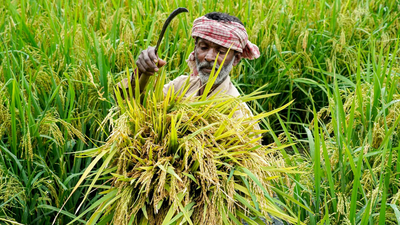
NEW DELHI: Apprehending a threat of deficient monsoon rainfall to the upcoming sowing season, Centre on Monday discussed contingency measures to minimise its impact on Rabi (winter-sown) crops, with Union agriculture minister Shivraj Singh Chouhan calling for data-driven planning, stronger centre-state coordination, weekly crop monitoring, balanced fertiliser use and water budgeting.Amid indications that the kharif (summer-sown) crops’ output may not match last year’s level despite progress in acreage, the minister, while addressing farm scientists and policymakers during a national conference, also emphasised the need to drive the Rabi strategy through less water-consuming pulses and oilseeds. The latest acreage data shows the total sown area at 1,107 lakh hectares (ha) as of Friday was about three lakh ha more than the ‘normal’ (average of last five years) acreage (1,104 lakh ha) despite a cumulative deficit of 12% in monsoon rainfall in the country. It was, however, 14 lakh ha less than the same period of 2025, a year which recorded 8% more than normal rainfall.The conference was convened to discuss the farm strategy, keeping in view the current drought situation in many states, so that the impact of low moisture content in the soil and shortage of water for irrigation due to deficient rainfall may not impact farming operations much. Sowing of rabi crops such as wheat and mustard begins in October.The Centre will, meanwhile, send teams to Karnataka and Maharashtra to assess the drought situation. Nearly two-thirds of Maharashtra has been affected and the state has already declared a drought, while Karnataka is also facing drought-like conditions due to the monsoon rainfall deficit of 30%.
Share your thoughts in the comments
Be respectful · TOI community guidelines
The monsoon season will end on Wednesday with a strong possibility of an overall rainfall deficit of more than 10% in the country as a whole — a deficient condition which is considered a drought. As of Monday, India recorded a deficit of 12% in cumulative (June 1–Sept 28) monsoon rainfall, with 12 states reporting a deficit of 20% or more.Underlining the current situation, Chouhan asked every district to assess the water available for irrigation before finalising crop plans. “Areas with limited water availability should prioritise less water-intensive crops such as pulses and oilseeds, while areas with assured irrigation can plan other crops accordingly,” he said while noting that the rainfed areas, in particular, require careful planning as the availability of soil moisture largely determines the crop choice and outcome.Rabi crops are normally sown in a total area of about 638 lakh hectares, out of which wheat generally covers nearly 50% of it, with the remaining around 50% being covered by pulses, oilseeds and coarse cereals.


