


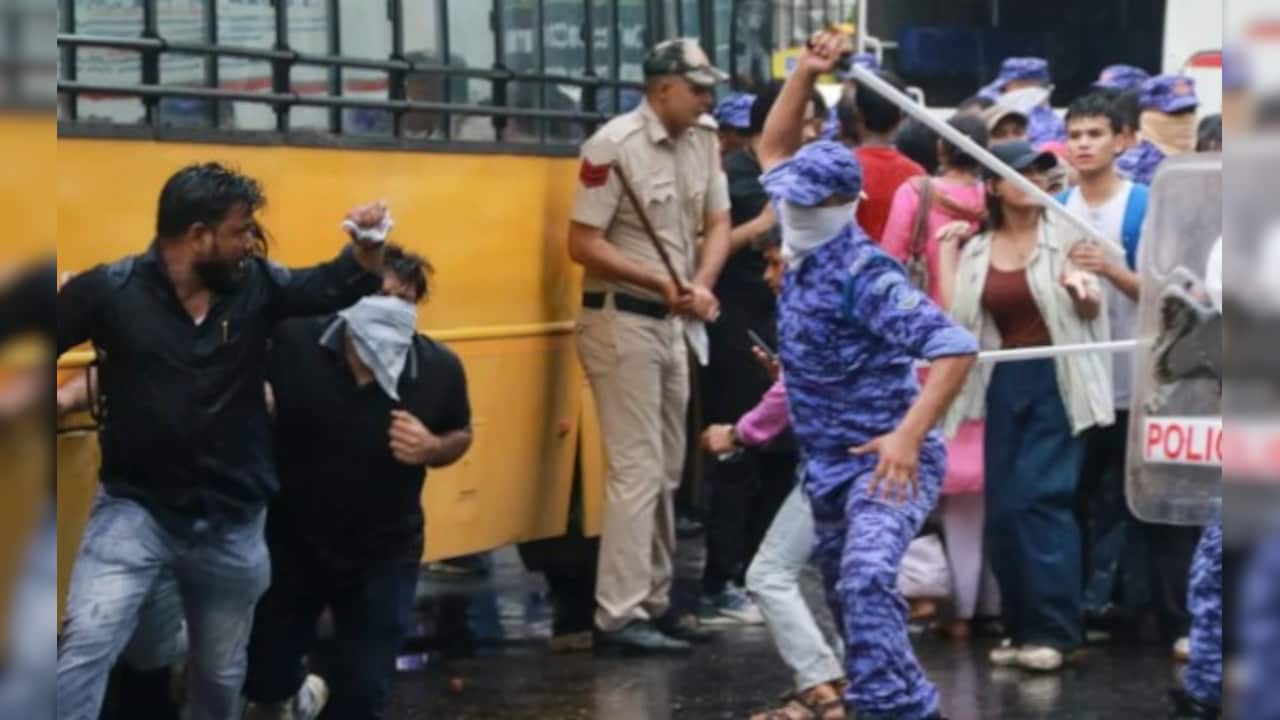
In a sharp critique of police action on the recent student protests, Supreme Court judge Justice Ujjal Bhuyan on Friday said that the detachment expected of police officers appears to be disappearing. He said it was very distressing to see police officers assaulting protesters.
“All of us are dismayed when we see young officers of the Indian Police Service personally going and assaulting protesters and demonstrators. This is something very, very distressing to observe,” Justice Bhuyan said at the launch of retired IPS officer Yashovardhan Azad’s book ‘Policing the Republic’.
“The detachment expected of police officers somehow seems to be disappearing, and this is indeed a matter of grave concern,” he added.
Read | Supreme Court Cancels All FIRs Against CJP Protesters, Criminal Antecedents Only Exception
Justice Bhuyan said that effective policing could be done without resorting to excessive use of force or infringement of human rights. “For most common people, a policeman on the street wearing a whistle and a lathi represents the power and authority of the state. When they feel wronged, they seek the help of the police. It is, therefore, of utmost importance that the police force maintains its credibility,” he said.
VIDEO | New Delhi: “Police personnel assaulting protesters is distressing; it is a matter of grave concern,” says Justice Ujjal Bhuyan on police action at Jantar Mantar, at the release of retired IPS officer Yashovardhan Azad’s book ‘Policing the Republic’. pic.twitter.com/BSF0qdY3Nn
— Press Trust of India (@PTI_News) September 4, 2026
Police and paramilitary action on student protesters during the CJP protest has come under sharp criticism from various quarters. The matter reached the Supreme Court, which has set up a high-level panel to investigate allegations of excessive force by the Delhi Police during the July 20 student protests at Jantar Mantar and the Parliament march.
The panel headed by former Supreme Court judge Justice R Subhash Reddy will examine complaints of lathi charges, tear gas, pellet gun usage, electronic batons, and targeted harassment or molestation of female protesters, alongside reviewing CCTV and video footage of the clashes.
Read | Supreme Court Sets Up Panel To Probe Cop Action, Violence During NEET Protests
Justice Bhuyan also mentioned the rising cases of custodial torture and deaths in the country and said it is one of the worst crimes in a civilised society.
“Custodial death is perhaps one of the worst crimes in a civilised society governed by the rule of law. Any form of torture, of cruel, inhuman, or degrading treatment would fall within the inhibition of Article 29, whether it occurs during investigation, interrogation or otherwise,” he said.
He pointed out that when functionaries of government become lawbreakers, it can encourage lawlessness.”If the functionaries of the government become lawbreakers, it is bound to breed contempt for the law and will encourage lawlessness. No civilised nation can permit that to happen. Does a citizen shed his fundamental right the moment a policeman arrests him?” he said.
Justice Bhuyan also touched upon the issue of extra-judicial killings or “fake encounters”, saying the Supreme Court had taken a serious view of such incidents.
Referring to a 2011 judgment, he said the court had held that fake encounters “nullify the very essence of the rule of law” and observed that when a fake encounter is proved against a serving policeman in a trial, it must be treated with the utmost seriousness.
“Encounter philosophy is a criminal philosophy. It cannot be a part of policing,” Justice Bhuyan said.


