


There are days at the World Cup when the stars align. Then there are days when the stars practically take turns outshining one another.
Wednesday belonged firmly to the latter category.
Kylian Mbappe scored twice and became France’s all-time leading goalscorer. Erling Haaland marked his long-awaited World Cup debut with a brace for Norway. Lionel Messi then stole the spotlight, producing a hat-trick on his 200th Argentina appearance to draw level with Miroslav Klose as the tournament’s all-time leading scorer.
It was the kind of day that felt tailor-made for football’s biggest names.
And then there was Cristiano Ronaldo.
The Portugal captain arrived at his country’s opening World Cup fixture against DR Congo carrying a record of his own. Already the first player to feature in six different World Cups, Ronaldo needed just one goal to become the first footballer ever to score in six editions of the tournament.
Instead, he left Houston still waiting.
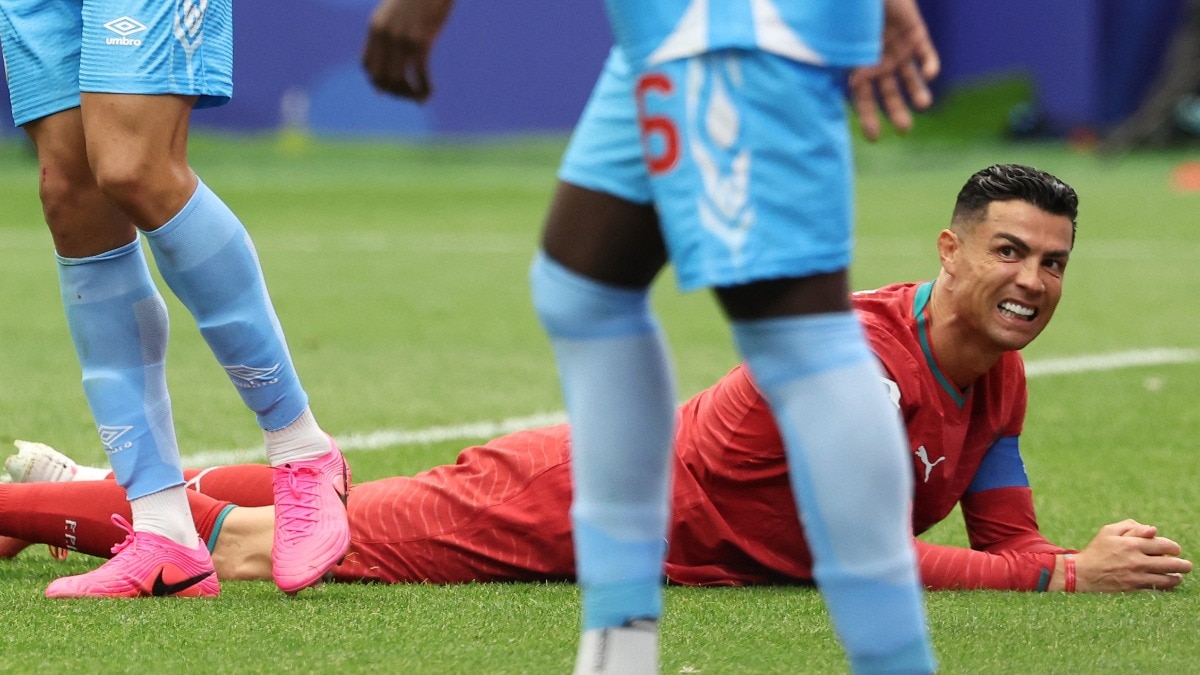
Portugal were held to a 1-1 draw by DR Congo in their Group K opener, with Joo Neves’ early header cancelled out by Yoane Wissa before half-time. For Ronaldo, it was another frustrating evening in front of goal, one that inevitably reignited questions about whether time is finally beginning to catch up with one of football’s greatest-ever players.
The 41-year-old has now gone without a goal in consecutive major tournaments, having also failed to find the net during Euro 2024. His last World Cup campaign in Qatar ended on a similarly disappointing note, with Ronaldo scoring only once before losing his place in the starting XI during the knockout stages.
Against DR Congo, however, the story was not just about Ronaldo.
PORTUGAL’S MIDFIELD LET THE HYPE DOWN
Cristiano Ronaldo will inevitably shoulder much of the criticism. That is the burden that comes with being Cristiano Ronaldo.
Yet Portugal’s shortcomings ran far deeper than their veteran striker.
This is a team blessed with what might be the most technically gifted midfield unit at the World Cup. Joo Neves, Vitinha, Bruno Fernandes and Bernardo Silva offer a blend of control, creativity and intelligence that few nations can match. Add Pedro Neto and Nuno Mendes on the flanks, and Portugal possess more than enough quality to unlock stubborn defences.
The problem against DR Congo was that they never really did.
Portugal controlled possession for long spells but rarely looked capable of turning that control into clear-cut chances. The passing was neat but predictable. The movement was tidy but lacked incision. Bruno Fernandes struggled to produce the defence-splitting passes that have defined much of his career, while Bernardo Silva drifted in and out of the game without ever truly imposing himself.
Vitinha and Neves dictated tempo, but Portugal often seemed content moving the ball around DR Congo rather than through them.
For a side packed with technicians, there was surprisingly little invention.
JUST ONE MOMENT OF INSPIRATION
That is what made Portugal’s opening goal stand out so sharply.
Just six minutes into the match, Pedro Neto delivered an inviting cross from the left and Joo Neves rose to guide a clever header into the far corner. It was quick, decisive and imaginative — everything Portugal’s attack would struggle to be for the remainder of the evening.
In hindsight, it proved to be the only real flash of inspiration Portugal produced.
After taking the lead, Roberto Martinez’s side became increasingly predictable. Crosses into the box were surprisingly rare despite having Ronaldo as the focal point of the attack. Portugal recycled possession patiently but seldom moved the Congolese defence out of shape.
As the game wore on, Ronaldo often found himself isolated between centre-backs, making runs that went unnoticed and waiting for deliveries that never arrived.
That does not completely excuse his performance. Great forwards are often judged by their ability to manufacture moments even when service is limited, and Ronaldo failed to do that. But it would be equally unfair to ignore how little support he received from a midfield expected to be among the tournament’s best.
The greater concern for Portugal may be what happened after Wissa’s equaliser.
Rather than responding with urgency, they lost control of the contest. DR Congo grew in confidence, threatened repeatedly on the counter-attack and even came close to snatching a famous victory. By the final whistle, it was the underdogs who looked the more dangerous side.
For a nation with genuine ambitions of lifting the World Cup, that should be a warning sign.
Portugal have the talent. They have the experience. They certainly have the midfield.
What they lacked against DR Congo was imagination.
And on a day when Mbappe, Haaland and Messi all added new chapters to their legacies, Ronaldo was left watching his own piece of history remain unwritten.
FIFA World Cup | FIFA World Cup Schedule | FIFA World Cup Points Table | Football News
– Ends



