


Three days ago, Cristiano Ronaldo was screaming “I’m back” into the television cameras after becoming the first footballer to score in six different World Cups. It felt like the perfect reminder that even at 41, football’s greatest goalscorer could still bend the sport to his will.
Saturday night in Miami told a very different story.
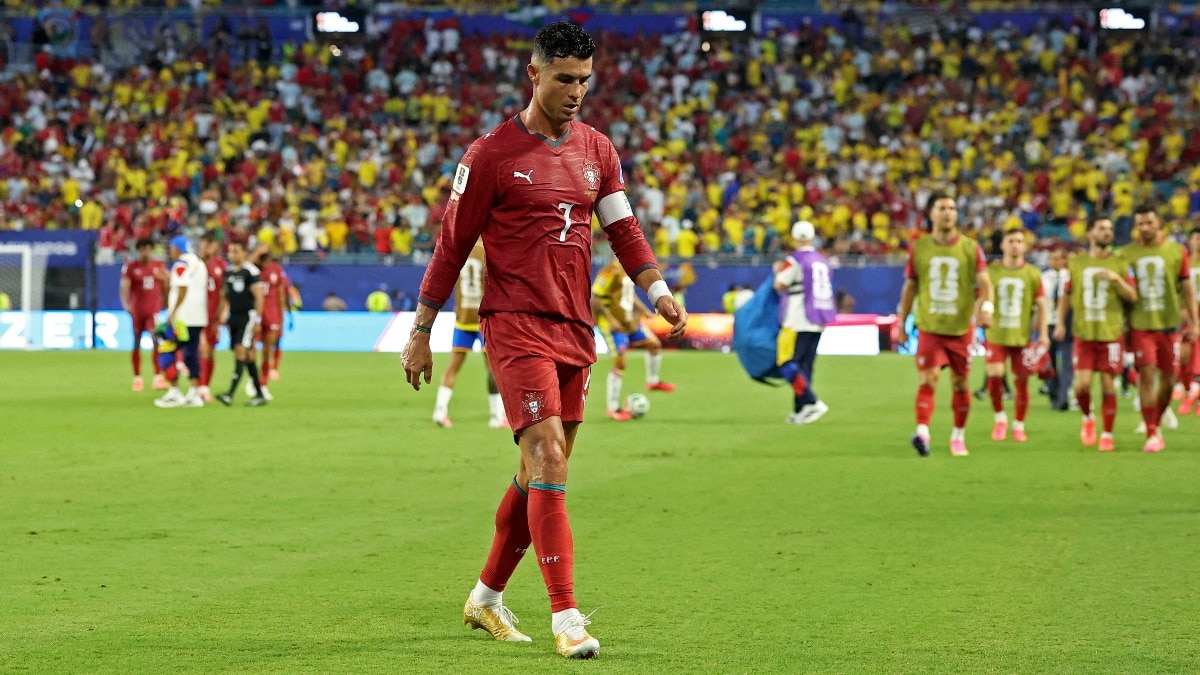
There was no goal. No celebration. No iconic moment. Instead, Ronaldo spent much of the evening waving at teammates, pointing towards empty spaces and waiting for Portugal’s attack to finally remember he was standing inside the Colombia penalty area.
Colombia vs Portugal, FIFA World Cup 2026: HIGHLIGHTS
It never really happened.
The Group K decider ended 0-0, with Colombia deservedly finishing top of the group after producing the better football for long spells. Portugal advanced as runners-up and will now face Croatia in the Round of 32, while Colombia earned a meeting with Ghana. Elsewhere, DR Congo completed a remarkable comeback from a goal down to beat Uzbekistan 3-1, claiming one of the best third-placed qualification spots and booking a last-32 clash with England in their first World Cup appearance since 1974.
For Portugal, though, the result almost felt secondary.
This was the first time at the tournament they came up against genuine elite opposition, and they looked worryingly ordinary.
The scoreline suggests a hard-fought stalemate. The performance suggested something far more concerning.
Portugal survived.
And they only did so because Diogo Costa produced one of the finest goalkeeping displays of this World Cup, while Colombia somehow forgot where the goal was.
The South Americans fired 24 shots to Portugal’s 13, forced Costa into six saves and even thought they had snatched a dramatic stoppage-time winner through Davinson Sanchez before VAR confirmed the defender had drifted offside.
If Costa was Portugal’s best player by some distance, their biggest disappointment was much further up the pitch.
Because the only thing more wasteful than Colombia’s finishing was Portugal’s midfield.
A MIDFIELD WITHOUT A MAP
This Portugal squad is overflowing with technical quality.
Bruno Fernandes is one of Europe’s finest creators. Vitinha controls matches for Paris Saint-Germain almost effortlessly. Ruben Neves brings composure and experience, while Joao Neves has emerged as one of the brightest young midfielders in world football. Add Joao Felix drifting between the lines and Pedro Neto stretching defences, and Portugal should have one of the most fluid attacking units in the tournament.
Instead, they looked like strangers trying to solve a puzzle together.
There was no rhythm to their passing. No obvious attacking patterns. No consistent movement between midfield and attack. Every possession seemed to begin with a player stopping, looking around and wondering where the next run was supposed to come from.
Bruno Fernandes repeatedly dropped deeper in search of the ball because Portugal struggled to progress through midfield. Vitinha rarely managed to dictate the tempo. Ruben Neves recycled possession without ever truly speeding the game up, while Joao Felix floated in and out without becoming the creative link Ronaldo desperately needed.
The most telling images of the night were not Colombia’s chances.
They were Ronaldo’s reactions.
The Portugal captain constantly spoke to his wingers, gestured towards teammates and pointed into spaces where he wanted crosses delivered. Time and again he drifted into dangerous positions only to watch Portugal recycle possession sideways instead.
Against Uzbekistan, Portugal finally played to Ronaldo’s greatest strength. They attacked wide areas relentlessly, delivered crosses early and allowed him to dominate the penalty box. Against Colombia, that blueprint disappeared.
Ronaldo managed only a handful of efforts, most from poor positions, and spent more time chasing service than threatening Camilo Vargas’ goal.
That is not entirely on him.
Portugal simply never looked like a team with a clear attacking identity.
And that inevitably raises uncomfortable questions for Roberto Martinez.
Because this no longer feels like a one-off off day. Whenever Portugal have looked convincing under Martinez, it has often been because individual brilliance has carried them through. Against Colombia, when those moments failed to arrive, there was very little evidence of a tactical framework capable of taking over.
It genuinely felt as though the players were deciding what to do after receiving the ball rather than executing a rehearsed plan.
For a squad packed with this much talent, that should worry Portugal supporters.
CROATIA WILL PUNISH THIS
The good news for Portugal is that tournament football is often about surviving. Costa ensured they did exactly that.
The Porto goalkeeper denied Jhon Cordoba after another dangerous Colombian break, produced outstanding saves from Jhon Arias, punched away dangerous deliveries under immense pressure and remained composed throughout a relentless Colombian barrage. Even when Davinson Sanchez finally headed home deep into stoppage time, the offside flag rescued Portugal before VAR confirmed the decision.
Costa could stop almost everything.
He just could not fix the football unfolding in front of him.
To Colombia’s frustration, they were almost as guilty as Portugal when it came to making the most of their opportunities. James Rodriguez once again dictated attacks beautifully before making way for Juan Quintero, Luis Diaz tormented Portugal whenever he found space, Jhon Arias constantly stretched the defence and Daniel Munoz made an immediate impact from the bench. Yet for all their excellent build-up play, the finishing touch never arrived.
That wastefulness allowed Portugal to escape with second place.
Croatia, however, may not be so forgiving.
A midfield featuring Luka Modric and Mateo Kovacic will ask even tougher questions than Colombia did, and if Portugal once again surrender control in the middle of the park, Ronaldo could spend another knockout game surviving on scraps.
One subplot also quietly disappeared with the final whistle in Miami.
Because Colombia topped Group K, Portugal slipped into the opposite side of the knockout bracket, ruling out what could have been a blockbuster Portugal vs Argentina quarter-final. It also means football fans hoping for a first-ever World Cup meeting between Cristiano Ronaldo and Lionel Messi will now have to wait until the final, assuming both teams get there.
On this evidence, though, Portugal have far bigger problems to solve before anyone starts dreaming about one last dance between football’s two greatest rivals.
FIFA World Cup | FIFA World Cup Schedule | FIFA World Cup Points Table | Football News
– Ends



