


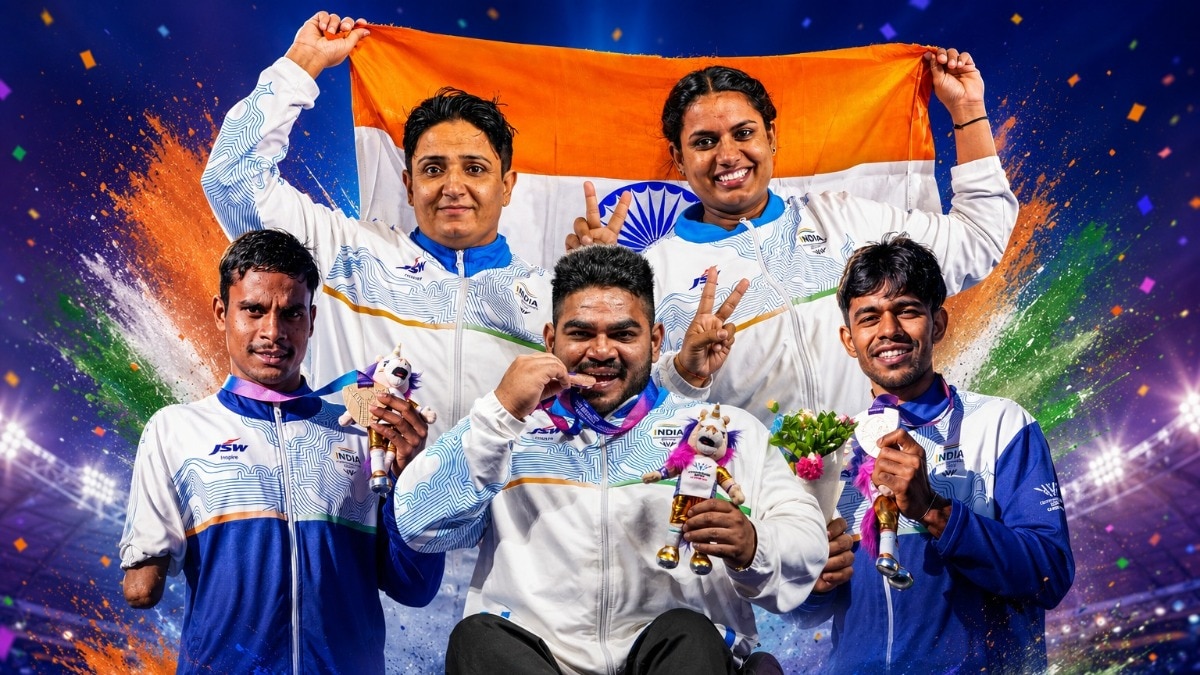
Somewhere between a landmine on the Line of Control, a motorcycle accident in Roorkee, a polio diagnosis in a Gujarat village, and a sixteen-year-old’s borrowed bicycle in Assam, India scripted the greatest para-sports story in its Commonwealth Games history. Seven medals.
Three gold, two silver, and two bronze. A number that sounds modest until you realise it equals everything India had won in every previous edition of the Games, combined. For a 28-member contingent that arrived in Glasgow with more hope than history behind it, that is not just a statistic. It is a generation announcing itself.
A TWENTY-YEAR WAIT, BROKEN
Events for athletes with disabilities first featured at the Commonwealth Games as an exhibition sport in Victoria in 1994. Eight years later, at the 2002 Manchester Games, para athletes became fully integrated into their national teams, making the Commonwealth Games the first truly inclusive international multi-sport event. Since then, India’s returns have been modest: one gold, two silver and four bronze across six editions, seven medals spread over twenty years of trying.
Birmingham 2022 had been the country’s best showing until now, with Bhavina Patel’s gold and Sonalben Patel’s bronze in para table tennis and a third gold from Sudhir in para-powerlifting, which was later stripped after he failed an in-competition dope test.
Glasgow rewrote all of it. Para track and field athletes alone brought home six medals, three gold, two silver, and one bronze, while Jhandu Kumar added a seventh in para powerlifting. It also ended a twenty-year wait for an Indian para athletics medal at the Commonwealth Games, the first since Ranjith Kumar Jayaseelan’s seated discus silver in 2006.
THE SOLDIER AND THE CADET
The story that carried India’s flag highest belonged to two men from the Indian Army who, in different ways, ended up somewhere they never planned to be.
Soman Rana grew up in Gaya, Bihar, and was, for a time, one of the country’s finer amateur boxers, finishing fifth at the 2005 National Championships. In December 2006, serving with the Gorkha Rifles along the Line of Control in Jammu and Kashmir, a landmine took his right leg. What followed at the Artificial Limb Centre in Pune was not the end of an athletic life but the start of a different one. Introduced to the shot put circle by Colonel Gaurav Dutta at the Army Paralympic Node in 2017, Rana discovered that the throwing motion resonated with his boxer’s shoulders, and he took to it quickly. He went to Tokyo and finished fourth. He went to Paris and finished fifth. Twice he came home a place short of the podium he wanted.
In Glasgow, at 43, he finally got there. A season’s best 13.40m was enough for gold, India’s first-ever Commonwealth Games title in the F57 shot put. “It feels wonderful. I am overjoyed to represent India on such a grand stage and win a gold medal,” he said afterwards, naming his family, the Army, his coach Rakesh Prasad and SAI Bengaluru as the people who had carried him there.
Twelve centimeters behind him stood a story that rhymed with his own. Shubham Juyal, from Roorkee, had wanted to be an Army officer like his father, and had already cleared the written exam for the Army Cadet College entry scheme in 2022, when a motorcycle accident that same year cost him a leg and that plan in one stroke. He, too, found his way to the Artificial Limb Centre in Pune, and there, instead of the vocational rehabilitation on offer, he chose the Army Paralympic Node and a coach named Rakesh Singh Rawat. His throw of 13.28m in Glasgow won silver and completed India’s first one-two finish in the event: two soldiers, two derailed plans, one podium.
THE POWERLIFTER WHO SOLD HIS RICKSHAW
If Rana and Juyal’s stories were written in the army’s rehabilitation wards, Jhandu Kumar’s would have been written on the back of a vegetable cart. The son of a vendor, India’s first medallist of the Games, once sold vegetables for a living and later drove an auto-rickshaw to make ends meet.
In 2023, with no other way to fund his trip to the National Para Powerlifting Championships, he sold his rickshaw. That decision paid dividends in Glasgow on the very first day of India’s campaign. Competing in the men’s heavyweight para powerlifting final at the SEC Armadillo, the 28-year-old lifted 190kg on his second attempt for 130.9 points, enough for bronze and enough to open India’s medal account at these Games. He nearly had more. A successful final attempt of 196kg would have broken the Commonwealth Games meet record, but the lift wasn’t completed.
“It feels amazing. I secured the first medal for India and hoisted our national flag,” Jhandu said on his return, admitting only a “tinge of disappointment” at missing gold. It was the quiet complaint of a man who had learnt to expect more of himself than circumstance ever offered him.
TWO WOMEN, ONE PODIUM
Before the shot put circle in Glasgow ever witnessed Rana’s winning throw, it had already belonged to Sharmila Dhankar.
Polio weakened one of her legs before she turned two. She was married young, and years later, her life unravelled when she was stripped of dignity and forced out of her home with her two daughters. She returned to her parents’ house in Chitrauli, a village in Haryana’s Mahendragarh district, and began again from scratch.
She rebuilt her life, remarried, and found in her husband, Ajit Singh, a quiet but decisive influence. It was he who nudged her towards a sport she had never considered.
Dhankar did not take up para-athletics until she was 34. Training under coach Tek Chand in Rewari, she rose with remarkable speed, defying both circumstance and the odds stacked against a late starter.
In Glasgow, a season-best throw of 9.81m earned her gold in the women’s F57 shot put, making her the first Indian to win a Commonwealth Games title in para athletics.
Standing behind her on the podium was Shilpa K. Shyla, whose journey had begun with a road accident at the age of four that cost her left leg. Growing up in Kanchigara Koppalu village in Karnataka’s Mysuru district, she completed a postgraduate degree and a Bachelor of Education before para athletics entered her life.
Her personal-best throw of 7.26m initially left her fourth. Only after a Nigerian athlete’s mark was disallowed on review did Shyla move into the bronze-medal position, claiming the first Commonwealth Games medal of her career.
“I cannot even describe how I feel,” she said afterwards, thanking her coaches and the governments of India and Karnataka for helping her reach the podium.
THE BOY FROM THE FOREST SCHOOL
In 2015, Maharashtra athletics official Vaijnath Kale was visiting a tribal residential school in Nashik district when an eleven-year-old caught his eye. The boy raced alongside able-bodied classmates as though the missing right arm, amputated below the elbow after an infection following a childhood fall from a mango tree, mattered to no one, least of all himself.
His name was Dilip Mahadu Gavit. Kale took him under his wing. Over the next decade, the barefoot village runner grew into an Asian Para Games champion and a Paralympic finalist.
The 400m was his event. But when it disappeared from the trimmed-down Commonwealth Games programme, Gavit switched to the 100m and won that too. His 10.71-second run secured gold and set a new Games record.
Chasing him home was Mohammed Basil Morssinganakath, born without his right arm in Kerala’s Veliyancode. Basil stopped the clock at 10.83 seconds to win silver, the first international medal of his career.
The result carried an added twist. Basil had beaten Gavit at the national trials before the Games. In Glasgow, they ran together once more, only this time they gave India the top two places on the podium.
“It is my first international medal. I am so happy,” Basil said, dedicating the silver to his family and coach.
Elsewhere in the contingent, not every story ended on the podium, but each added its own texture to the campaign. Ramesh Shanmugam finished seventh in the men’s T54 1500m para final.
Priyanka Goswami finished seventh in the women’s 10,000m race walk with a season-best 45:53.93, while compatriot Ravina was disqualified. National record holder Dev Kumar Meena cleared 5.30m to finish fourth in the pole vault, with Kuldeep Kumar placing sixth at 5.10m.
Teenage para-cyclist Lisha Das finished sixth in the women’s C4-C5 1000m time trial, bringing India’s campaign in Glasgow to a close. Every one of them wore the same colours as the medallists. Not every colour finds a place on the medals table.
WHAT SEVEN MEDALS MEASURE
Since Manchester 2002, India had won seven para-sport medals across six Commonwealth Games. The 28-member Indian para sports contingent left Glasgow with seven medals of its own, three gold, two silver and two bronze, the country’s finest para-sport campaign at the Commonwealth Games.
A soldier who lost a leg to a landmine and found a shot put circle instead. A cadet whose dream ended on a motorcycle and began again in a wheelchair. A vegetable seller who sold his own rickshaw for a shot at the podium. A teenager from Assam still finishing her homework between training sessions. Seven medals, seven different journeys, all leading to the same place. None of it was owed to them. In Glasgow, they took it anyway.
– Ends



