
















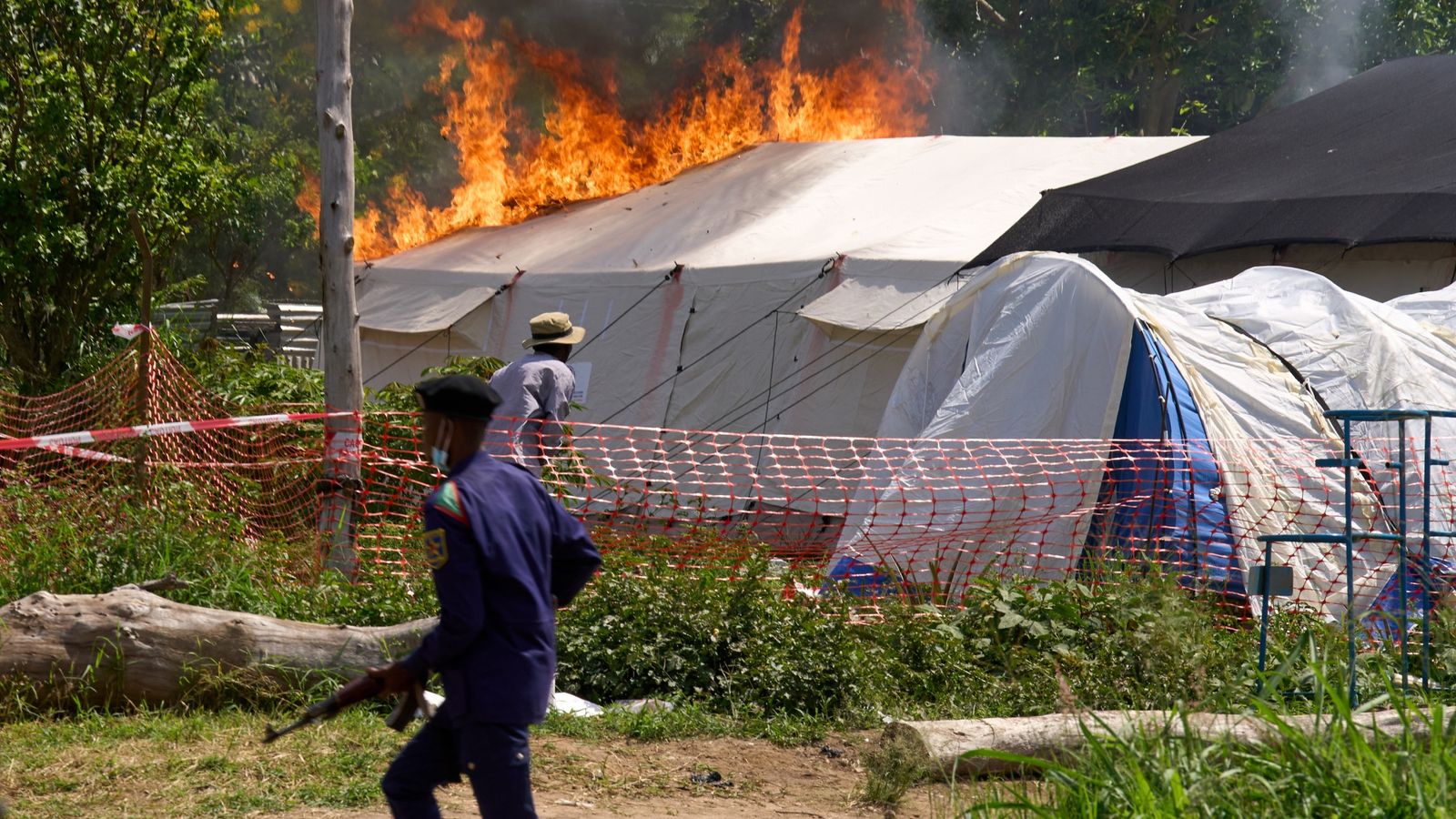
Fears are growing that the Ebola outbreak in the Democratic Republic of Congo (DRC) is gathering momentum, as a treatment centre is set alight by an angry crowd.
The outbreak has resulted in 160 suspected deaths out of 670 suspected cases, of which 61 have been confirmed, according to DRC health ministry data published on Thursday.
Two Ebola cases have also been confirmed in neighbouring Uganda. and now the disease is spreading to rebel-held areas of the DRC, the latest figures show.
The World Health Organisation, which has declared a public health emergency of international concern, said the outbreak is almost certainly much larger and has also expressed concern over the speed of the spread.
In the town of Rwampara, one of the outbreak’s hotspots in Ituri, clashes broke out on Thursday after the family of an Ebola victim disputed that the disease had killed him and demanded his body is handed over to them.
Witnesses told the Reuters news agency that protesters gathered outside the hospital and set fire to tents run by a medical charity, prompting police to fire warning shots and tear gas.
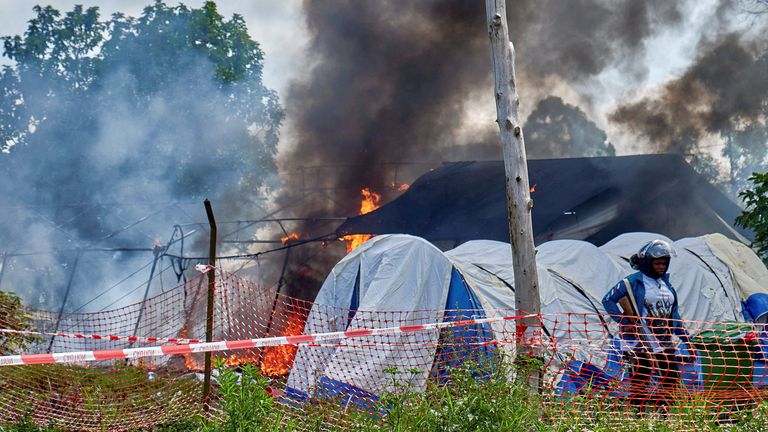
A burning Ebola treatment centre in Rwampara outside Bunia, Ituri province. Pic: Reuters
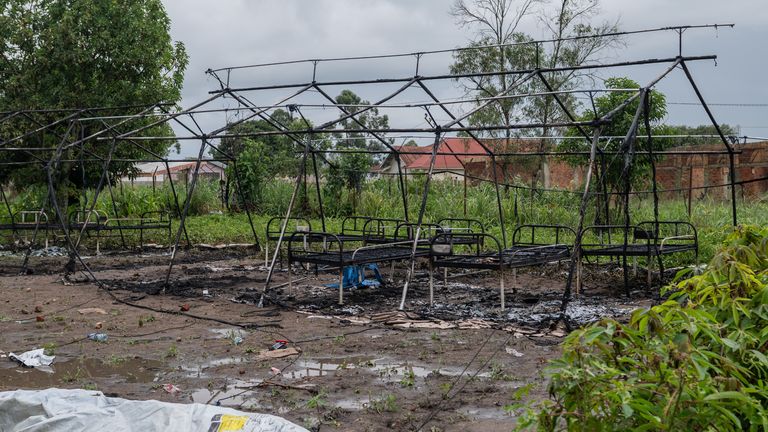
The smouldering ruins of an Ebola treatment centre, destroyed by family members in Rwampara. Pic: AP
Meanwhile, a confirmed case has been reported hundreds of miles from the epicentre, in a rebel-held area of the country.
It signals a further spread of the disease, which experts believe has been circulating undetected for around two months in the epicentre, Ituri province.
That is hundreds of miles away from the site of a new death, reported on Thursday, of a 28-year-old patient in South Kivu province – a rural area near the provincial capital, Bukavu.
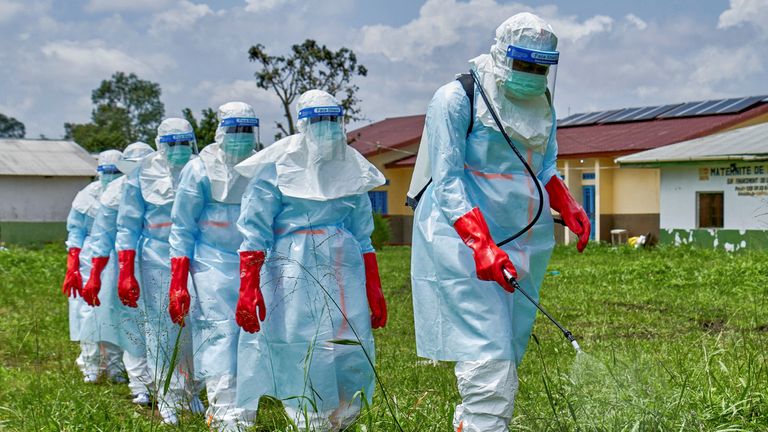
Red Cross workers disinfect an area around Rwampara general hospital. Pic: Reuters
Details were released by The Alliance Fleuve Congo, a rebel group which includes the Rwanda-backed M23 fighters who seized swathes of eastern DRC last year.
Local health officials confirmed two suspected cases had been detected in the province, including the fatal case.
An Ebola case was also confirmed last week in Goma, capital of neighbouring North Kivu province, which is under M23 control.
Speaking to reporters in Geneva, Jane Halton, chair of the Coalition for Epidemic Preparedness Innovations (CEPI), said the confirmed cases announced to date likely represent only “the top of the iceberg”.
CEPI, which funds vaccine development, is assessing potential candidates for Ebola.
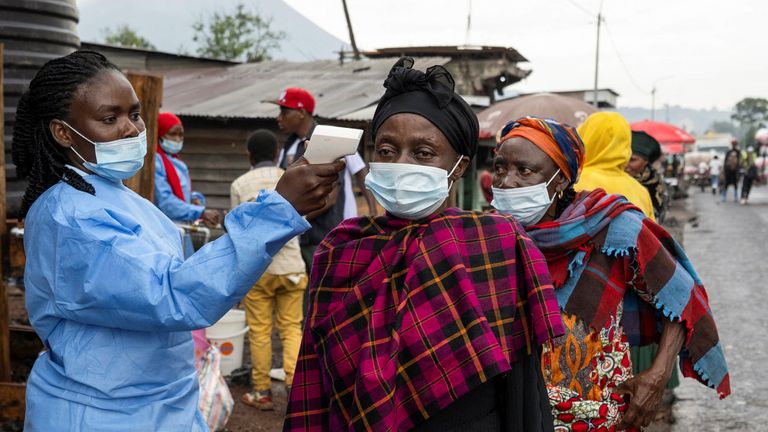
A health worker takes temperatures at a checkpoint before people enter the city of Goma, North Kivu province. Pic: Reuters
UK offers £20m funding
Also, there is no available vaccine or medicine for the Bundibugyo strain responsible for the outbreak. An expert said this week it would be at least six to nine months before one would be available.
Health workers and aid groups have also said they are in dire need of more supplies and staff to respond.
On Thursday, Britain said it was allocating up to £20m to the response, through support for frontline health workers, improved infection control and disease surveillance.
The US has so far committed £17.1m ($23m) and said it would help open up to 50 clinics in DRC and Uganda.
Read more from Sky News:
Why you should care about outbreak
Protests over Congolese man’s death
Rubio: Signs of US-Iran deal to end war
Travel restrictions tightened
Neighbouring Uganda has confirmed it is suspending all public passenger transport with DRC for the next four weeks, excluding trucks carrying food and goods.
The US Department of Homeland Security has also announced enhanced screening for certain Americans who have visited Congo, Uganda or South Sudan in the previous 21 days.
From Thursday, they will be redirected to Washington Dulles International Airport to undergo extra checks.
There are already restrictions banning other travellers from those three countries.
On Wednesday, an Air France flight from Paris to Detroit was ordered to be diverted to Montreal after a passenger from the DRC boarded “in error”, Customs and Border Protection said.




