


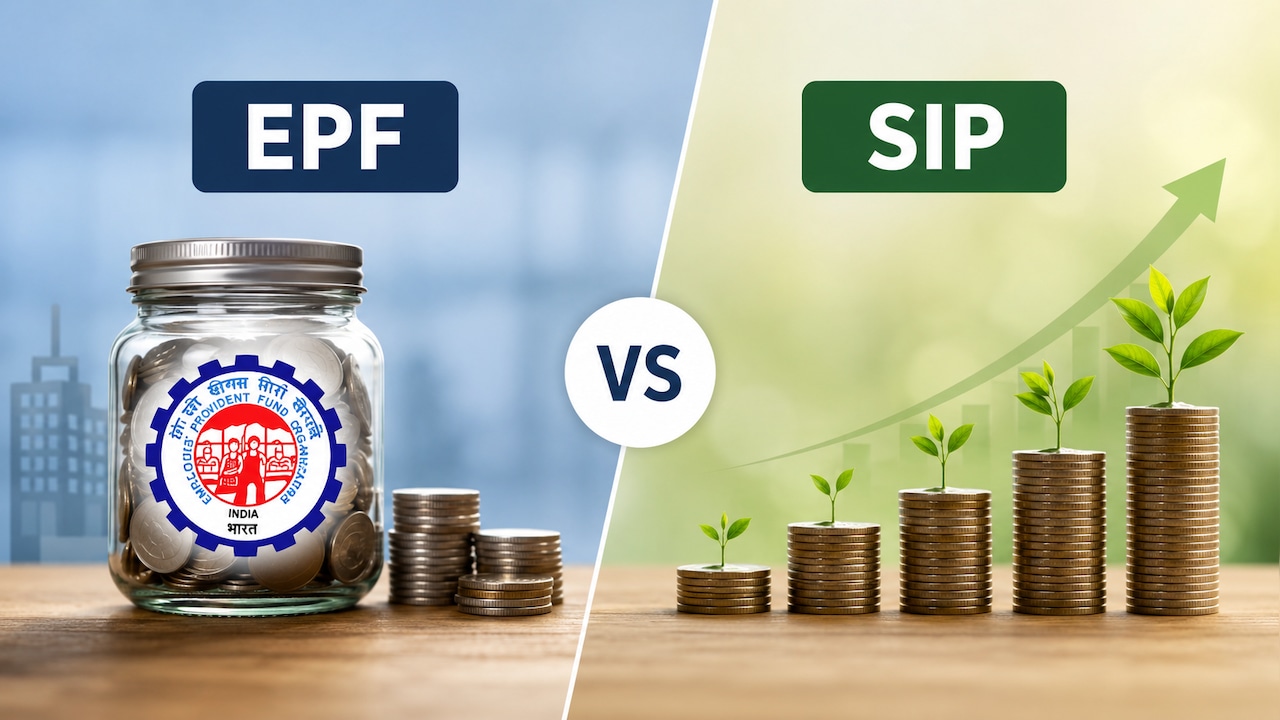
Building a retirement corpus requires consistency, patience and choosing investments that match your financial goals. The Systematic Investment Plan (SIP) and the Employees’ Provident Fund (EPF) are two popular ways of creating a long-term corpus. While EPF is a popular savings option for salaried individuals, SIPs have emerged as an alternative for investors seeking higher growth through equities.
Some people contribute to both, while others pick one of them. But which investment scheme may help you generate a higher retirement corpus if you invest Rs 10,000 every month for 20 years?
Let’s compare the potential outcome from EPF and an equity mutual fund SIP, assuming you start at age 30 and continue until age 50.
Also Read: Investing In Arbitrage Funds After CAS? Here’s A Smarter Way To Deploy Your Money
Investing Rs 10,000 In EPF
EPF is a government-backed retirement savings scheme that offers a declared interest rate and is not directly exposed to stock market volatility. The EPF interest rate for FY 2025-26 is 8.25% per annum.
If Rs 10,000 is invested every month for 20 years, the calculation is:
Monthly investment: Rs 10,000
Tenure: 20 years
Assumed interest rate: 8.25% per annum
Total investment: Rs 24 lakh
Estimated interest earned: Rs 36.76 lakh
Estimated corpus: Rs 61.11 lakh
Investing Rs 10,000 In SIP
An equity mutual fund SIP works differently. At a 12% assumed return, the SIP corpus could therefore be significantly higher than the EPF corpus. However, this higher potential comes with market risk, and actual mutual fund returns can be higher or lower than the assumption.
Monthly investment: Rs 10,000
Tenure: 20 years
Expected rate of return: 12%
Total investment: Rs 24 lakh
Estimated returns: Rs 74.92 lakh
Maturity corpus: Rs 98.92 lakh
But your money is invested in market-linked securities, which means returns are not guaranteed and the value of the investment can fluctuate.
EPF Vs SIP: Which One Should You Choose?
Choose SIP if you are young, have a high-risk appetite, and your investment horizon is above 20 years. Equities through SIP compound faster and reach milestone amounts significantly earlier than fixed-income instruments.
EPF, on the other hand, can be chosen if you are risk-averse, closer to retirement age, or fall in a high tax bracket and want a safe, predictable debt allocation without equity volatility.
Also Read: Missed EPF Contributions For Years? Here’s What Happens To Your PF And Pension Benefits
Ultimately, the right strategy depends on your risk appetite, retirement goals, existing EPF balance and overall asset allocation. The calculations above are illustrations based on assumed rates of return and should not be treated as guaranteed future returns.
Essential Business Intelligence,
Sharp Market Insights,
Practical Personal Finance Advice, Daily Fuel, Gold and Silver Prices and Latest Stories — On NDTV Profit.


