


The Round of 16 heat is thick enough to see. Egypt are 2-0 up on the reigning champions and dreaming out loud, Mohamed Salah wheeling away with his arms out, a man who knows exactly what a World Cup quarter-final would mean this late in his career. An entire nation has stopped whatever it was doing to watch Argentina, the holders, get taken apart by a team they were never supposed to fear.
Then, 21 minutes from full-time, the fold begins. Cristian Romero heads one back. Four minutes later Lionel Messi, 39 years old and playing like he isn’t, drags the scoreline level. In stoppage time, Enzo Fernandez completes a remarkable comeback, Argentina scoring three goals in 13 minutes to win 3-2.
By the time anyone sits down to make sense of what happened, the story isn’t the comeback. It’s a goal Egypt scored an hour earlier that no longer exists, ruled out after a video review spotted a foul at the origin of the attacking phase, almost a full pitch away from the ball. Within minutes, Egypt’s coach was calling it an injustice. Pundits disagree over whether the review should have happened at all. Everyone watched the same match. Almost nobody agrees with what they saw.
Cricket had been living with those arguments for decades. Before DRS, umpiring mistakes became part of the game’s folklore, debated for years because there was no way to challenge them. Indian fans, in particular, can probably recite a few by heart: Steve Bucknor’s contentious calls involving Sachin Tendulkar, Daryl Harper’s infamous lbw decision in Adelaide, and a string of phantom edges and impossible lbws that television replays exposed but could never overturn. Once the finger went up, that was the end of it.
Football and cricket have since spent two decades trying to stop afternoons like those from being decided by a single human judgement. Cricket got there first. More importantly, it made one decision football never did.
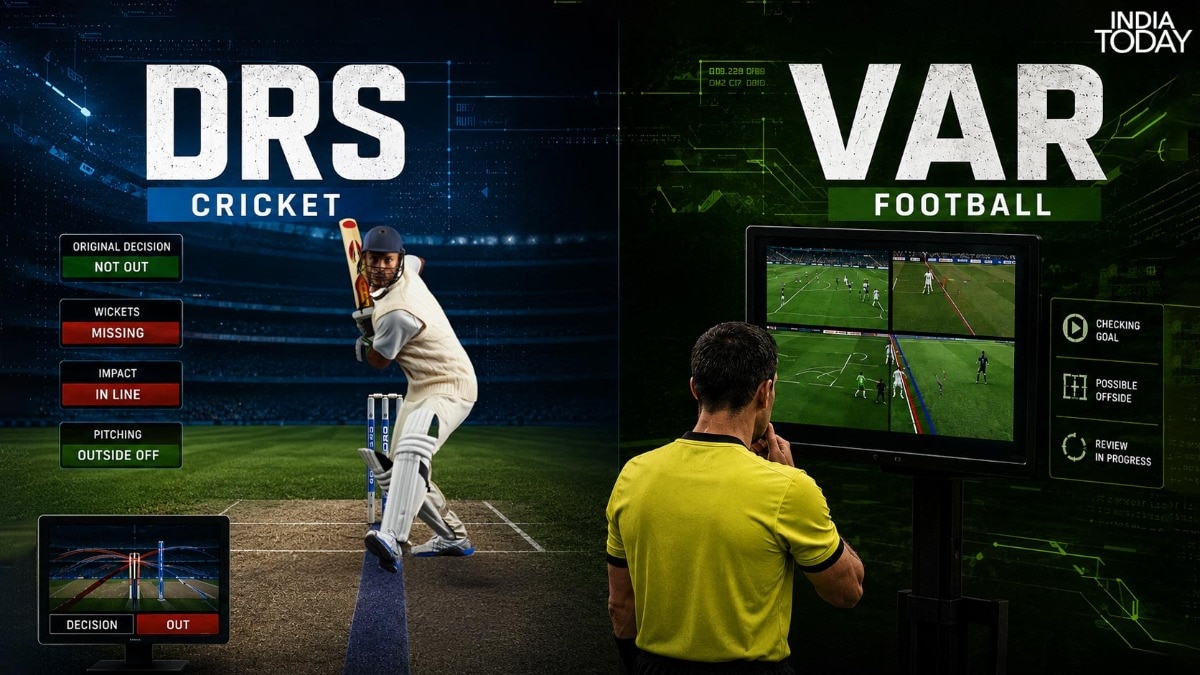
Unlike cricket’s Decision Review System (DRS), which puts the power to challenge an on-field decision in the hands of the players, football’s VAR keeps that trigger with the referee. That single difference has shaped almost every debate each sport has had about technology ever since.
If Diego Maradona’s ‘Hand of God’ happened today, it probably wouldn’t become football’s most famous goal. There would be a VAR check, half a dozen replay angles and, within a minute or two, the referee would be pointing for a free-kick instead of the centre circle. Frank Lampard’s ghost goal against Germany at the 2010 World Cup would have met a similar fate, goal-line technology confirming the ball had crossed the line before England players had even finished protesting.
For years, football kept coming back to moments like those whenever the debate around technology resurfaced, each mistake strengthening the case that better tools would mean better decisions, and better decisions would mean a fairer game.
That promise has largely been fulfilled. This World Cup has been played with VAR, semi-automated offside, Connected Ball Technology and more camera angles than ever before, and several obvious mistakes that would once have dominated headlines have quietly disappeared from the game.
Yet as the tournament has moved into its knockout rounds, technology has once again become one of football’s biggest talking points, not because it has stopped working but because football has discovered that getting more decisions right does not necessarily stop people arguing about them.
Goals now come with a brief pause attached to them: players glancing at the referee, fans searching for the big screen, commentators holding back before committing to the moment. It has become such a natural part of watching football that most fans barely notice they’re waiting.
The conversations have changed too. A decade ago, supporters argued about what referees had missed. Today, they’re just as likely to debate why VAR intervened in one game but not another, or why similar incidents ended with different outcomes. Nobody wants those old-style howlers deciding football’s biggest matches again; what’s been questioned this past fortnight isn’t the existence of the technology, but whether it’s being applied consistently from one match to the next.
CONSISTENCY IS THE REAL TEST
That Argentina comeback is where this World Cup’s technology debate truly burst into life. VAR had chalked off an earlier Egypt goal, and within minutes social media had slipped into familiar territory: accusations of inconsistency, claims of favouritism, suggestions the tournament itself had been compromised. Whether those allegations carried substance almost became secondary. People were talking less about Argentina’s comeback and more about the people sitting in the VAR room. None of it was ever in Egypt’s hands to demand. Under the laws governing VAR, only the referee can start a review; a team can appeal to him, gesture at the screen, remonstrate, but it cannot force one, and crowding him to try risks a card of its own.
FIFA’s refereeing chief, Pierluigi Collina, quickly found himself defending both the officials and the process. Rejecting suggestions of bias, he insisted the review had simply applied the Laws of the Game as they are written.
“A foul is a foul,” Collina said. “It doesn’t matter if it happens close to the goal or 50 metres away. If it’s part of the attacking phase, it has to be punished.” He also dismissed suggestions that certain teams or players received favourable treatment, insisting referees judge only what they and the technology see.
Argentina against Egypt was far from an isolated incident. Croatia had a stoppage-time equaliser against Portugal wiped out after Connected Ball Technology detected the slightest touch putting a teammate offside in the build-up.
Days later, Jude Bellingham’s equaliser for England against Norway survived only after FIFA confirmed the technology had detected no contact with an overhead camera cable, as Norwegian players had alleged.
Away from VAR, England’s Jarell Quansah received a two-match ban for a challenge against Mexico, while the United States’ Folarin Balogun had a similar red card’s ban suspended on probation. Different matches, different technologies, same conversation: not whether the technology worked, but whether the same standards were applied every time, and whether anyone but the officials had a say in when they were tested.
Former FIFA referee Jonas Eriksson believes that is where the frustration lies. “What everyone wants from referees, they want the correct decisions, yes, but more important always is consistency,” he told Reuters.
“Player A gets the same sanction as Player B. Team A gets the same sanction as Team B. That’s what you expect. This is not the case when it comes to Quansah and Balogun.” He also thinks football has been poor at explaining why such differences occur, leaving fans to guess at the reasoning.
Former Premier League referee Keith Hackett reached the same conclusion, writing that both Balogun and Quansah had committed Serious Foul Play challenges sanctioned by a red card, and that FIFA had failed in its duty to the game by treating the two so differently.
None of those voices are arguing for football to abandon technology. If anything, they accept it has made the game fairer; their concern is that fans now expect it to produce the same standard of decision every single time, and this World Cup hasn’t always delivered that.
Eriksson, Hackett and Collina disagree on the conclusions, one wanting more consistency, another questioning FIFA’s disciplinary process, the third defending the officials outright, but all three are arguing about the same thing: not whether the technology sees clearly, but whether the game applies what it sees fairly, and none of them has ever had to ask whether a player could have triggered the review themselves. That question doesn’t exist in football.
Football has already settled the question of whether technology belongs in the game; few supporters would swap today’s system for an era of ghost goals and blatant handballs deciding World Cups. But settling that question has only opened a harder one, about consistency, that VAR alone can’t answer, because the decision to even look was never anyone’s but the referee’s to begin with.
CRICKET GOT THERE FIRST
Cricket’s version of that instinct arrived a decade earlier, in 2009, when DRS was built specifically to stop the kind of one-man howler that Adelaide had been. Trialled in a Sri Lanka-India Test in 2008 and formally launched by the ICC that November, it reached ODIs by 2011 and T20Is by 2017, never sold as a replacement for umpires, only as a check against exactly that kind of decision.
There’s a structural difference here that shaped how each sport’s arguments would play out. DRS puts the trigger in the players’ hands.
A batter given out, or a fielding captain denied an appeal, can invoke a review on the spot, no referee’s permission required, capped at three unsuccessful reviews per innings in Tests and two in white-ball cricket. Run the count-down, and you’re back to trusting the umpire, but until then, the contest over a decision belongs to the people actually playing the match. Football never made that trade, as the consistency debate above shows: the trigger stayed with the officials throughout.
Three technologies do the work once a review is called. Ball-tracking, marketed as Hawk-Eye or its rival Virtual Eye, uses up to 10 high-speed cameras mounted around the ground, triangulating footage into a three-dimensional model of the ball’s path. It doesn’t run on a generic assumption about a bowler or a pitch; each delivery is measured individually, split into pre-bounce and post-bounce segments, so a tall quick and a shorter, whippier bowler generate genuinely different trajectories, rebuilt from that specific ball’s data rather than an average. It gets shakier with less post-bounce flight to measure, a full delivery striking the pad almost instantly, or sharp turn off a rough patch late in a Test. Alongside it sits UltraEdge, which uses stump microphones and sound-wave analysis to detect contact between ball and bat or pad, and Hot Spot, which uses infrared cameras to flag contact through heat signatures, though cost and reliability have pushed it out of regular use.
It has plainly cut down on Adelaide-style disasters. But it produced its own flashpoint: Umpire’s Call.
Here’s what it actually means. On review, ball-tracking projects the ball’s path onward from the point of impact. For an lbw to be overturned, it has to show the ball hitting the stumps by more than half its width; show less than that and the on-field umpire’s original call stands, whatever it was. The rule exists deliberately, as a buffer for the technology’s margin of error on marginal deliveries, particularly ones pitching a long way from the batsman or coming off the seam awkwardly.
The trouble is what that buffer does in practice. The same ball-tracking image, say, 35 per cent of the ball clipping leg stump, produces a different result depending on whether the umpire out in the middle originally said out or not out, since it’s the on-field call that gets protected. Two batsmen hit in near-identical positions by near-identical deliveries can walk off with opposite outcomes, purely because one umpire’s finger went up and the other’s didn’t. It isn’t the technology disagreeing with itself. It’s the same evidence being read two different ways depending on who was standing over the stumps in real time.
That’s the bit players have never made peace with. Virat Kohli wanted the nuance scrapped.
“If the ball is clipping the stumps, it should be out – whether you like it or not you lose the review. And that is how simple the game has to be: if it hits the stumps or it misses the stumps, it doesn’t matter how much it is hitting and those kind of things. Because it is creating a lot of confusion,” he said in 2021.
But, some have argued in favour of it. Nasser Hussain, former England captain, put it nicely.
“You need the umpire’s call. It’s not there to back up the umpire; it’s to give the margin of error for the technology. Umpires will give virtually everything out because they think it will be clipping, and we will have more two-day Test matches,” he had said.
The irony is that Umpire’s Call was never really an admission that the technology is unreliable. If uncertainty alone were the issue, a ball projected to clip the stumps by a fraction and one projected to miss by the same fraction would be treated alike. They aren’t. Only one ends up as Umpire’s Call.
DRS VS VAR
DRS has made cricket fairer, with fewer decisions resting solely on one umpire’s judgement. But Umpire’s Call acknowledges the same truth football is only now grappling with: getting a decision right is not the same as applying it consistently. Cricket’s compromise is at least easy to understand. Teams have a limited number of reviews. Umpire’s Call has a clear boundary. You may not always agree with it, but you know where the line is.
Football’s is not. It depends, match to match, on whether one man decides an error was obvious enough to be worth a second look.
Nor did either sport get to bank the viewing experience along with the fairness. Football’s fans learnt to hold their celebrations until the screen says so. Cricket’s learnt something similar: a review that used to take as long as an umpire’s finger now takes the better part of three minutes, replays stacked on replays, a hush falling over the ground while 11 players wait to find out whether they’re allowed to celebrate.
Commentators have learnt to talk through the pause rather than around it, because the pause is no longer an interruption to the coverage. It is the coverage.
25 years ago, Harper’s finger went up in Adelaide and that was that; no review, no argument technology could settle. Cricket answered that with a mechanism the players themselves can trigger, bounded, numbered, argued about but at least written down.
Football built a version of the same machine and quietly kept the keys. Both games are fairer now, and slower, and still arguing.
– Ends



