


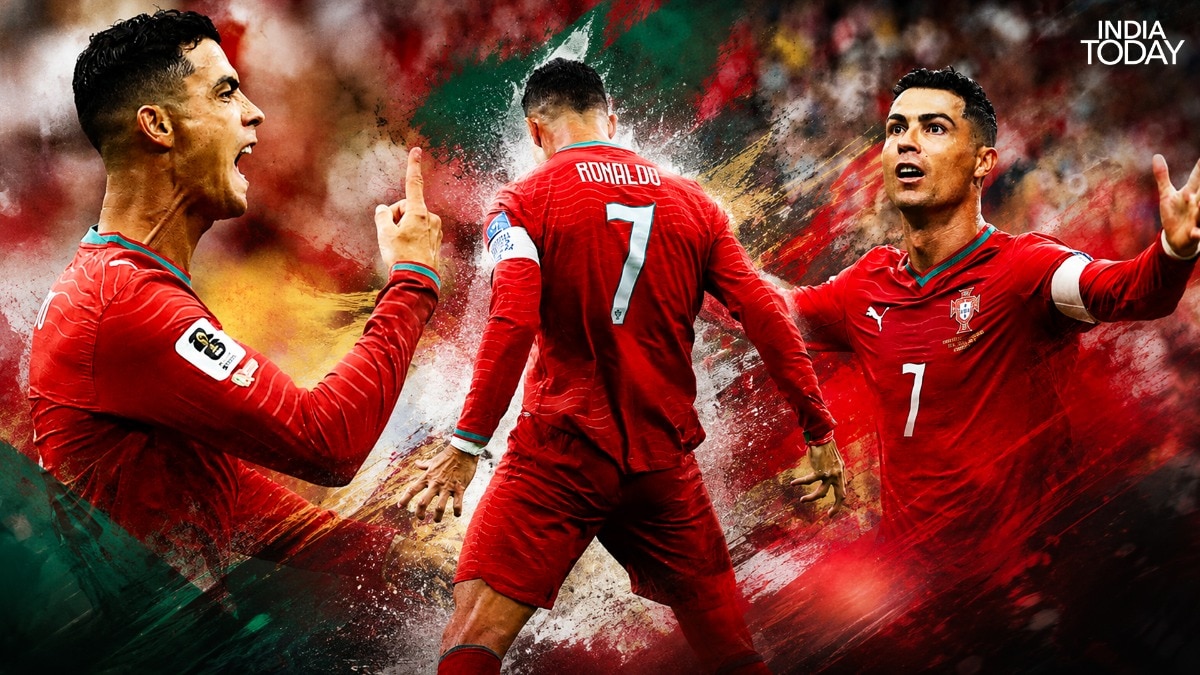
“I’m back. I’m back.”
Cristiano Ronaldo shouted those words with a grin into a television camera after Portugal’s 5-0 demolition of Uzbekistan in Houston. The statement felt almost unnecessary.
For anyone who has followed his career over the last two decades, there was something deeply familiar about what had just unfolded. The criticism had arrived after Portugal’s frustrating 1-1 draw against DR Congo. Questions were asked about his age, his place in the side and whether Roberto Martinez was holding on to football’s most famous No. 7 for sentimental reasons rather than footballing reasons.
Four days later, Ronaldo had two goals, another World Cup record, and yet another reminder that public doubt remains one of the most reliable sources of motivation in professional sports.
At this point, it is less a pattern and more a law of nature. Football questions Cristiano Ronaldo. Cristiano Ronaldo responds.
Carlo Ancelotti perhaps explained the phenomenon better than anyone when he once observed that “the only thing more dangerous than Cristiano Ronaldo is Cristiano Ronaldo who didn’t score in the previous game.”
It sounds like a joke. It also happens to be one of the most accurate scouting reports ever delivered on the Portuguese forward.
After all, this is a footballer who has scored more than 975 professional goals, 147 international goals and somehow managed to remain relevant across six different World Cups. Entire generations of defenders have arrived, peaked and retired while Ronaldo has continued finding ways to stay in the conversation.
That conversation, as it usually does, became particularly loud after the draw against DR Congo.
Ronaldo had managed just 25 touches, failed to register a shot on target and extended a drought at major tournaments that had quickly become a talking point. Thierry Henry dissected his movement. Chris Sutton questioned whether Portugal were limiting themselves by continuing to build around him. Social media delivered the familiar verdicts.
Finished. Selfish. Too old.
The remarkable thing about Ronaldo is that he has heard all of those words before, often right before producing one of those nights that reminds people why he is still here.
THE GOAL HENRY ASKED FOR
The irony of Ronaldo’s opening goal against Uzbekistan was impossible to ignore.
Following the DR Congo draw, Thierry Henry had spent several minutes breaking down a second-half Portugal attack. Francisco Conceicao was driving into the box. Bruno Fernandes was arriving at a promising position. Ronaldo, according to Henry, chose the wrong movement.
“The team needs to score, not you,” Henry said.
The criticism was not really about selfishness. It was about function. Henry’s argument was that Ronaldo’s job at that moment was to create space rather than occupy it, to drag defenders away rather than arrive in the same area as his teammate.
Six minutes into the Uzbekistan game, Joao Cancelo drilled a low cross into the penalty area and Ronaldo produced precisely the type of movement Henry had been advocating. The run was sharp, the timing perfect and the finish instinctive.
Football does not often provide such neat callbacks.
This one arrived less than a week later.
The goal settled Portugal, settled Ronaldo, and set the tone for what followed. Nuno Mendes doubled the lead with a clever free-kick before Bruno Fernandes found Ronaldo with a beautifully weighted pass for his second of the night.
By the final whistle, Portugal had scored five, Ronaldo had two, and the striker could easily have ended up with a hat trick.
There were chances for more. Fernandes repeatedly looked for him. Bernardo Silva joined the search when he came on. Portugal’s players seemed determined to help their captain complete the set.
They did not quite manage it.
The brace, however, was enough to make history.
Ronaldo became the first footballer ever to score in six different World Cups and moved past Eusebio as Portugal’s leading goalscorer in the competition. At 41, he also became the oldest player to score twice in a World Cup match.
Not bad for a player who was apparently finished four days earlier.
MESSI’S TOURNAMENT, RONALDO’S REMINDER
This World Cup has belonged to Lionel Messi so far.
There is no shame in saying that.
Five goals in two matches. A hat-trick against Algeria. A brace against Austria. The all-time World Cup scoring record. Argentina already through to the knockout rounds.
Messi has been sensational and, at this moment, probably the standout player of the tournament.
The temptation, as always, is to turn everything involving Ronaldo into a competition with Messi.
It does not need to be.
The reality is that one of football’s greatest privileges has been watching both men continue to produce moments long after logic suggested they should be winding down. Messi has started this World Cup at a level very few players in history have reached.
Ronaldo’s story has been different.
His tournament began with criticism, frustration and questions about whether he still belonged at this level. The answer, at least for one night in Houston, arrived emphatically.
That does not mean the criticism is entirely unfair.
Ronaldo is not the player he was at 35. He is certainly not the player he was at 25. There are things he can no longer do. The relentless pressing, the endless running into channels and the ability to dominate every phase of a game for 90 minutes are naturally harder at 41.
There may well come a point later in this World Cup when Roberto Martinez decides Portugal need something different against elite opposition. There may even be matches where Ronaldo is no longer the answer.
But that was never really the point.
The point is that doubting Cristiano Ronaldo remains a dangerous habit.
Because what continues to separate him from almost everyone else is not simply his ability to score goals. It is his refusal to accept the version of himself that other people create.
“I can say it was a very tough week, a difficult week, a week in which public opinion was very harsh on us, on all the players, especially on the coach,” Ronaldo admitted after the match.
“But it’s always like that because when you think about it, it’s already 23 years I’ve been a professional and whenever things don’t go well it’s, ‘Cristiano, he’s finished, he’s old’.”
His response was not delivered through an argument.
It arrived through goals.
“It was a good response from me and my teammates, which is what we wanted,” he said.
Later, when asked about his now-viral “I’m back” message, Ronaldo smiled and offered another insight into the mentality that has carried him through more than two decades at the top.
“I always arrive, even if it’s later, but I’m there. My career has always been like this, it wasn’t going to change.”
Perhaps that is the best way to understand Cristiano Ronaldo in 2026.
Maybe he will not finish as the World Cup’s leading scorer. Maybe Messi gets to sit on the throne for one more reign, or maybe younger forwards such as Kylian Mbappe, Haaland will ultimately produce bigger numbers. They have so far.
Maybe Portugal’s journey will end earlier than many expect.
But there is something endlessly compelling about watching a man who refuses to stop fighting.
The records are extraordinary. The longevity borders on absurd. Yet the quality that continues to define Ronaldo above all else is his appetite for the battle.
Whenever football decides the story is over, he seems to take it personally.
And as long as that remains the case, scrutiny’s favourite child will continue finding ways to answer back.
FIFA World Cup | FIFA World Cup Schedule | FIFA World Cup Points Table | Football News
– Ends



