


How much a state earns and spends affects everything from roads and schools to healthcare and welfare schemes. When expenditure rises faster than income, governments often rely on borrowing to bridge the gap.
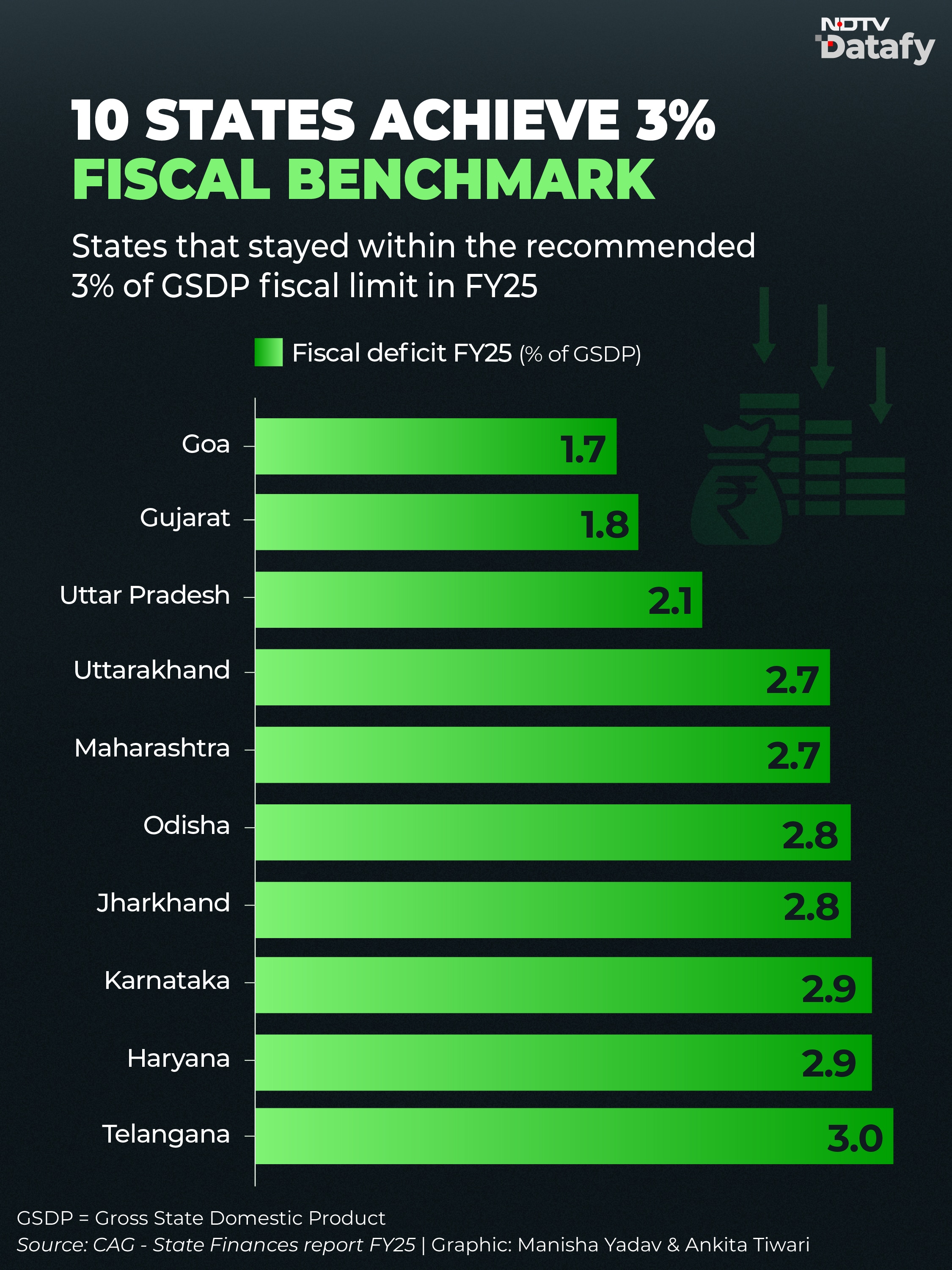
Data from the Comptroller and Auditor General’s (CAG) State Finances 2024-25 report shows that many states continued to depend heavily on borrowing in 2024-25. Only 10 of India’s 28 states managed to keep their fiscal deficit at or below the 3 per cent of Gross State Domestic Product (GSDP) benchmark recommended by the Fifteenth Finance Commission. The remaining 18 states exceeded the limit.
A fiscal deficit is the gap between a government’s total expenditure and its total receipts, excluding borrowings. Simply put, it shows how much money a government needs to borrow to meet its spending commitments.
Among the states that stayed within the 3 per cent limit were Uttar Pradesh, Gujarat, Goa, Maharashtra, Odisha, Jharkhand, Karnataka, Haryana, Uttarakhand and Telangana. Goa recorded the lowest fiscal deficit at 1.7 per cent of GSDP, followed by Gujarat at 1.8 per cent and Uttar Pradesh at 2.1 per cent.
In contrast, several states reported much larger fiscal deficits. Meghalaya recorded the highest fiscal deficit at 8.7 per cent of GSDP, followed by Nagaland (6.1 per cent), Sikkim (5.6 per cent), Himachal Pradesh (5.4 per cent) and Mizoram (5.3 per cent). Andhra Pradesh and Punjab also reported fiscal deficits above 4.5 per cent of GSDP.
The report also points to differences in how states manage their day-to-day finances. Revenue balance measures whether a state’s regular income is enough to cover routine expenses such as salaries, pensions, subsidies and administrative costs.
Whereas 13 states recorded a revenue surplus in 2024-25, meaning their revenue receipts were higher than their revenue expenditure. Arunachal Pradesh recorded the highest revenue surplus at 19.4 per cent of GSDP. Other states with revenue surpluses included Goa, Odisha, Uttar Pradesh, Tripura, Nagaland, Jharkhand and Gujarat.
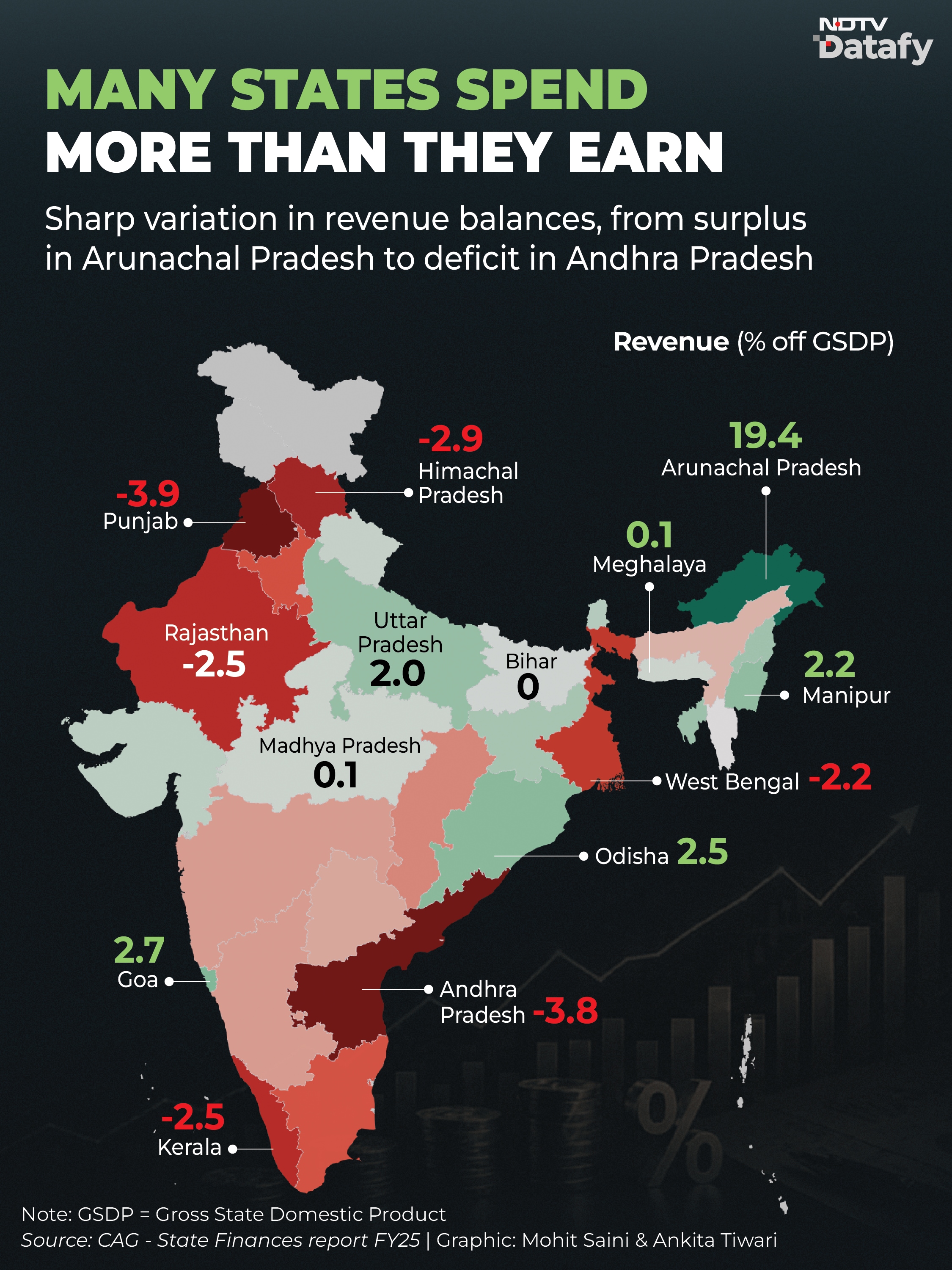
At the same time, 15 states ended the year with a revenue deficit, indicating that their routine spending exceeded their regular income. Punjab recorded a revenue deficit of 3.9 per cent of GSDP, followed by Andhra Pradesh at 3.8 per cent. Himachal Pradesh, Kerala, Rajasthan and West Bengal also reported sizeable revenue deficits.
The numbers show that revenue surplus and fiscal deficit do not always move together. A state can earn enough to cover its routine expenses and still borrow heavily for infrastructure and development projects. Uttar Pradesh, Odisha and Gujarat are examples of states that recorded revenue surpluses but continued to post fiscal deficits.
The data shows borrowing remains an important part of state finances. While some states have managed to keep deficits under control, a majority continue to spend beyond the recommended fiscal limits. As governments face demands for infrastructure, welfare spending and public services, balancing development needs with fiscal discipline is likely to remain a key challenge in the years ahead.



