


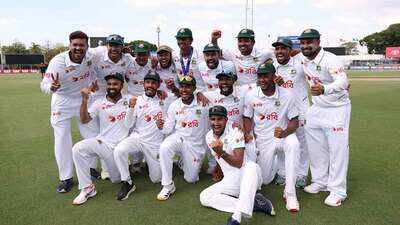
Days before the Darwin Test against Bangladesh, Australia captain Pat Cummins had said in a podcast: “Some of our guys are saying no to half-a-million pounds for 20 days’ work to go and play those two Test matches against Bangladesh. I think it is a tension point. At the moment our guys are so keen to play for Australia that they’re happy to forgo that, but I don’t think we can accept that that is going to be the case forever.’”Cummins, the proud face of arguably the best fast-bowling attack in Tests today, was only reminding us aloud how the dynamics of world cricket have drastically changed over the last decade. But, it was Bangladesh cricket that quietly chose to go the other way during that period, a move that ironically culminated in mowing down Cummins’ powerhouse Test team on their own soil on Sunday.In doing so, six months after forfeiting their T20 World Cup place due to diplomatic reasons, they have made this World Test Championship cycle the most exciting one since its inception in 2019.Bangladesh’s pace resources have now become the talk of the cricket town. They had shown their potential in demolishing Pakistan — both at home and away in last two years.The Test win in Darwin is the realisation of the talent and the immaculate process focusing on Test cricket put in place by the Bangladesh Cricket Board (BCB).“Even (as recently as) fivesix years ago, pacers didn’t want to play Test cricket. They were happy playing just whiteball cricket. The BCB decided to incentivise Test cricket. Special contracts were drawn where the pacers could make a fancy living by playing Tests,” former Bangladesh captain and current chief selector Habibul Bashar, who led the team when Bangladesh beat Australia in an ODI for the first time in 2005, told TOI from Darwin.BCB changed the match fee and contract structure in 2019. Till then, ODI players were the best paid which resulted in fast bowlers backing out of Test cricket.The board decided to rework the contracts in a way that saw Test players become the highest paid cricketers in the country. The fee for a Test match has been doubled from 4 lakh Bangladeshi Taka to 8 lakh Bangladeshi Taka.“Now, our fast bowlers preserve themselves for Test cricket. They don’t run after contracts in T20 leagues. If a T20 league contract comes, the BCB assesses if the player can be released,” said Bashar.Now, Bangladesh have a battery of pacers who come from humble backgrounds. Tearaway quick Nahid Rana comes from a remote village in Rajshahi close to the India border and Hasan Mahmud is from Lakshmipur in Chittagong while Ebadot Hossain and Tanzim Shakib are from Sylhet.The word in Bangladesh cricket is that they don’t want bowlers going the Mustafizur Rahman way who didn’t prioritise Test cricket for playing in T20 leagues.
Changing pitches in domestic cricket
The trigger point in the pace revolution came in 2014-15.Over the last decade, former Bangladesh captain Akram Khan, Bashar and Minhajul Abedin got working on domestic cricket in various capacities like chief selector, head of cricket operations and BCB director.“The domestic pitches used to be bare and spinner-friendly. The teams would play three spinners and one pacer. We worked on the grounds and decided to make it a rule of having at least 6-mm grass on the pitches.“We also made it compulsory for teams to play three pacers in first-class matches. It encouraged these bowlers from the outskirts to bowl fast. When the pitches became pacer-friendly, teams organically started picking more pacers,” Bashar said.
Hiring legends as fast bowling coaches
Bangladesh cricket’s primary pipeline is U-19 cricket. When fast bowlers are spotted at that level, the board takes over their journey.However, a big point in Bangladesh’s pace-bowling revolution has been hiring big international bowlers as fast bowling coaches.“We brought in Courtney Walsh, Heath Streak and Allan Donald as fast bowling coaches. Their presence with the national team made a huge difference.“At the same time, we encouraged domestic coaches to spend time with them too. That knowledge passed on and helped in shaping raw fast bowlers,” Bashar claimed, subtly highlighting their ecosystem’s unique thinking that is creating a reverse revolution in cricket.


