


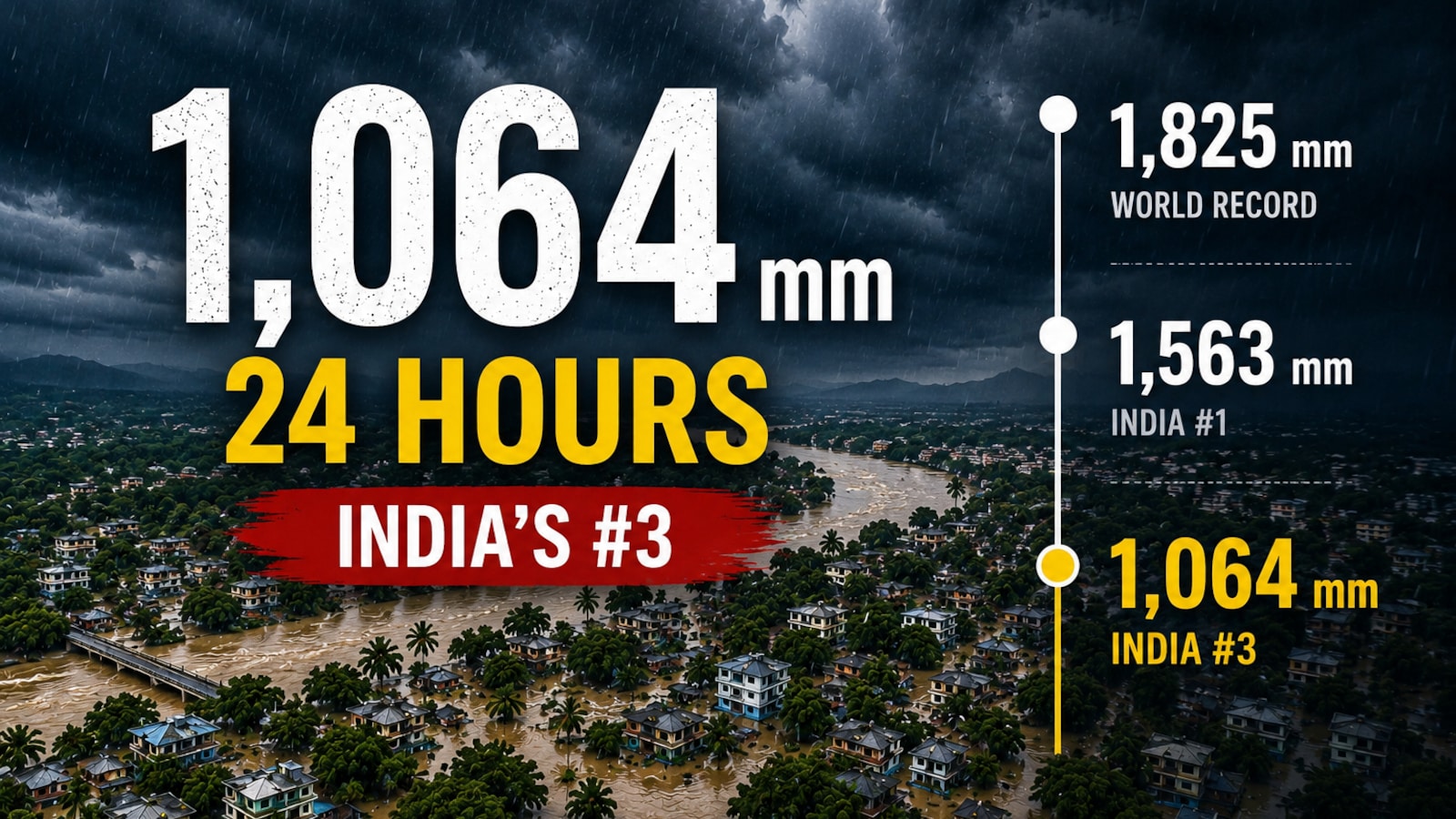
Umargam in Gujarat’s Valsad district has entered the record books after receiving 1,064 mm (106.4 cm) of rainfall in just 24 hours ending 8:30 am on July 23. The rainfall, which triggered widespread flooding and disrupted normal life across the district, is now the third-highest 24-hour rainfall ever recorded in India.
More than one metre of rain fell over Umargam in just 24 hours – an amount greater than the average annual rainfall recorded in many Indian cities.
Where Does Umargam Rank In India?
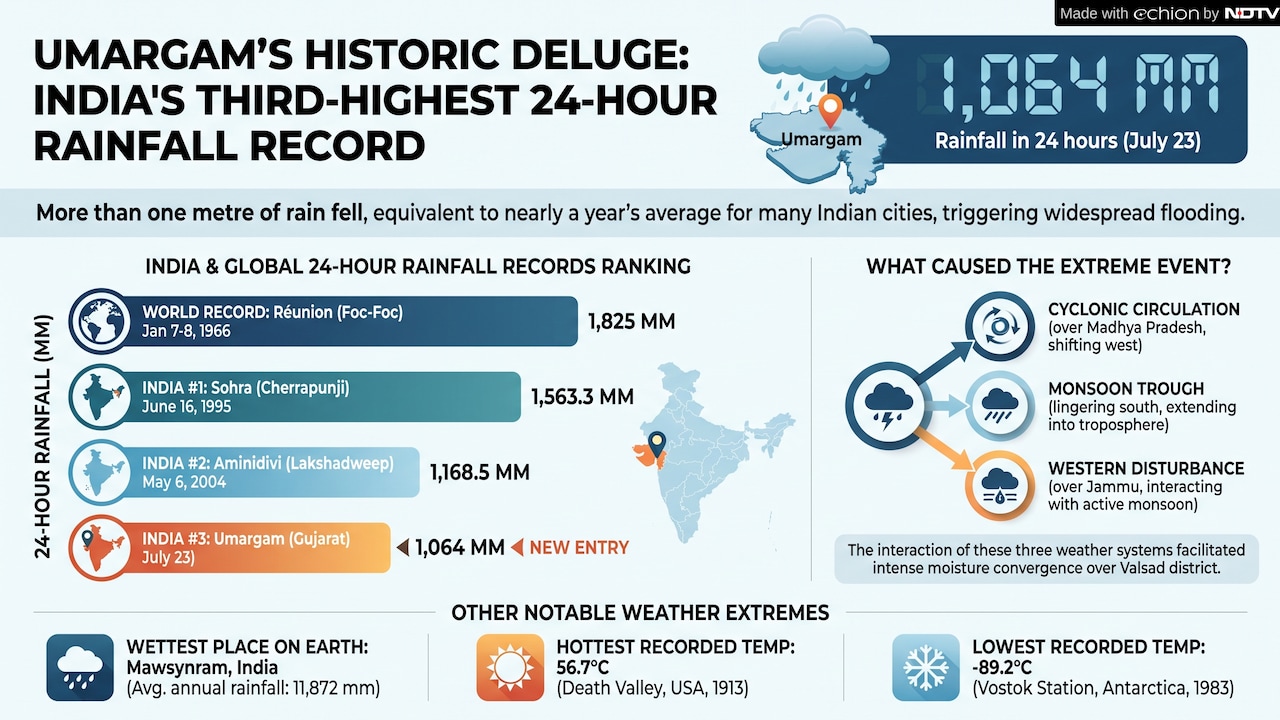
With 1,064 mm of rain in a single day—equivalent to nearly a year’s rainfall in many Indian cities – Umargam now holds the third-highest 24-hour rainfall record in India, according to IMD and historical rainfall records. The highest 24-hour total was recorded at Sohra (Cherrapunji), Meghalaya, which received 1,563.3 mm on June 16, 1995. The second-highest was recorded at Aminidivi in Lakshadweep, where 1,168.5 mm fell on May 6, 2004.
Here’s how Umargam’s rainfall compares with India’s biggest cloudbursts and the global 24-hour rainfall record.
| Rank | Location | Rainfall (24 hours) |
| World Record | Foc-Foc, Réunion | 1,825 mm |
| India #1 | Sohra (Meghalaya) | 1,563.3 mm |
| India #2 | Aminidivi (Lakshadweep) | 1,168.5 mm |
| India #3 | Umargam (Gujarat) | 1,064 mm |
While Umargam now ranks among India’s most extreme rainfall events, it still falls short of several global weather records recognised by the World Meteorological Organization (WMO).
How Umargam Compares With Global Rainfall Records
-
Highest 24-Hour And 12-Hour Rainfall Records In The World
According to the WMO, the highest 24-hour rainfall ever recorded anywhere in the world was 1,825 mm, measured at Foc-Foc on the French island of Reunion in the Indian Ocean between January 7 and 8, 1966. The extraordinary rainfall occurred during the passage of Tropical Cyclone Denise.
During the same event, Foc-Foc also recorded the highest 12-hour rainfall ever observed, with 1,144 mm falling between January 7 and 8, 1966.
-
Highest One-Minute And One-Hour Rainfall Records In The World
The highest one-minute rainfall recorded was 31.2 mm at Unionville, Maryland, USA, on July 4, 1956, while the highest 60-minute rainfall was 305 mm at Holt, Missouri, USA, on June 22, 1947.
-
Highest 72-Hour And 96-Hour Rainfall Records In The World
For longer-duration rainfall, Cratère Commerson on Réunion holds the global records for both 72-hour and 96-hour rainfall, receiving 3.93 metres (3,930 mm) between February 24 and 26, 2007, and 4.936 metres (4,936 mm) between February 24 and 27, 2007, respectively.
-
Highest 48-Hour And 12-Month Period Rainfall Records In The World
Meanwhile, Cherrapunji in Meghalaya holds the world record for the highest 48-hour rainfall, with 2,493 mm recorded between June 15 and 16, 1995. The town also holds the record for the highest rainfall over a 12-month period, receiving 26.47 metres (26,470 mm) between August 1860 and July 1861.
Mawsynram in Meghalaya, India, is recognised by Guinness World Records as the wettest place on Earth, receiving an average annual rainfall of 11,872 mm (467.4 inches). The exceptional rainfall is caused by moisture-laden southwest monsoon winds rising over the Khasi Hills, triggering intense orographic precipitation.
Let’s also look at other fascinating weather extremes.
According to the WMO, the world’s longest recorded dry spell, which lasted 172 months, from October 1903 to January 1918, took place in Arica, Chile, one of the driest places on Earth.
-
Hottest And Lowest Temperature Ever Recorded
Among temperature records, the highest air temperature ever officially recorded was 56.7°C at Furnace Creek in Death Valley, California, on July 10, 1913. On the other hand, the lowest recorded temperature was -89.2°C at Vostok Station in Antarctica on July 21, 1983.
Tropical Cyclone Freddy, which lasted 36 days between February and March 2023, is the longest-lasting tropical cyclone ever. The storm travelled across the Indian Ocean from the coast of northwestern Australia to southern Africa, causing widespread damage and significant economic losses.
What Caused The Exceptionally Heavy Rainfall In Umargam, Valsad?
The IMD attributed the extreme rainfall over south Gujarat to the interaction of three weather systems. An upper-air cyclonic circulation over central Madhya Pradesh gradually shifted westwards towards southeast Rajasthan and adjoining southwest Madhya Pradesh.
At the same time, the monsoon trough lingered south of its typical position and extended into the middle troposphere, facilitating intense moisture convergence. Adding to this, a western disturbance over Jammu and adjoining areas interacted with the active monsoon system, resulting in exceptionally heavy rainfall over Valsad district.
Conclusion
While Umargam’s rainfall fell short of the world record set in Réunion Island in 1966, it now ranks among the most extreme rainfall events ever documented in India. The event also highlights how active monsoon systems, aided by favourable atmospheric conditions, can produce rainfall totals comparable to some of the world’s most intense weather episodes.
Essential Business Intelligence,
Sharp Market Insights,
Practical Personal Finance Advice, Daily Fuel, Gold and Silver Prices and Latest Stories — On NDTV Profit.



