


There have been many reports of long queues at European airports since the EU’s new biometric data system was introduced, and travel industry leaders are worried it will only get worse in the peak summer months.
The new EU entry-exit system (EES) was rolled out in April, requiring passengers to give biometric information such as fingerprints and facial images upon first entry into the Schengen Area.
The Airports Council International (ACI), which represents 600 airports, says that wait times at border control have reached up to five hours in some cases since the EES rollout, creating “unsustainable pressure” for staff.
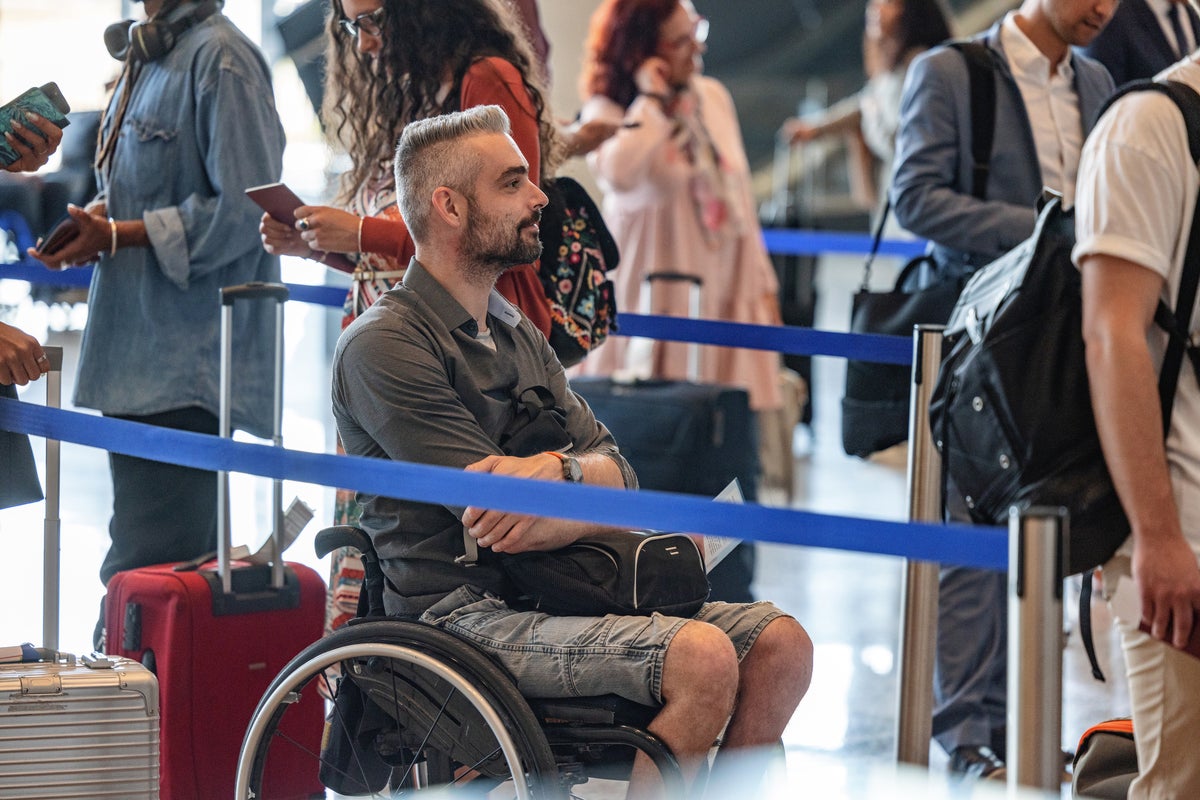
While these new border challenges are disruptive for many UK travellers, long queues and delays can pose specific issues for those travelling with a visible or non-visible disability, as well as those who are injured or are older.
Do you have a visible or non-visible disability, have reduced mobility or have an injury and have passed through EES recently and want to share your experience with The Independent for publication? Whether it’s positive or negative, let us know at amelia.neath@independent.co.uk
What to know if you have a disability or reduced mobility
The Independent has contacted the five busiest airports within the Schengen Zone (Paris, Amsterdam, Madrid, Frankfurt and Barcelona) to see what advice they give and what they offer to passengers with disabilities. We have also rigorously checked EU documents to see what guidance is being given to border staff on how they should be operate EES in a non-discriminatory way.
While Paris’ Charles de Gaulle and Frankfurt airports are yet to respond, the Spanish airport group Aena and Amsterdam’s Schiphol airport gave us a good sense of how airports are pairing EES with their current accessibility assistance.
Schiphol airport says that passengers can make use of staff assistance when it is needed, and will need to opt for this for arrivals, departures or transfers when booking their flight ticket.
The airport said that everyone will follow the EES process via kiosks or desks, but assistance staff will be able to personally guide and support people with reduced mobility via dedicated facilities “to speed up the process or provide tailored support”.
Schiphol Airport has done this by adding EES kiosks into their assistance lounges, as well as adding a dedicated “reduced mobility” lane and desk at border crossings.
Those who are travelling on transfer caddies in the airport will also be sent through a dedicated passage with EES processing without needing to step off.
The Royal Netherlands Marechaussee, which is the force responsible for border control in the country, said in the case that EES self-service registration machines cannot be used, “one of our officers will manually register the required passport details, fingerprints, and facial images at the border control booths”.
Similar to Schiphol, the Spanish airport group Aena says at Madrid and Barcelona, they have set up separate queues for families and people with reduced mobility, who can go through manual passport control instead.
What about a non-visbile disability?
There are 340 airports in 70 countries, and 31 airlines worldwide that are involved in the Hidden Disabilities Sunflower network.
These airlines and airports have trained their entire workforce to support individuals with non-visible disabilities, usually allowing them to also use the separate airport assistance lanes.
You can buy a Sunflower lanyard, ID card and other items on the network’s website. There is no qualifying list of non-visible disabilities; it is open to anyone who wants to indicate that they may need additional support.
Some European airports may have separate schemes for hidden disabilities.
If I have a hand impairment?
EES regulation states that if it is physically impossible to give fingerprints on a kiosk, the passenger will be exempt from the requirement to do so.
If the hand or finger impairment is temporary, this will be recorded in the EES system, and the person will have to submit their fingerprints again when they are able and next passing through the Schengen Area.
“The border authorities shall be entitled to request further clarification on the grounds for the temporary impossibility to give fingerprints,” the EES regulation states.
“Member states shall ensure that appropriate procedures guaranteeing the dignity of the person are in place in the event of difficulties encountered in the capturing of fingerprints.”
Border guards are also advised to postpone biometric enrolment until the person exits the EU in case of temporary injuries, or when biometric data is impossible or difficult to capture due to injuries, disabilities, age or other physical features.
What is being done to make EES accessible?
The EU Agency for Fundamental Rights released guidance last October ahead of the EES rollout to help member states implement the new system in respect of fundamental rights.
It has based this guidance on the official regulation published about EES when it was voted for in 2017.
Staff have been told they must pay particular attention to non-EU nationals with specific needs, such as older people, people with disabilities and children during the EES process, which should “operate in a non-discriminatory manner”.
The FRA has also advised airport managers to offer accessible training at border crossing points, ensure there’s enough room for wheelchairs, and to deploy EES kiosks with adjustable heights and voice assistance.
It also said that front-line officers should be guided on how to capture biometric data in a “dignified and non-discriminatory manner”.
The FRA’s report found that at least one border crossing point at Marseille airport equipped border guards with tablets that enable mobile EES checks. This is something that could help people with reduced mobility.
Border guards have been told to consider using mobile equipment to capture facial images or fingerprints, particularly for non-EU nationals with reduced mobility or those crossing borders by car.
They are being advised by the FRA to stay alert to signs of distress or discomfort and support non-EU nationals with specific needs, such as children, older people and people with disabilities.
They also need to ensure that people with disabilities and those with limited digital skills can access and understand the information.
Additionally, they should offer to collect data more discreetly from travellers who feel uncomfortable with the EES process due to disabilities, religious attire or other reasons.
Read more: EU airport boss blames EES design for long border queues



