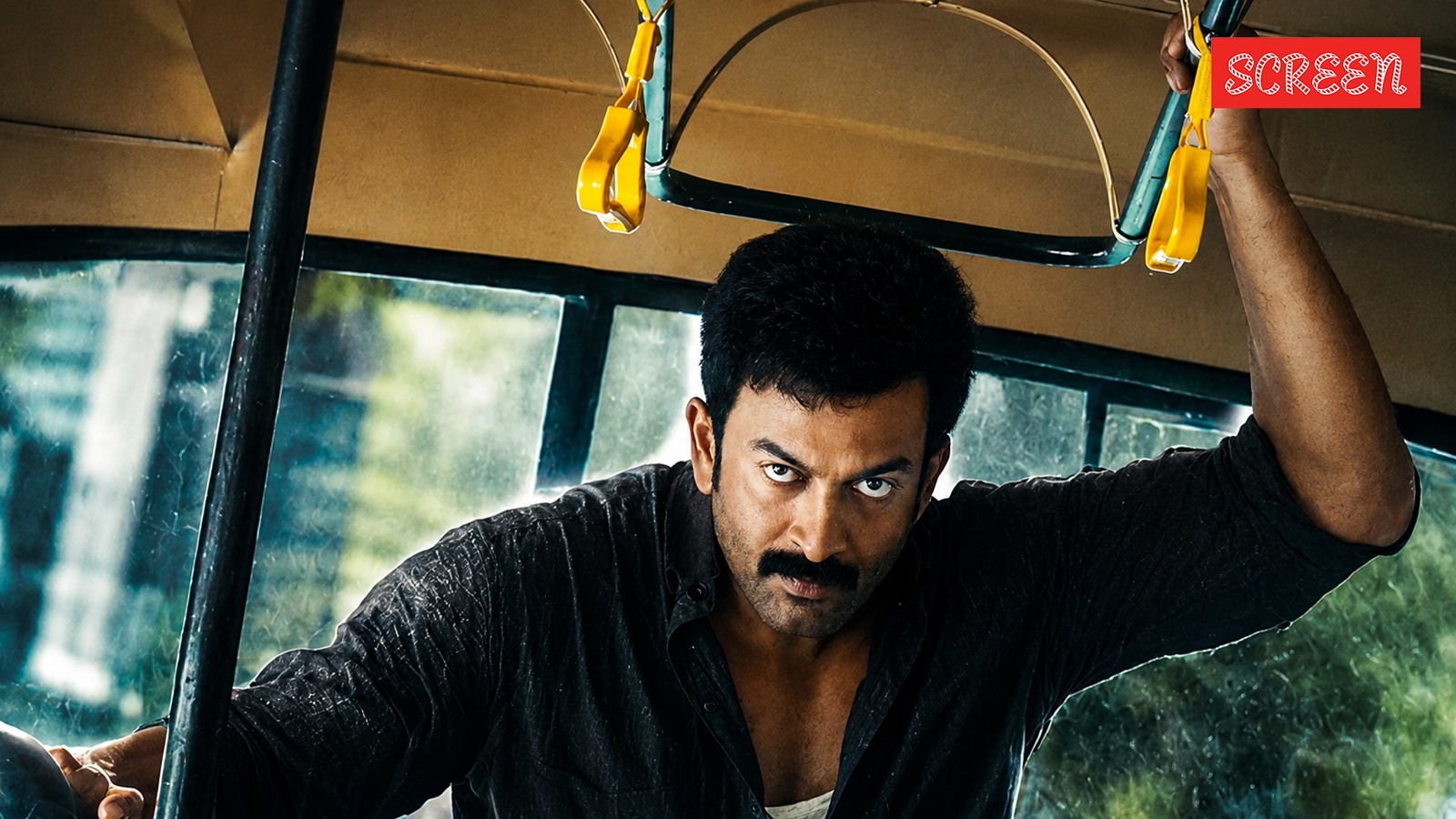
I, Nobody movie review: There is a moment early in I, Nobody where Rajeevan, played by Prithviraj Sukumaran, sits across from a police officer. The officer explains the food chain to him. Grasshopper eats grass; frog eats grasshopper; snake eats frog and eagle eats snake. Simple enough, one might think, but then comes the twist in the analogy: in this society, the grasshopper must also eat the frog. The question is whose heads you are willing to consume to survive? A man is being told, in the plainest words, that the world he thought he lived in does not work the way he believed it did.
That one scene tells you everything about what kind of a film Nissam Basheer has made. This is not a movie interested in holding your hand. It assumes you are paying attention, and it rewards you in a scene or two.

The story follows Rajeevan, a government employee living the kind of life nobody writes about. He has a wife, Meera, two children, and a desk job that keeps the lights on. Nothing about his existence invites attention. That changes when he witnesses something he wasn’t supposed to see. From that point, he is pulled into the orbit of a serious crime, branded a troublemaker by the system, and left to fight his way out of a situation he does not fully understand. The people and institutions he trusted begin to turn on him, and the question that drives the film is whether Rajeevan can survive when nobody believes him.
It is a solid setup, and for the first act, the film lays its groundwork well. You buy into Rajeevan’s world because the screenplay by Sameer Abdul takes the time to make it feel real. But taking time is one thing, taking too much is another.
Prithviraj blends into the character with restraint, and there is something commendable about the choice. He does not walk into the film like a star. He lets the character be small, confused and scared. But the problem is that the restraint rarely shifts gears. Rajeevan reacts to most situations with the same worried expression, and after a point, you stop seeing a layered performance and start seeing a man who looks the same in the first half as he does in the second. The internal progression that should mark his journey from an ordinary man into someone fighting for survival isn’t visible. There are flashes of it in a few scenes, but they are not enough to carry a film.
Parvathy, as Meera, brings her usual conviction to the role. Her character is a mother first and a wife second, and she makes that priority feel genuine. There is a scene where she is told, in front of Rajeevan, that her husband is a criminal. The way she processes that information, without dramatics, without a breakdown, is probably the best piece of acting in the entire film. But the screenplay does not build on that moment — Meera’s arc peaks early and then plateaus. For a reunion that audiences have waited for years, Prithviraj and Parvathy are given surprisingly few scenes that let their chemistry breathe. They share space, but the writing keeps them at arm’s length from each other for most of the runtime, and the emotional payoff suffers for it.
Also Read: Amid Satluj row, CBFC member on how films are certified: ‘No anti-national themes’
Story continues below this ad
On the technical side, there are clear positives. Dinesh Purushothaman’s cinematography has a few genuinely striking compositions. He builds atmosphere through framing and colour, and in the best sequences, the visuals do the heavy lifting that the script cannot. Nixon George’s sound design adds genuine tension to several moments. The action choreography by Yannick Ben, Kalai Kingson and Amith Jolly Bastin is grounded but feels too much. Jakes Bejoy’s score is functional but does not leave a lasting impression.
The biggest issue, and it is the one that drags the film down, is pacing. At close to two hours and forty minutes, I, Nobody needed to earn every minute of its runtime. The second act sags; scenes are held longer than they need to. Information that could have been delivered in one exchange is spread across two or three. The mystery at the centre of the film is stretched thin, and when the reveal finally comes, it doesn’t land with the force the buildup promised. You spend a long time being told that something is coming, and when it arrives, the reaction is closer to “that’s it?” than the gut punch the film is clearly going for.
Also Read: Jana Nayagan release update: Distributors informed about July 24 release window
The bank heist element, which should have been the film’s biggest draw, is oddly undercooked. The mechanics of the job, the planning, the tension of execution, are not given the attention they deserve. The heist feels more like a backdrop to Rajeevan’s personal crisis than a fully realised set piece. Malayalam cinema has rarely explored this genre at scale, and it is disappointing that I, Nobody does not take fuller advantage of the opportunity. The film also points to socio-political themes about power and the way system crushes the powerless, but it never commits to those ideas strongly enough for them to register as anything more than subtext.
Story continues below this ad
As I say this, I, Nobody is not a bad film. The craft is visible, and there are enough individual moments that work to suggest a better version of this story was possible. But the combination of a sluggish middle act, underwritten characters and a central mystery that does not justify its own length makes it a frustrating watch. Basheer has the skills to make a great thriller. He proved that with Rorschach. Walk in with tempered expectations and you may find things to appreciate. Walk in expecting the next Rorschach, and you will leave disappointed.