


For years, my father’s prescription for my frantic life was simple, repetitive, and entirely ignored: take up yoga to calm the mind. Like most sons navigating the quiet persistence of parental wisdom, I treated it as background noise. Yoga, in my mind, belonged to the realm of slow mornings and lifestyle choices, not the high-octane world of a sports journalist.
By June 2, a calm mind was the last thing on my agenda anyway. I was still carrying the heavy, bone-deep exhaustion of a frantic IPL 2026 season, desperately looking for a brief window to breathe before the FIFA World Cup 2026 demanded my full attention. The plan was merely to recharge the batteries. No other sport was on my radar.
Then the organisers of the World Yogasana Championship called.
My initial instinct was to treat it as a clinical, desk-bound exercise: write a brief explainer to introduce the sport to our readers, and move on. When Yogasana Bharat chief Udit Sheth kindly invited me to Ahmedabad to cover it live, I politely declined, citing the brutal calendar ahead.
But newsrooms have a way of disrupting quiet plans. On June 3, my team lead quietly nudged me toward the tournament—the exact same way he had pushed me toward the Hockey Asia Cup in Rajgir the previous year. Having just survived his own IPL grind, his briefing on Ahmedabad was short and ominous: “It’s absolutely hot out there.”
He had omitted a similar warning about Rajgir, which had turned out to be a natural sauna in its own right, leaving me to wonder if he was secretly moonlighting as an Ironman coach testing my physical endurance. Jokes aside, I trusted his news sense. Within hours, the tickets were booked.
Before I left, he left me with one piece of parting advice: When looking for a feature, keep an open mind.
That is easier said than done when approaching a discipline still fighting for its identity in a crowded sporting landscape. But as I walked into the arena, I kept an open notebook. On the first page, I instinctively scribbled three words: One breath. One stage. One world.
COVERING YOGASANA
Then, I looked up at the three competition stages, and my father’s vision of a quiet, meditative lifestyle choice evaporated instantly. It took me a moment to quite literally pick my jaw up from the floor.
The question that immediately hijacked my brain was simple: Is the human anatomy actually designed to do that?
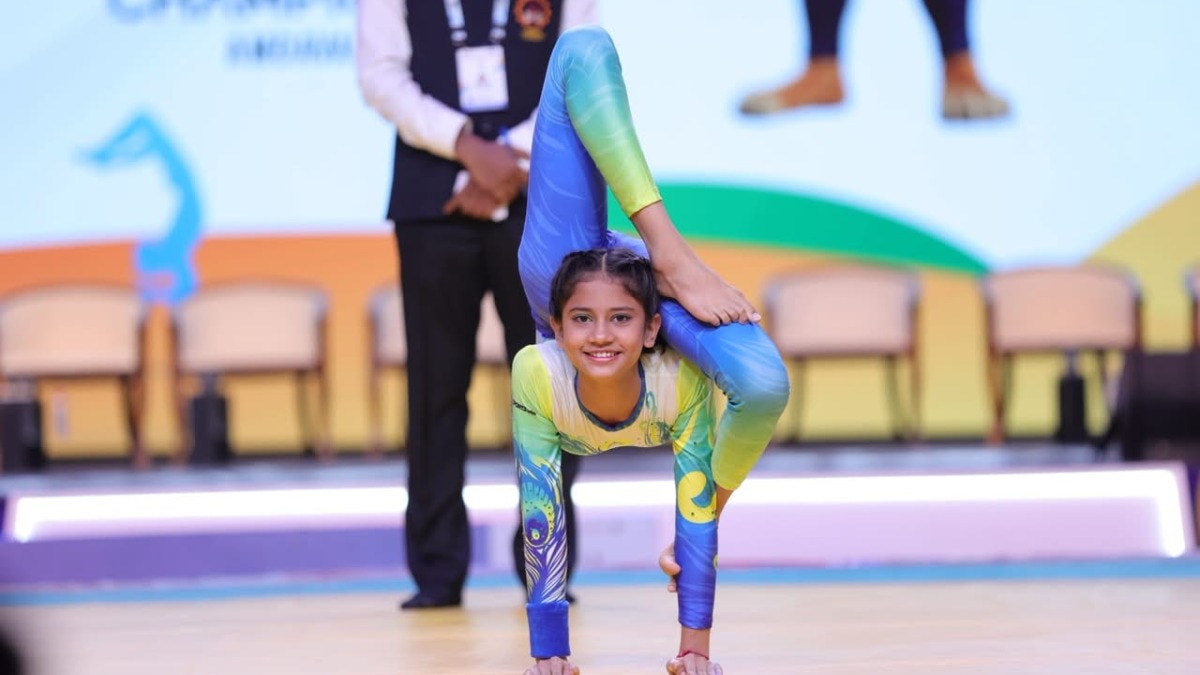
On stage, an Indian athlete was in the middle of arching her back into a flawless, terrifying ‘D’ shape. Her head rested casually on the floor between her legs, while her lower body remained as unyielding as granite. She looked out at the crowd, smiled, raised her arms to complete the posture, and made the impossible look routine. In the press box, I could swear my own lower back cracked in sympathy, my hamstrings tightening at the mere sight of it. This wasn’t a wellness retreat; it was elite, agonizingly precise athleticism.
The sheer scale of the spectacle only added to the vertigo. This wasn’t just a singular exhibition, but a complex matrix of six age categories and a bewildering array of disciplines. There were individual battles in traditional yogasana, leg balance, forward and hand balances, twisting, and artistic solos. Then came the synchronized choreography of the group events—rhythmic pairs, artistic pairs, and full artistic groups.
All around the arena, the expression was uniform. Fans, seasoned journalists, and even the organisers stood suspended in the same state of disbelief, collectively trying to process how the human body could be pushed to such aesthetic extremes.
The atmosphere inside the venue felt less like a competition and more like a community gathering. Athletes spent as much time helping each other as they did competing against one another. That was something many of them explained to me in detail during my first day covering the event.
After recovering my jaw from the floor and putting my glasses back on, I decided to judge the sport myself.
So, along with the three sets of judges, I started observing the athletes closely.
To me, every asana looked perfect and filled with amazement.
The scores told a different story.
What looked flawless from the stands was often viewed differently by judges and even by the athletes themselves.
That was when I developed my own measurement system.
For me, it became all about visual appeal and the ease with which participants executed their routines. Even the slightest vibration in a thigh muscle seemed capable of making the difference between winning a medal and missing out.
That also helped me understand why the electronic scoring system was so important.
More importantly, I noticed that athletes themselves appeared comfortable with the scores being awarded.
THE ISSUES
But once the initial awe settled, some organisational issues began to stand out.
Organising a tournament involving athletes from 78 countries is never easy, so Yogasana Bharat officials can certainly be afforded some slack for a few shortcomings.
However, one of the biggest issues was scheduling.
While competition was officially supposed to begin at 8 am every day, most of the action didn’t get underway until around 10 or 10:30 am on the two days I attended, creating confusion among athletes and officials alike.
Kimani Blake, a member of Team USA and a bronze medallist at the event, was vocal about how the delays affected competitors.
“The only thing is timing with the events. They gave us a schedule with when and where every event would be, but ever since we started, every event has been about 1 to 3 hours behind.”
“Things keep changing very fast and not everybody has the information. Things get very confusing very quickly.”
“As an athlete, you’re trying to warm up your body, trying to organise your eating around when you’re going to do the event. Now you thought you were going to go contort and now you haven’t eaten all day and you’re confused. That part is very stressful and I think that’s one of the main things that needs to be refined,” said Kimani.
Another issue was the condition of the Eka Arena itself.
Using the elevators often felt tougher than performing an asana, as both required immense patience. If you were lucky enough to get hold of one, chances were it would already be packed with athletes and officials travelling between floors.
The overall hygiene of the venue also left room for improvement, with pigeons occasionally providing their own freestyle aerial displays.
Thankfully, none of the events were affected by bird droppings, but it was something that clearly needed to be addressed.
Despite these concerns, the organisers deserve the benefit of the doubt. This was the first World Yogasana Championship and, with experience, many of these issues can be ironed out.
AHMEDABAD THE SPORTING HUB
The debate around Ahmedabad becoming India’s sporting capital has surfaced repeatedly in recent years.
The city’s deep association with cricket has divided opinion, with some feeling the sporting-hub narrative is being pushed a little too aggressively.
The yogasana athletes I spoke to, however, viewed the city positively.
Veronica Vega, the youngest competitor at the World Yogasana Championship, felt Ahmedabad could host even more yoga events in the future.
“When I see the city, I see that like it could host more yoga competitions.”
“Because for how many people are here and how many are watching and how many want to compete and do other stuff in the yoga, it shows that a lot of people want to do it and a lot of people are doing it,” said Vega.
Nabila Sol Barrazza, who won all five of Argentina’s medals at the event, was equally impressed.
“They created a huge event and they provide like five-star accommodation and all the service. So this is a really huge event that is a mark to start and to plan the future to keep growing.”
“For sure, I take a huge positive image for all the countries that are here. Always we talk about that, like it’s incredible how they are so organised, providing everything that we ask for.”
“They are taking care of us in a really nice way. So we are really, really happy, and for sure all this commentary will go around the world when we return to our home,” said Nabila.
Yet the one thing I had been warned about before arriving refused to stay quiet — the heat.
Every time you stepped outside the arena and returned, you felt drained.
Now imagine athletes competing in a Summer Olympics or Paralympics under similar conditions.
At that point, competitors would effectively be battling both the weather and each other.
Ahmedabad also still has work to do when it comes to infrastructure. Those areas will need close attention ahead of the 2030 Commonwealth Games and potentially the 2036 Olympics if India’s bid succeeds.
WHAT’S NEXT?
The biggest question surrounding yogasana remains simple: What’s next? Can it genuinely withstand the test of time and become a sustainable sport?
The organisers certainly believe so. Some even suggested that yogasana could one day rival cricket and football in popularity. That naturally drew a few chuckles inside the press box. Being ambitious is important. Shooting at your own foot is not. So we needed answers, and Udit Sheth was the man providing them.
His approach was measured. His focus was not on Olympic dreams or medal counts but on making the sport appealing to viewers watching at home.
“My mindset is that the sport has to look sexy on television. Finally, if it is viewer friendly, then we are doing something correctly,” said Sheth.
When asked about Olympic ambitions, Udit was equally direct.
“My vision is not to be included because we are a host country. I want to be included on my own standards. Now the Olympics can be anywhere.”
“I want by 2030 to be a demo sport over there and God willing, we have it over here, of course, we want to be included, but want to be there, not like break dance, you know, come into one Olympics and not be there in the other.”
“That’s very important to me,” said Udit.
Even when discussing event management, the Yogasana Bharat chief admitted there was still plenty to learn.
At the end of the championship, India emerged as the overwhelming winners with 80 medals, including 70 gold.
To put that dominance into perspective, Japan finished second in gold medals with just three.
The gap was enormous.
But one thing yogasana cannot afford to do is rest on its laurels.
Sport evolves constantly.
Innovation can quickly change the pecking order.
Take hockey as an example. Before astro turf arrived, India was the team everyone feared. Once the surface changed, countries such as the Netherlands, Germany, Australia and Belgium surged ahead.
Udit acknowledged a similar challenge could emerge in yogasana.
India has already sent close to 80 coaches around the world to help other countries improve.
“Athletes from other countries are winning over here in India. In 2 years, the gap we have will change. As you said, these guys are punching above their weight, right?”
“And I see that, you know, there is a rhythm in the African continent. There is a steel in the South American and Americans, so there is a lot of catch-up that they’ll do in a very short time, right?”
“And that’s where we will have to pick up our training and development also,” said Udit.
This is where I felt academies could become crucial.
One of yogasana’s biggest strengths is accessibility.
All you really need is a mat and a small space. But if India wants to remain the undisputed force in the sport, it will need to identify talent early, nurture it properly and produce world-beaters consistently. That process would also make the sport more attractive to younger generations.
The upcoming Yogasana Super League is another encouraging step, potentially helping push the sport further into the mainstream.
As I made my way back home, my phone rang.
It was my dad.
He wanted to know how the trip had gone. The moment I mentioned yogasana, his curiosity immediately kicked in. He wanted to know about the rules, the scoring system and how the competitions worked. And that’s when it struck me.Maybe that’s exactly why yogasana could find a home in the sporting world.
– Ends



