


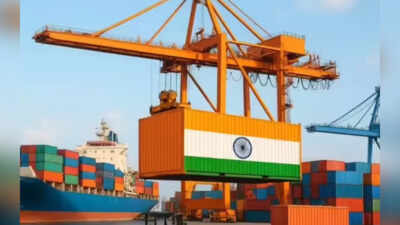
India’s merchandise exports rose 23.04% year-on-year to $44.40 billion in September 2026, up from $36.08 billion a year earlier, according to data released by the Ministry of Commerce and Industry on Thursday.The merchandise trade deficit narrowed to $30.21 billion from $33 billion in September last year, even as imports increased to $74.61 billion from $69.08 billion, the data showed.India’s overall exports, including merchandise and services, grew 10.99% to an estimated $80.75 billion in September, compared with $72.76 billion a year earlier.Overall imports rose to $94.05 billion from $86.93 billion, while the combined trade deficit narrowed to $13.30 billion from $14.17 billion, according to the ministry.
Electronics, engineering goods drive export growth
Commerce secretary Rajesh Agrawal said merchandise shipments were driving the growth in exports.“If you look at merchandise exports in September, they are at $44.40 billion, which is 23.04 per cent higher than last September,” he said during a press briefing, according to news agency ANI.Higher shipments of electronic goods, petroleum products, engineering goods, chemicals and agricultural products supported the increase.Agrawal also said export growth had accelerated in the second quarter of the current financial year. Overall exports grew 15.84% in July-September, compared with 11.84% in the first quarter, he said.According to the ministry’s presentation, India’s overall exports reached an estimated $242.6 billion in the second quarter, compared with $233.6 billion in April-June. The July-September figure was the highest ever recorded for the second quarter.
Imports rise as merchandise trade gap narrows
Merchandise imports increased to $74.61 billion in September from $70.67 billion in August, while exports rose from $43.81 billion to $44.40 billion over the same period, according to government data.The merchandise trade deficit stood at $30.21 billion, marginally below economists’ expectations of $30.4 billion in a Reuters poll. However, it was higher than the $26.86 billion deficit recorded in August.Global energy prices remain a factor in India’s import bill. Brent crude futures have stayed above $100 a barrel amid the Iran war, while attacks around the Strait of Hormuz have increased.Iran has said it is stepping up strikes in response to the US blockade of its ports and tougher sanctions introduced last month.
India looks to expand export markets
India is seeking to diversify its export markets through trade agreements with key partners. A trade deal with New Zealand is set to take effect next week, while India’s trade pact with Britain is already in force. A broader agreement with the European Union is moving towards implementation.The United States remained India’s largest merchandise export destination in the first half of the current financial year, despite tariff-related disruptions.India’s merchandise exports to the US rose 11.1% to $50.81 billion during April-September 2026, compared with $45.73 billion a year earlier.Imports from the US increased 26% to $32.33 billion from $25.66 billion, according to data presented by the commerce ministry.India’s merchandise trade surplus with the US narrowed to $18.48 billion from $20.07 billion in the corresponding period last year.Agrawal said negotiations for the proposed India-US trade agreement were progressing in the right direction, with both sides working towards concluding the deal at the earliest.“The negotiations are in the right direction. Probably, we are in a very good zone. We anticipate closing the deal and signing it at the earliest possible time,” he said.He said the agreement would depend on the finalisation of the broader US tariff framework, with a parallel process underway under Section 301.“The deal has to be signed when the overall tariff structure is getting formalised. There is parallel work being done in the US also to get back the tariff structure based on some of the outcomes of the 301,” he said.Agrawal added that India was seeking preferential access to the US market to help its exporters compete with those from other countries.“When you do a trade deal, it gives you not only market access in each other’s markets; it gives you preferential market access in a particular market,” he said.


