New Delhi:
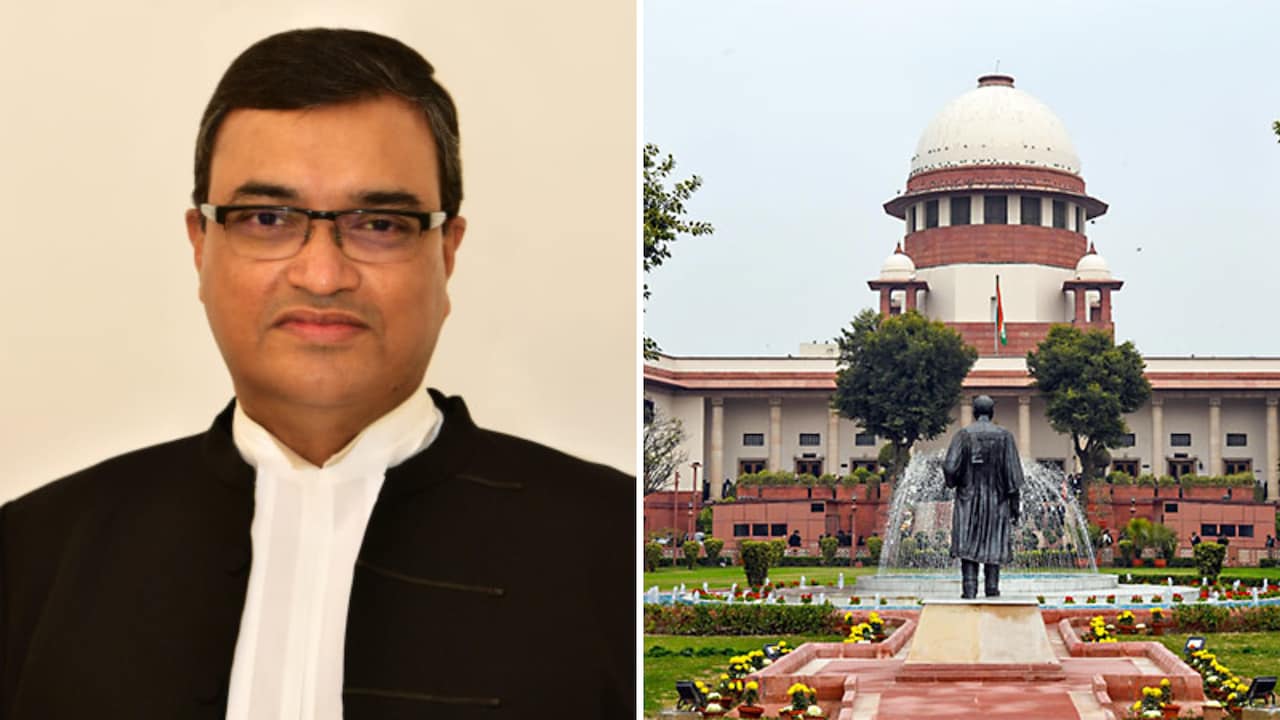
When Justice Dipankar Datta of the Supreme Court on Wednesday raised questions about the method of appointing Election Commissioners, the government lawyer mentioned how judges are appointed. It drew a sharp reaction from the bench. Justice Datta said, “The oft-repeated phrase that ‘judges appoint judges’ is a myth,” and noted that the government is selective in clearing the Collegium proposals on appointments.
Justice Datta made the remarks while addressing the submission by Solicitor General Tushar Mehta during the hearing of petitions challenging the 2023 law that gives more say to the government in appointments to the Election Commission of India (ECI). Petitions against the law raised concerns about the PM and a minister nominated by the PM effectively getting a 2:1 majority against the Leader of Opposition, who is the third member of the selection panel.
The central government sought to counter this by saying that even in judicial appointments, existing judges have a predominant say in picking future judges under the Collegium system. Justice Datta took exception to this argument. He underscored that even under the Collegium system, there is a consultative process at play between the government and the judiciary before judges are appointed.
Busting The “Myth”
“The oft-repeated phrase that ‘judges appoint judges’ is a myth, which people have been fed by vested interests through motivated narratives, often drawing sustenance from certain controversial decisions taken in this century in relation to the appointment of judges,” he said. “A sweeping generalisation that the Collegium acts as a law unto itself overlooks the detailed consultative process envisaged under the Constitution and the intrinsic role of the executive, both at the Centre and in the States, as well as intelligence and other agencies in the appointment process, including vetting of credentials, and the fact that every appointment bears the imprimatur of the President,” he added.
Justice Datta went on to lament that it has become “fashionable” to overlook this. “The uninitiated and the unversed unknowingly have thus been made to believe that the Collegium of the Supreme Court and the Collegia of the High Courts comprise of judges who appoint judges, and it has become fashionable nowadays to blame the collegium for every infelicitous choice, conveniently forgetting that aberrations are exceptions and not the norm, and that no system can guarantee infallibility of human choice,” he added.
He criticised the selective manner in which the central government clears Collegium proposals at times. He added that the judiciary often chooses not to confront the executive on such matters to avoid “head-on” conflicts and avert a possible Constitutional crisis.
Government “Selective” In Implementation
“What is most worrying and needs attention for a remedy is that the sanctity of a Collegium resolution is lost each time the executive implements it selectively, albeit approving the majority of those recommended while withholding at least one. Undeterred by such piecemeal approvals and regardless of the fate of those not cleared by the executive, the Collegium chooses to proceed, seemingly to avoid a head-on conflict with the executive, and [is] left with the Hobson’s choice to keep the institution running. What it thereby averts, arguably, is a constitutional crisis,” he further said.
He then questioned how long such a conflicting interplay be permitted. “The larger question which looms is: how long can this state of affairs continue if such selective implementation is allowed to acquire the character of an accepted practice?”
He also invoked BR Ambedkar, who led the Constitution draft panel. “Dr Ambedkar’s vision was that the judiciary must both be independent of the executive and be competent in itself. However, given the present situation, that vision appears blurred and under serious strain,” he observed.
He rejected the central government’s argument about the Collegium as a possible way to justify the selection panel proposed under the 2023 law for election commissioners’ appointment.
“This court is left to wonder why, even after the judiciary has been relegated to playing second fiddle to the executive in the matter of appointment of judges, is there still a clamour to induct an outsider at the stage of selection (of election commissioners)?” he said.
He added, “Coming as it does from the side of the executive, the argument ill-behoves its stature and is a feeble attempt to deflect attention from its own dereliction and failure. Since it is the executive that wields decisive control and holds the reins over the appointments of judges at every stratum, the response of the defenders for sustaining the impugned legislation by seeking to draw a parallel with the collegium system of not having an outsider is rather disingenuous, evasive and discouraging.”
The judge also expressed hope that the Collegium in future is able to recommend ideal judges, leaving little room for any criticism of the system’s working. “At the same time, this court expresses hope and trust that henceforth only judicious and apposite choices shall be made by the present collegium under the able leadership of the CJI, giving little room for future criticism of the system’s working,” he observed.
Row Over Poll Body Appointments
The observations were part of Justice Datta’s ruling on the question of whether petitions challenging the Chief Election Commissioner and Other Election Commissioners (Appointment, Conditions of Service and Term of Office) Act, 2023, need to be referred to a larger Bench.
The 2023 law created a three-member Selection Committee for appointing the Chief Election Commissioner (CEC) and other Election Commissioners. Notably, while the earlier selection mechanism required consultation with the Chief Justice of India (CJI), the selection panel laid down under the 2023 law did not include the CJI. Instead, a Union Cabinet Minister was made part of the panel, with the remaining two members being the Prime Minister and the Leader of the Opposition.
The petitioners before the Court had raised concerns that such a selection process could compromise the independence of the ECI. The Union government had earlier requested the Court to refer the matter to a larger Bench under Article 145(3) of the Constitution.
A Division Bench of Justices Datta and Satish Chandra Sharma delivered a split verdict on this aspect. Justice Datta rejected the government’s request for the larger bench reference and gave a prima facie opinion. Justice Sharma disagreed with the observations made by Justice Datta and said that a substantial question of law was involved in the matter, which must be decided by a larger bench.