


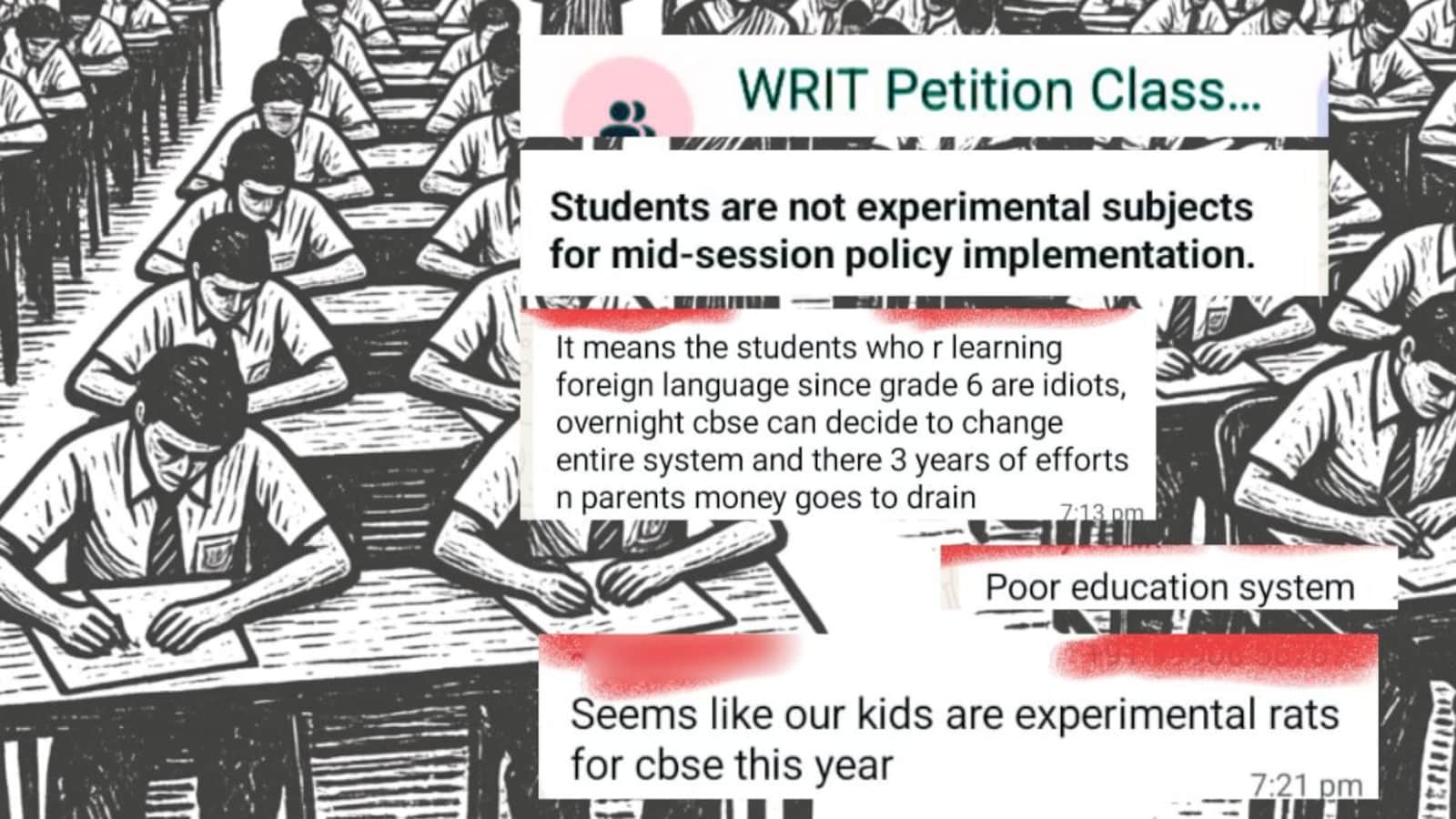
“Seems our kids are experimental rats for CBSE this year“, wrote an angry parent of a Class 9 student on a WhatsApp group of parents of students of a prominent Noida school.
“It means students who were learning a foreign language since grade 6 are idiots. Overnight, the CBSE can decide to change the entire system and their three years of effort and parents’ money goes to drain,” she added a little later.
“They (CBSE) expect kids to learn Hindi and Sanskrit now?” another mother pitched in, as the anxious parents vented out their anger.
“This is all ad hoc. How will the schools implement it?” asked another.
“CBSE, every 2-3 years comes up with something totally immature. Change is important, but not at the expense of burdening the child,” share another parent.
WhatsApp groups of parents of Class 9 students are brimming with anger, anxiety and confusion.
Reason: CBSE’s sudden bombshell on the three-language policy for class 9 students.
So, What Happened?
On April 9, 2026, the Central Board of Secondary Education (CBSE) clearly stated that the three-language policy would not apply to Class 9 students until the 2029-30 academic session. It was to be implemented from grade 6 this year. Schools and parents worked around that. Students and parents made their language choices.
Cut to May 15. The board made an abrupt U-turn and stated that the new 3-language policy would apply to class 9 students and the change will be implemented from July 1 i.e. in six weeks. This mandate has triggered panic among parents, students and schools alike.
Advertisement – Scroll to continue
What Is The 3-Language Policy?
The new policy for Class 9 mandates that students must study three languages (R1, R2, and R3), with at least two being native Indian languages. Students study three languages. The first two are usually English and a regional Indian language (or Hindi). A foreign language (like French or German) can only be opted for as the third language, provided the other two are native Indian languages. Since most CBSE schools are English-medium institutions, English automatically becomes one compulsory choice, leaving little room for foreign languages such as German or French within the core three-language combination. CBSE says that French, German or Spanish can be taken as an extra fourth subject.
There will be no CBSE Board examination for the third language (R3) in Class 10. All assessments for R3 are school-based and internal, though the grades will still be reflected on the student’s CBSE certificate.
CBSE says the change is in line with the National Education Policy, 2020 and the National Curriculum Framework for School Education (NCF-SE) 2023.
Why Are Parents And Teachers Angry, Confused?
Students who are today in Class 9 made their language choices three years ago in Class 6. They have spent 3 years learning a language and have gained certain proficiency and liking for it. Most have continued with the same language in Class 9. Now, the CBSE tells them, their choice, which was as per the board’s rules then, no longer holds. Now, they have to study two Indian languages compulsorily. So, the board expects a child in Class 9 to forget the language of choice after investing three years on it and start learning two Indian languages. Why? Because some babus decided so.
Class 9 is the preparatory year before the boards that these children will face the next year in Class 10. The pressure and expectation of schools, parents are already high. Students are already navigating extended syllabus, subjects, study patterns and time management. Now, this CBSE atrocity. And this CBSE move has come at a time, when it has still not been able to provide all textbooks to class 9 students even after a month into the session.
Are The Schools Prepared?
Pratima Maiti, who has 45 years of experience as a school teacher, told NDTV that the CBSE’s decision is “poorly timed and top-down”. “Class 9 is already a foundation year for Class 10 Board prep. Forcing a third language now disrupts academic focus, especially when many students have just stabilized after post-pandemic learning gaps. It feels like policy compliance being prioritized over student learning outcomes,” she noted with concern.
So apart from pressure on students, what are the practical difficulties schools will face in implementing it?
“There aren’t enough trained teachers for Sanskrit and other regional languages in Tier-2/Tier-3 cities. Schools will have to hire ad-hoc or outsource impacting the quality of education,” Ms Maiti said.
“With Science, Maths, Social Studies, and two core languages already, adding a third language means either 8+ periods/day or cutting labs, sports, arts. Schools can’t expand the day legally beyond set hours.”
Multilingualism Welcome, Adhocism Is Not
Ms Maiti says that learning a regional language enables kids to understand local dynamics better and mingle better with the society. But making them learn at an advanced stage (Class 9) suddenly puts a lot of pressure. This could have been gradually phased in.
In North India specifically where predominantly only one language, Hindi, is spoken, options for R3 become severely limited. This sudden change would push school to reposition teachers and pressurize inexperienced teachers to teach languages such as Sanskrit, Bengali, Assamese etc.
Additional Pressure On Students?
“Yes, directly,” said a teacher at a prominent Delhi school. “Class 9 students are 14-15 yrs old, dealing with subject streaming, career anxiety, and board preps. Adding a new language with grammar, literature, and board weightage increases rote load, homework time, and exam stress.”
“Multilingualism sounds good in theory, but for a child already juggling 6-7 subjects, it becomes burnout,” added Ms Maiti.
The real negative impact: Many CBSE schools introduced French/German/Spanish from Class 6 as an elective. If schools are now forced to add a 2nd Indian language like Sanskrit to meet compliance, they will have to drop French/German/Spanish to make room, which disrupts students who’ve studied it for three years.
“The policy has good intent but ignores ground reality – teacher availability, time in a school day, and student mental load in Class 9. Without funding, training, and flexibility, it risks becoming another checkbox exercise that hurts the students it’s meant to help,” said another Noida school teacher.
As a Class 9 student’s mother shared on a WhatsApp group: “We moved from Gurugram to Bangaluru this academic year. My son was studying French in Gurugram school. Now, with the three-language rule, he will have to learn Kannada from scratch. This is creating unnecessary burden on him during a crucial phase of his studies”.
Reform Or Harakiri?
Any policy is as good as its implementation. Given the sudden change, the confusion and anxiety among parents and educators, the new policy seems like a disaster in making. A whimsical policy change is being dressed up as reform.
This policy decision of the CBSE has adhocism written all over it in BOLD letters. The parents now hope for a court intervention. The CBSE’s decision has been challenged in the Supreme Court. The parents hope that the court will stay this arbitrary move.
A concerned parent summed it up on a WhatsApp group of parents who have moved the Supreme Court: “Even assuming that the policy is valid and well-intended, it cannot be imposed mid-session… there is a very strong Article 14 fairness argument…Students are not experimental subjects for mid-session policy implementation.”



, with at least two being native Indian languages.)