




As India moves towards implementing the four labour codes, pursuant to the notification of the final central rules on 8 May 2026, much of the attention has been on wages, working hours and social security. However, an equally important and practical aspect that directly affects employees is the process of nomination. While nomination processes have always existed under earlier labour laws, the new framework brings greater clarity, structure and standardisation across benefits.Nomination determines the individual entitled to receive statutory dues and benefits in the event of unforeseen circumstances. Under the labour codes, this process has been significantly formalised, with prescribed forms, defined timelines and clearer compliance requirements. For employees, this enhances certainty but also necessitates timely action and periodic review, to ensure nominations remain accurate, up to date and valid.A notable shift is that nomination is no longer a single declaration. Instead, separate nominations may be required for different benefits such as wages, gratuity and maternity benefits. While this approach reduces ambiguity and facilitates smoother settlement, it also places a greater onus on employees to carefully complete and maintain each nomination requirement.Nomination under the Code on WagesUnder the Code on Wages, employees are required to nominate an individual who will receive unpaid wages in the event of their demise. This nomination is to be made in a prescribed format as set out under the rules (Form VII as per central rules). This requirement is designed to ensure that wage-related dues can be disbursed promptly and without ambiguity. In the absence of a valid nomination, employers may face challenges in identifying the rightful claimant, which can lead to unnecessary delays in payment. For employees, submitting a nomination provides clarity and ensures that the intended beneficiary receives the dues smoothly. The central rules also provide detailed guidance on how nominations should be made. For example, if an employee has a family at the time of making the nomination, it has to be in favour of the spouse first, and then, if needed, other family members. In fact, if someone chooses to nominate a person outside the family, the nomination is treated as invalid. If an employee gets married, they are expected to make a fresh nomination in favour of their spouse. Any nomination made before the marriage automatically becomes invalid. So, it’s not just about filling out a form once—it’s about revisiting and updating it as circumstances change.Although this may appear to be a routine administrative formality, it carries considerable practical significance . Wage payments are often time-sensitive, and the availability of a clear and valid nomination reduces the risk of procedural complications at a later stage. Employees should therefore ensure that the nomination is completed correctly and reflects their current intent.In the absence of a valid nomination, the central rules require the employer to deposit the amount with the prescribed authority within six months. Once such a deposit is made, legal heirs may face practical challenges in claiming these funds, including procedural delays and additional documentation requirements. Thus, it is important for employees to ensure that valid nominations are made and periodically reviewed. Doing so helps avoid unnecessary complications and ensures that dues can be accessed by the intended beneficiaries without difficulty.Nomination for gratuity under the Code on Social SecurityNomination assumes greater importance in the context of gratuity, given that it is a long-term benefit and often represents a significant financial entitlement. Under the central rules, employees are required to submit a nomination in the prescribed form (Form III) for gratuity.The rules also introduce specific timelines for submitting nominations, depending on whether the employee is already eligible or becomes eligible for gratuity after implementation of labour codes. Employees who meet the eligibility conditions are expected to submit the nomination within a specified period. At the same time, the rules provide flexibility by allowing employers to accept nominations even if they are submitted after the prescribed timeline.Similar to the nomination for wages, the gratuity nomination also has a link to the family status. Where an employee does not have a family at the time of making the nomination, they are permitted to nominate another person. However, once the employee acquires a family, a fresh nomination must be submitted within a specified period (i.e., 90 days as per the central rules). The code also recognises the role of dependents by including dependent parents and, in the case of a woman employee, dependent in-laws within the concept of ‘family’, subject to specified income conditions. This aligns the nomination process with evolving family structures and ensures that benefits reach individuals who are actually dependent on the employee.Another important requirement is that employees must provide the Aadhaar details of the nominee while submitting the gratuity nomination. This adds an additional layer of identification / verification for settlement of gratuity claims.Nomination for maternity benefitsThe central rules also provide clarity on nomination in relation to maternity benefits. A woman employee is required to nominate a person who would receive maternity-related dues, and this is done as part of the prescribed process for availing such benefits. This requirement ensures that payments can be made smoothly even in situations where direct receipt by the employee may not be possible. From an employee perspective, this adds an element of preparedness and ensures that benefits can be accessed without administrative delays during an important life stage.While the process is straightforward, timely completion of nomination is important to avoid last-minute issues. It also ensures that the intended person is clearly identified in advance. Similar to the gratuity nomination, nomination for maternity benefit also requires employees’ to provide Aadhaar details of the nominee.Common features across nomination processesAcross wages, gratuity and maternity benefits, the labour codes introduce certain common principles that bring uniformity to nomination processes and ensures consistency across organisations. At the same time, the rules provide flexibility by requiring employers to accept nominations even if they are submitted after the timeline.These common elements reflect an effort to balance compliance with practicality, making the system both structured and workable.
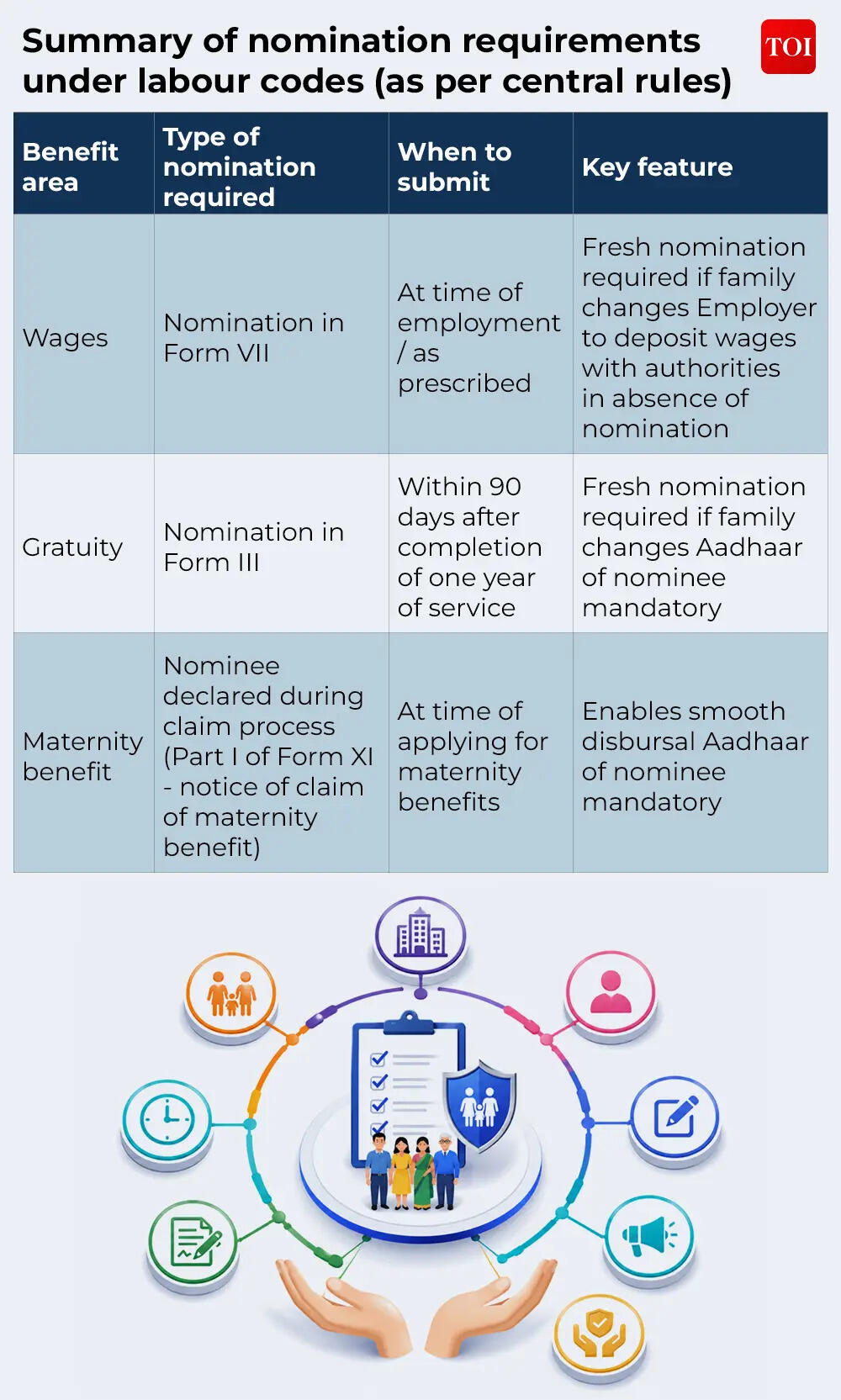
(All requirements aligned with central rules formats and timelines)
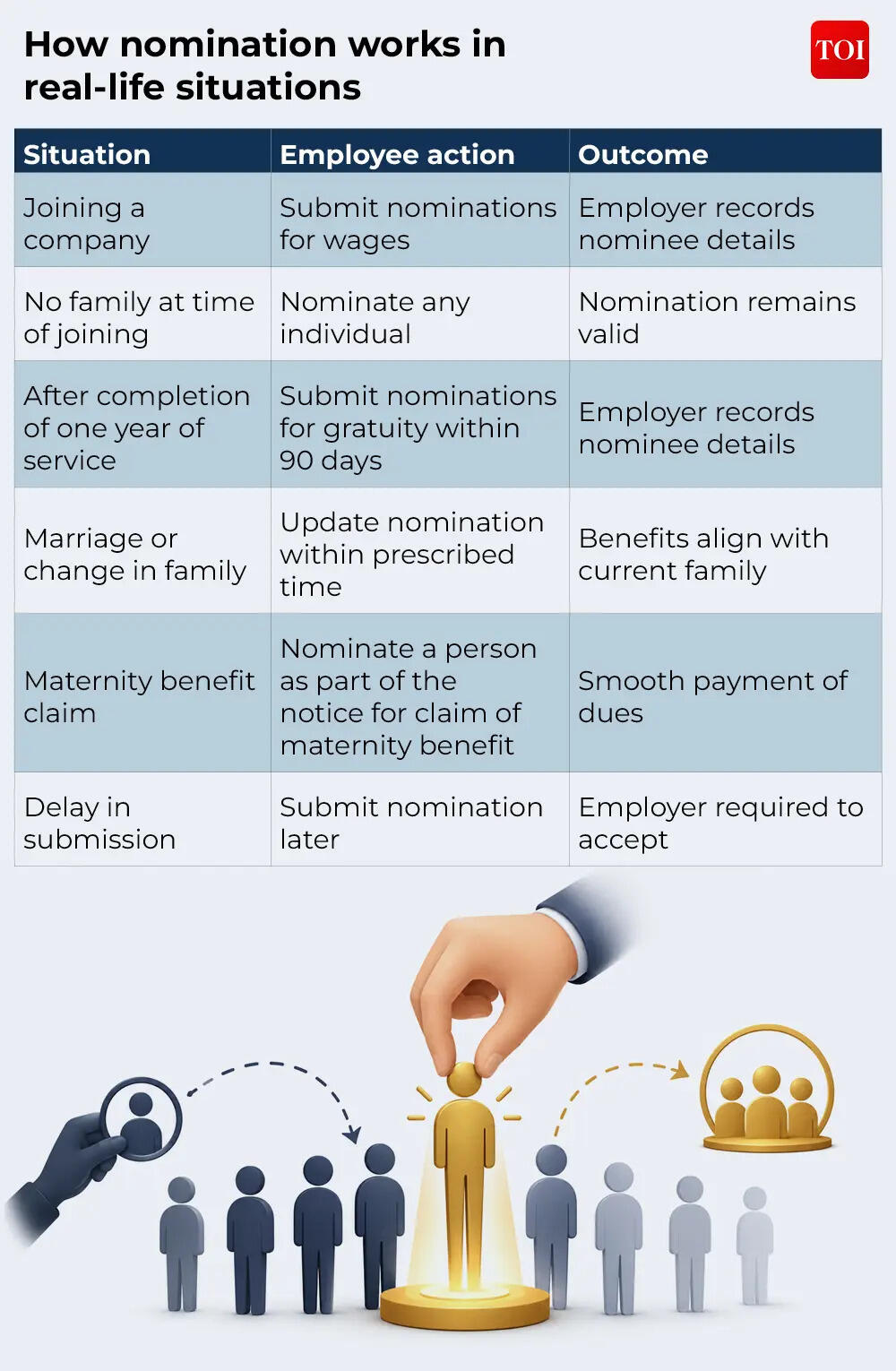
(Reflects timelines, flexibility and family-based updates under central rules) A small step with significant impactWhile nomination may appear to be a simple administrative requirement, it plays an important role in ensuring financial clarity and security for employees and their families. The labour codes, read with the central rules, bring greater structure and consistency to this process, making it easier for benefits to be delivered without complications.For employees, taking timely action on nominations is a relatively small step but one that can have a meaningful impact. By completing nominations and keeping them updated, employees can ensure that their statutory benefits serve their intended purpose when they are needed the most.(The author, Puneet Gupta is Partner, People Advisory Services Tax at EY India)



