


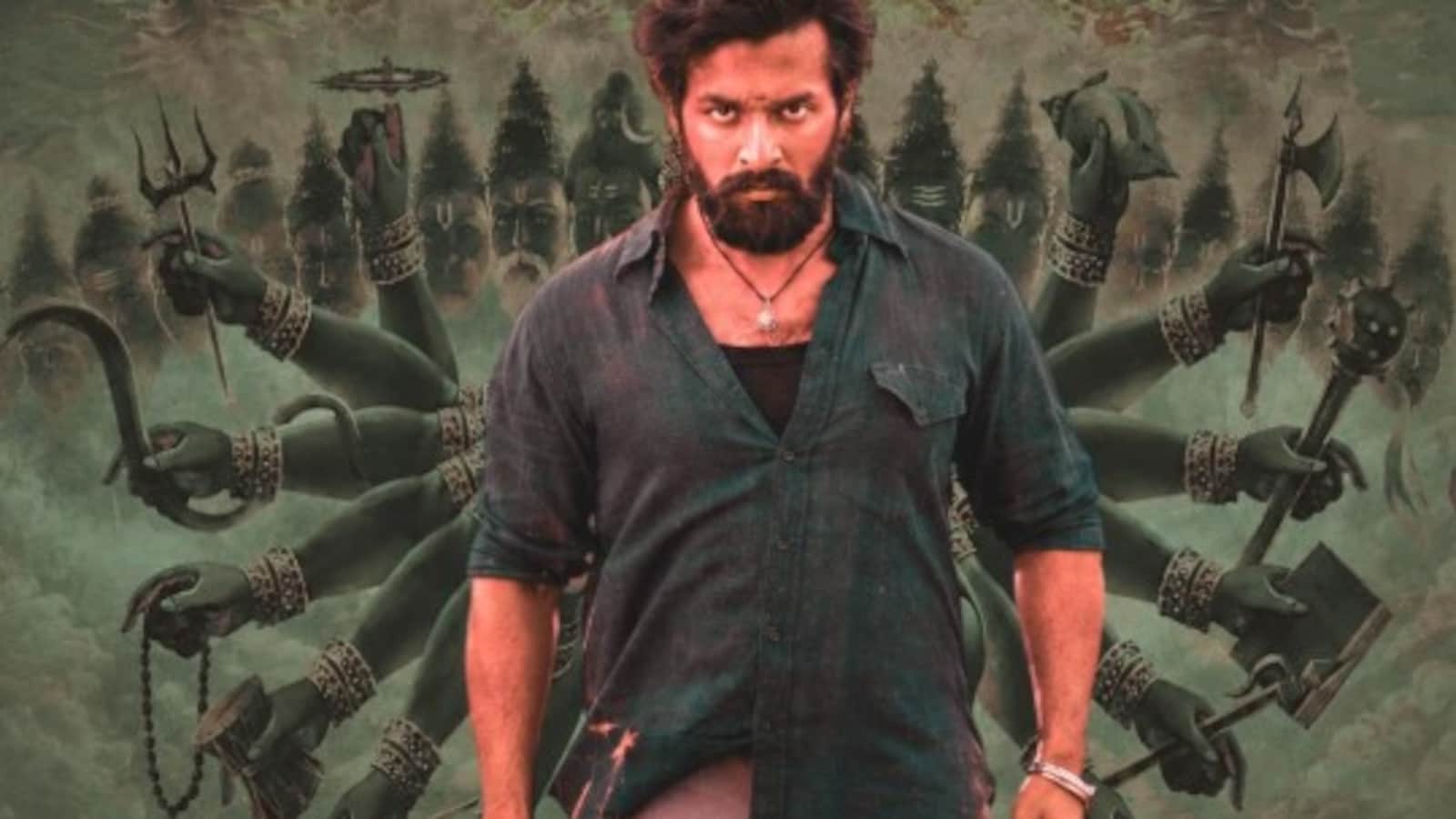

Telugu actor Akhil Akkineni has spent the better part of his career searching for the breakthrough film that would firmly establish him as a leading man. It was expected that, with director Murali Kishor Abburu’s Lenin, Nagarjuna’s younger son would finally make a mark in Telugu cinema in a role that played to his strengths. The idea of star-crossed lovers caught in a web of rivalry and conflict has been explored countless times in Indian cinema, drawing on our mythology, but what Lenin tries to do is add novelty with a rural backdrop and family dynamics.
Circa 1976, we see the fictional village of Srirampuram in the Chittoor district of Andhra Pradesh, where it is the annual week-long festival of Bharatham Jatara, dedicated to Draupadi Amman. As the entire village buzzes with excitement and festive fervour, an orphan, Lenin (Akhil Akkineni), lands in the village. The head family takes him in and his world begins to revolve around them, their son Vasanth, and Vasanth’s love, Bharathi (Bhagyashri Borse), who comes from another wealthy family in the village. While one expects Lenin’s life to be uneventful and idyllic, an unexpected betrayal exposes simmering rivalries and sets him on a path that changes the course of his life. The battle for love and the desire for revenge in this film echo the Mahabharata and Ramayana, except for the title, evidently. The title Lenin suggests someone rebellious who launches a revolution, and in this film that is what an orphan called Lenin attempts. But is he successful?
For the first part of the film, Lenin plays out like a regular village drama, with community gatherings, festivals, friendships and a newfound love as Lenin grows from boy to man. Beneath the laughter, however, lie age-old rivalries, influential families and invisible social boundaries adhered to automatically by different classes. One day the faultlines crack wide open and Lenin becomes a man intent on revenge. The second half moves into heavy action, a wedding and numerous twists, and we learn why Lenin was sent to prison. There are other revelations as well (some clearly unnecessary and some predictable) alongside constant references to mythology (for example, a game of cards), which eventually grow tiresome.
Director Murali Kishor Abburu delivers a film with commercial elements and, as in his previous work, takes time to build Lenin’s character and world. The rustic scenes are well drawn and there are plenty of supporting characters added to lift the film, but many lack depth and end up ornamental rather than integral to the story. At the heart of Lenin is the love story between Lenin and Bharathi, but it never quite realises its full emotional potential. While Akhil Akkineni and Bhagyashri Borse share an easy screen presence, the screenplay does not invest enough in their relationship for the audience to become truly emotionally involved. When their romance is tested by betrayal and circumstance, the emotional impact falls short. Thus, Lenin’s premise is promising, but the director’s over-ambition makes the film lose the plot and land in familiar territory.
Lenin is perhaps the film in which Akhil Akkineni has been able to fully explore his acting abilities; he delivers a solid performance. He is at ease in emotional scenes as he is in action sequences, and it is evident that he is comfortable carrying a film on his shoulders. The chemistry between him and Bhagyashri Borse is charming and she contributes strongly to the film’s emotional core. Her character, Bharathi, has a degree of agency, which is a positive move in Telugu cinema. Bhagyashri Borse has already proved her talent, and this film is another feather in her cap.
Technically, the film scores well. Leon Britto’s cinematography captures the rustic nature of rural Andhra Pradesh beautifully, while Navin Nooly’s editing could have been tighter. Music director S Thaman provides a background score that elevates the film, but the songs are nothing to take home.
Lenin could be a turning point in Akhil’s career, but for the audience it is a romantic action drama that gets lost in its own ambitions.



