


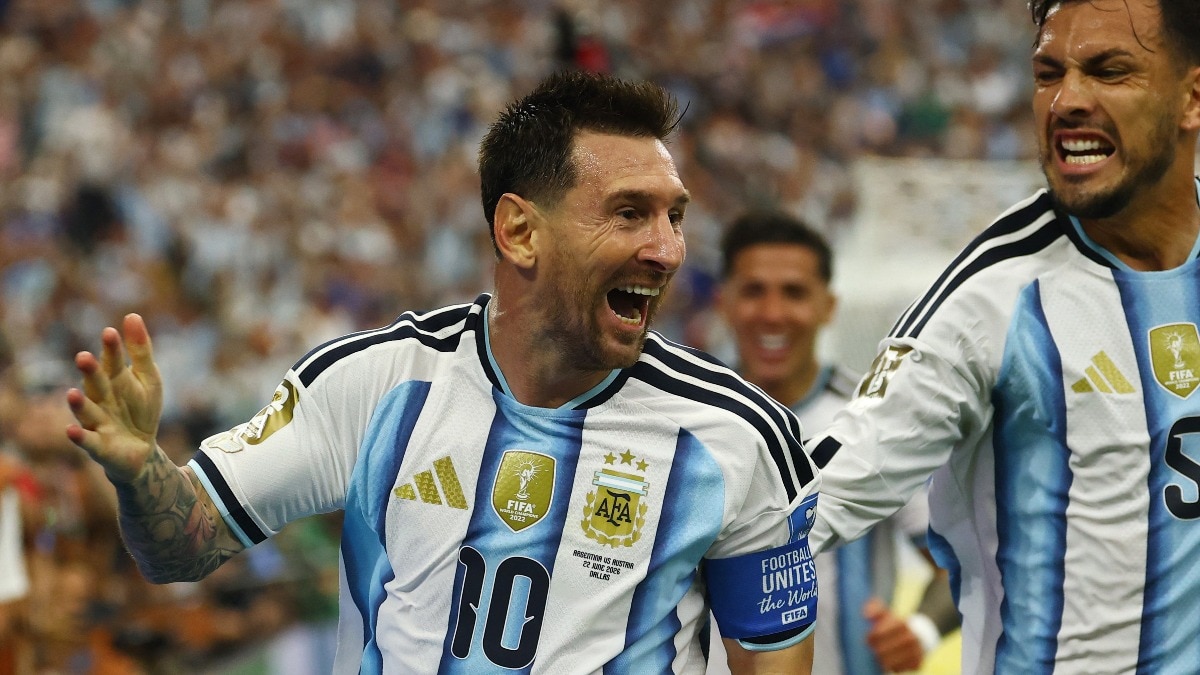
The easiest way for Lionel Messi to break the World Cup scoring record was from the penalty spot. Instead, he ended up doing it the hard way.
After his hat-trick against Algeria in Argentina’s opening match, Messi arrived in Dallas level with Miroslav Klose on 16 World Cup goals and needing just one more to become the tournament’s outright leading scorer. When Argentina won an early penalty against Austria, the crowd sensed the moment had arrived. The script looked perfect. Messi would step up, score and move into the history books.
Austria had other ideas.
ARGENTINA vs AUSTRIA, FIFA WORLD CUP 2026: HIGHLIGHTS
The penalty was saved, the stadium was briefly stunned and what many expected to be a straightforward evening for the world champions suddenly became something far more interesting. Austria grew into the contest, Argentina became increasingly frustrated, and the record remained where it was.
It never stays that way for long when Messi is involved.
By the time the final whistle arrived, the Argentina captain had scored twice in a 2-0 win, moved onto 18 World Cup goals, become only the third player to score in six consecutive World Cup matches and helped the defending champions secure their place in the knockout rounds with a game to spare.
The numbers were remarkable, but they did not fully capture the feel of the evening. This was not a repeat of the Algeria game where Messi seemed capable of scoring every time he touched the ball. Austria made Argentina work for every opening, defended aggressively and spent long periods disrupting the rhythm that had carried Lionel Scaloni’s side through their opener.
That challenge only seemed to make Messi more central to the story. Every attack passed through him, every promising move drew the eyes of the packed crowd in Dallas and every Austrian clearance was followed by another wave of Argentina pressure. The breakthrough eventually arrived before half-time and, once it did, the rest of the evening felt as though it was moving in a familiar direction.
MESSI GETS THE RECORD, THEN ADDS ANOTHER
Austria’s plan was clear from the opening whistle. Rangnick’s side defended in numbers, closed spaces quickly and tried to ensure that Messi received the ball with as little room as possible.
For large parts of the first half, they succeeded.
Argentina enjoyed possession but lacked the sharpness that defined their performance against Algeria. Marcel Sabitzer was influential in midfield, Konrad Laimer covered enormous ground and Austria looked increasingly comfortable as the game wore on.
That was what made the breakthrough feel so important.
Messi had already seen a penalty saved and watched a couple of promising attacks break down. Yet just before the interval, he found the opening Austria had spent nearly an entire half trying to prevent. Picking up the ball around the edge of the box, he shifted into space and produced a finish that sent the ball into the corner and the stadium into celebration.
The goal carried significance beyond the scoreline. It was Messi’s 17th World Cup goal, taking him past Klose and making him the leading scorer in the history of the tournament. It also placed him alongside Just Fontaine and Jairzinho as only the third player to score in six consecutive World Cup matches.
For most players, that would have been enough history for one evening.
Messi was not done.
Austria remained in the game for much of the second half and continued searching for an equaliser, but Argentina gradually tightened their grip on the contest. Then, deep into stoppage time, Messi produced one final reminder of why he remains the defining figure of this World Cup.
Collecting possession on the right, he drifted infield and released Julian Alvarez. The move seemed destined to fizzle out when Alvarez failed to connect properly with the finish, but Messi had continued his run. While defenders paused, he reacted first, collected the loose ball and swept it into the net.
The roar that followed felt different from the one that greeted the record-breaking goal. This one carried a sense of appreciation. The record had already been broken. This was simply Messi enjoying himself.
Goal number 18. Goal number five of the tournament. Another piece of history nudged a little further away from everyone else.
ARGENTINA LOOK READY FOR KNOCKOUTS
The result will naturally be remembered for Messi’s latest record, but Argentina will take just as much satisfaction from the manner in which they handled a difficult opponent.
Austria were organised, competitive and considerably tougher than Algeria had been in the opening match. There were periods when the game became scrappy, moments when Argentina struggled to find their usual fluency and phases where the Austrians threatened to drag the contest into an uncomfortable finale.
Yet the world champions rarely looked rattled.
Rodrigo De Paul, Alexis Mac Allister and Enzo Fernandez controlled long stretches of midfield, while Cristian Romero produced another commanding display before being forced off with a knee issue. Nicolas Otamendi slotted in comfortably after replacing him and Emiliano Martinez dealt confidently with the limited work that came his way.
What stood out most was Argentina’s patience. There was no panic after the missed penalty and no desperation when Austria grew into the game. Scaloni’s side trusted their structure, trusted their quality and waited for the right moments to appear.
That is often the hallmark of teams built for tournament football.
Two matches into the World Cup, Argentina have six points, a place in the knockout rounds and a captain who already has five goals to his name. More importantly, they are beginning to show different sides of themselves. Against Algeria they dazzled. Against Austria they had to dig a little deeper.
The final result was the same.
Argentina will now face Jordan in their final Group J fixture on June 27 with qualification already secured. Scaloni may choose to rotate and protect key players before the knockout rounds begin. Messi, meanwhile, heads into that game sitting alone at the top of the World Cup scoring charts with 18 goals and showing little sign that he is ready to stop adding to the tally.
FIFA World Cup | FIFA World Cup Schedule | FIFA World Cup Points Table | Football News
– Ends



