


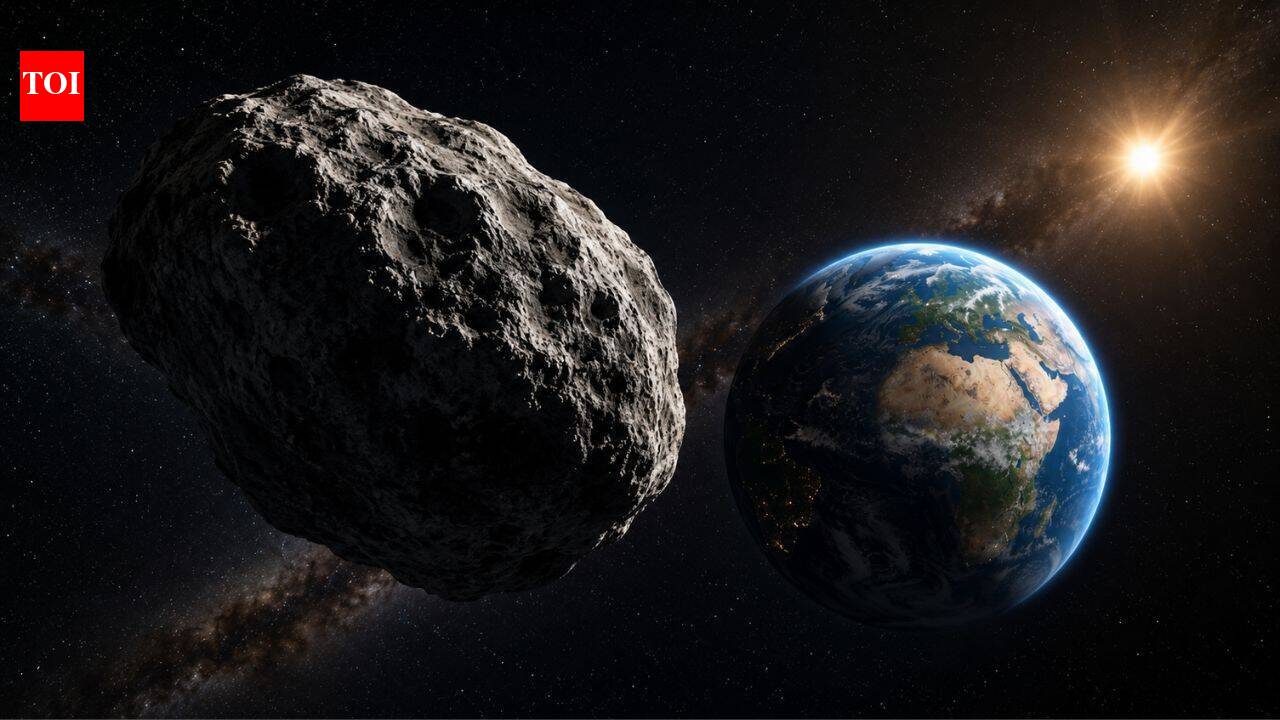

The asteroid that’s set to drift past Earth this weekend is not the kind of object that usually catches public attention, even in astronomical circles where near-Earth flybys are fairly routine. Still, there are moments when the numbers line up in a way that makes people look twice. A rocky body several times taller than the Eiffel Tower, moving through the inner solar system on a path that brushes past our planet at what space agencies still describe as a safe distance, tends to do that. It won’t be visible to the naked eye, and nothing about its trajectory suggests anything unusual in a hazardous sense, but the combination of its size, timing, and relative brightness has made it a talking point among observers who follow the sky closely. The pass happens on Saturday, June 27, 2026, when it slides through space at roughly 1.6 million miles from Earth.
Massive asteroid 1997 NC1 set for close approach in late June
The object in question is asteroid (152637) 1997 NC1, a near-Earth asteroid estimated to measure somewhere between 710 and 1,600 metres across. That places it in the category of bodies that planetary scientists tend to watch with steady interest rather than alarm. It is large enough to reshape regional landscapes if it were ever on an impact course, yet its current orbit is well understood.According to data compiled by the European Space Agency, the closest approach occurs at around 11:14 UTC on 27 June, when the asteroid reaches its nearest point at about 2.6 million kilometres away. The orbit classification used by astronomers places it in the Aten group, meaning it spends much of its time inside Earth’s orbit while still crossing our path at intervals.“A close approach to Earth by an object this size only occurs every few years, although this time the bright nearby moon might impede its observability at closest approach,” Juan Luis Cano of the ESA’s Planetary Defence Office said.
How astronomers have tracked it since 1997
The asteroid was first picked up in 1997 by the NEAT survey, part of a broader effort at the time to catalogue objects moving through Earth’s neighbourhood. Back then, detection systems were far less automated than today, and follow-up observations were essential to confirm its orbit.Over the years, repeated tracking has refined its path to the point where its future passes can be predicted with high confidence. The object itself has not changed course in any dramatic sense; what has changed is the precision with which astronomers can map its motion against the background of the solar system.Its previous recorded close approach was in 1993, and the next comparable pass is not expected until 2088, which is part of the reason this weekend’s flyby is being treated as a rare observational window rather than a routine event.
How to watch the asteroid flyby through a livestream online
For most people, the simplest way to follow the asteroid will be through a livestream rather than a telescope in the garden. The Virtual Telescope Project is planning online observations across both 26 and 27 June, starting at 23:00 UTC each evening.The feed will be led by astrophysicist Gianluca Masi, who typically narrates these sessions while the telescope captures the slow drift of objects across star fields. The asteroid itself won’t appear as a dramatic shape or glowing body. It shows up more as a moving point of light, shifting position against fixed stars over the course of minutes.
Asteroid visibility quick tips
Under the right conditions, the asteroid sits near the edge of visibility for modest equipment. Estimates place its peak brightness around magnitude 10, which puts it beyond unaided eyesight but within reach of small telescopes and, in darker skies, large binoculars.European Space Agency notes that a telescope of around 100 mm aperture should be enough to pick it up as a faint point moving slowly across the field of view. It is not the brightness that gives it away but the motion. Over a few minutes, it shifts against the background stars in a way that becomes unmistakable once noticed.A complication this time is the lunar phase. A bright moon, nearing full just a couple of days after the closest approach, will wash out some of the fainter stars. That makes the asteroid harder to isolate visually, especially from suburban locations where light pollution is already an issue.
Timing, sky position and the moon’s interference
During the days around closest approach, the asteroid drifts across a wide section of sky, beginning in Lyra before moving southwards into Norma. That path places it differently depending on whether an observer is in the northern or southern hemisphere, though the general motion remains consistent.Its speed across the sky is relatively quick for a telescopic target, at roughly 40 arcseconds per minute. That figure sounds technical, but in practice, it means that over the course of a short observing session, it will visibly shift position if tracked carefully.



