


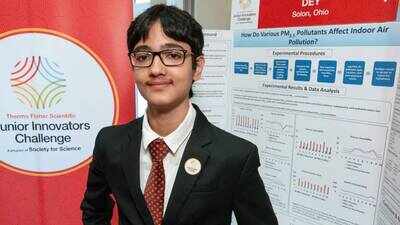
An eighth-grader from Solon, Ohio, is drawing attention to an often-overlooked source of air pollution – the air inside our homes. Archishman Dey, a student at Solon Middle School, conducted a science project examining how common household activities affect levels of PM2.5, or fine particulate matter measuring 2.5 micrometres or less in diameter.His experiment tested five everyday sources – an air fryer, candle, humidifier, natural gas and incense. Of these, burning an incense stick produced the highest level of PM2.5 in his experiment.
Archishman Dey explains why he studied indoor air pollution
Archishman said his project was inspired by his concern about the air people breathe inside their homes.“When people think about air pollution, they usually imagine cars, factories, or smoke stacks outdoors, which we classify as ambient air pollution. But what if I told you that the air in your kitchen, right inside of your home, can sometimes be more polluted than the air outside?” he said in his project video.He explained that PM2.5 refers to extremely small particles that can be generated by smoke, fumes and dust from everyday activities.“PM2.5 means particulate matter. Matter less than 2.5 micrometers in diameter. So tiny that it’s invisible to the naked eye,” Archishman said.He added, “These particles can go deep into our lungs and cause a variety of health issues.”According to the data published by Society for Science, Archishman became particularly interested in incense after noticing visible smoke at his grandparents’ home. His grandparents have asthma, which made him concerned about their exposure to indoor pollution.“I was most curious about the daily burning of incense sticks at my grandparents’ home, where you could visibly see smog in the air,” he said.
He tested five common household pollution sources
To conduct the experiment, Archishman used an air-quality sensor to measure PM2.5 levels. He designated one room as a control area and measured the baseline concentration before testing each source.“I started wondering which activities inside of our homes produce the most of these tiny particles. That’s how I came up with my project to compare five different sources of indoor PM2.5 which we use in everyday life and find out which one can pollute our indoor homes the most,” he explained.The five sources he tested were cooking on a gas stove, frying food with an air fryer, burning incense sticks, using a humidifier and burning a candle.“For each one, I measured the PM2.5 before, during, and after the activity right here in my control room to see how high the pollution levels went and how long it took to return to normal,” he said.
Incense generated the highest PM2.5 levels
The results showed that incense was by far the biggest source of fine-particle pollution among the five activities tested.“When I burn an incense stick, the monitor number shot up the furthest. That was the worst source by far,” Archishman said.According to the data published by Society for Science, the incense stick generated an average PM2.5 concentration of 76.27 micrograms per cubic metre. The air fryer ranked second at 14.29 micrograms per cubic metre, while the humidifier produced about 5.5 micrograms per cubic metre.Archishman said cooking on a gas stove also resulted in a significant increase in PM2.5, while burning a candle produced the smallest effect in his experiment, although it still caused a short-term spike.“The air fryer came next, followed by cooking on a gas stove, which also made for a significant increase in PM2.5. After that was using a humidifier, which only caused a small increase. Finally, burning a candle had the least effect, but there was still a short spike in PM2.5 levels,” he said.
‘Everyday activities can quietly fill our lungs’
Archishman said the findings made him more aware of the pollution generated by routine household activities.“It means that everyday activities like frying food or lighting candles can quietly fill our lungs with these particles that harm our lungs,” he said.He added, “We experience this kind of exposure all the time, but most of us don’t realize how slowly and steadily we’re breathing these particles in.”For Archishman, the project was also about finding practical ways for families to improve their indoor environment.“I aimed to provide simple data that could enable families to recognize invisible air quality dangers and adopt healthier practices with the aim of improving their indoor environment,” he said, according to Society for Science.In his video, he suggested simple measures such as opening windows, using exhaust fans while cooking and turning on an air purifier.“The good news is that it’s something we can control. By simply opening windows, using exhaust fans while cooking, or turning on an air purifier, we can reduce these pollutants within just a few minutes and make our indoor air much cleaner,” he said.
Archishman hopes to become an environmental engineer
Beyond the project, Archishman takes part in academic competitions including Science Olympiad and MathCounts. He has also represented Ohio at the national competition.“Cracking the code to a problem after tireless thought is what I find most enjoyable,” he said.Archishman said he hopes to become an environmental engineer and use science and mathematics to tackle major environmental challenges.“The mathematics and science behind everything around us is truly fascinating. I want to learn about these systems and solve the world’s most pressing problems such as waste management, pollution and ensure a healthier planet for the future generations,” he said.He concluded his presentation with a simple message: “Even though we can’t see these particles, they affect our health every day. Remember, clean air starts right here at home.”


