


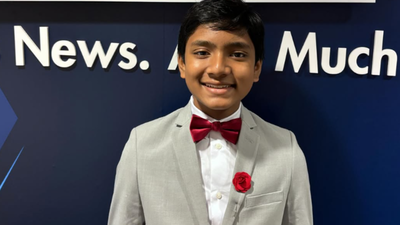
At 2 years old, Suborno Isaac Bari was already doing something that would later become a defining detail of his childhood: reciting the periodic table. Mathematics was developing alongside that early fascination with science, and his parents soon realised that ordinary lessons were not quite enough to contain his curiosity. Years later, the New York student would take an accelerated route through school, skipping several grades before graduating from Malverne High School at just 12 in June 2024. By then, he had already experienced university-level classes and had been invited to lecture at colleges in India. His next step was New York University, where he planned to study mathematics and physics.Bari had also set himself an unusually early academic target, hoping to complete his undergraduate degree by spring 2026 and eventually pursue doctoral research in mathematics.
Suborno Bari’s early maths skills surprised his parents
The first signs did not come from a classroom or a competition. They appeared during ordinary lessons at home.Bari’s mother, Shaheda, was teaching him basic arithmetic when he was around two. His father, Rashidul Bari, later recalled that his son’s answers soon became less interesting than the questions that followed them. A simple addition problem could turn into a question about whether the same principle worked with unknown numbers.His father was studying mathematics at the time and initially did not regard the behaviour as particularly extraordinary. That changed when the questioning continued across different mathematical ideas.He eventually described what he was seeing to one of his professors. The professor urged him to pay closer attention to the child’s abilities.Around the same period, Bari was also becoming fascinated by science. His family says he was able to recite the elements of the periodic table at the age of two, an accomplishment that later became one of the most frequently reported details of his childhood.
Bari’s academic path soon moved beyond the usual timetable
Bari’s education was gradually reorganised around his academic ability. Instead of moving through each school year in sequence, he skipped several grades.He told Good Morning America, that by the time he graduated from Malverne High School, he had bypassed 5th, 6th, 7th, 9th and 11th grades. He completed his fourth, eighth, 10th and 12th grades within the district while also passing the New York State Regents examinations needed for graduation.That made him 12 years old at graduation. The school did not simply place him in classes with much older pupils and leave him there. Rebecca Gottesman, the district’s director of K-12 counselling, said staff and the family worked on an arrangement that allowed Bari to take more advanced academic courses while retaining opportunities to interact with children closer to his own age.For part of that arrangement, he attended higher-level classes and then returned to younger pupils for electives and other activities. The aim was to keep his academic work moving quickly without ignoring the social side of growing up.
University classes became part of his high school years
The numbers attached to his school record were striking even without his age being taken into account. Reportedly, he scored 1,500 on the SAT and 34 on the ACT, while also completing five Advanced Placement classes.Before graduating, Bari had taken non-degree courses at several universities in the New York area, including NYU, Stony Brook University, the City University of New York and Brooklyn College. The experience introduced him to longer classes, heavier workloads and material that was compressed into a much shorter period than he was used to at school.
At seven, Bari was already speaking at Indian universities
Bari’s academic activities had also taken him outside the United States.When he was seven, he began receiving invitations from universities in India to give lectures. He has spoken about mathematics and physics to university audiences, including at Mumbai University.Those appearances gave him contact with students, lecturers and university administrators well before he became a university student himself. His father said the experience exposed Bari to people working at different levels of higher education.The family has also said that former US president Barack Obama sent Bari a letter in 2016 recognising his work and accomplishments.
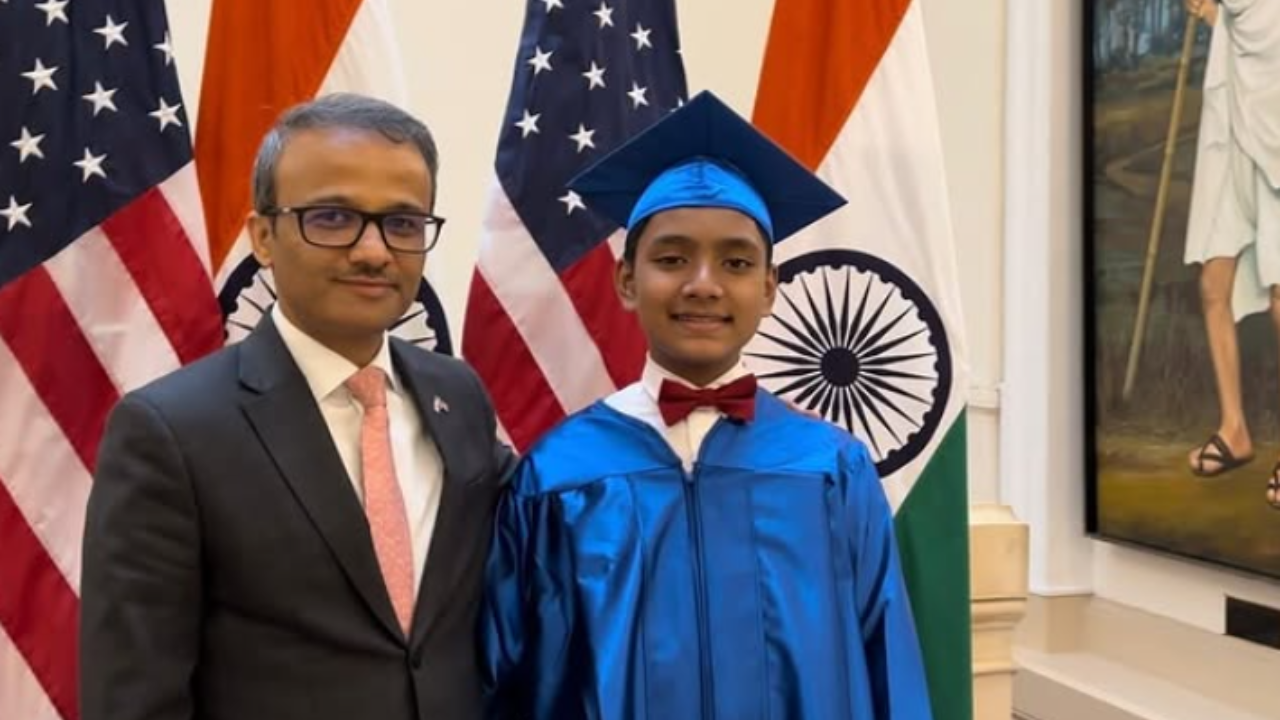
PC: Instagram
He entered NYU with plans to finish college by 14
Bari was accepted by New York University with a scholarship to study Mathematics and Physics. He described him as the youngest student in the university’s 193 years, based on the information available at the time.His plans were ambitious. Suborno told CNN, “I hope to graduate college at 14 in spring 2026”. He added, “If I ever decide to do a second Ph.D., it will be in physics, but mainly I want to focus on math.”
Teaching remained part of the plan
There was a familiar thread running through Bari’s plans for the future: teaching.Both of his parents work in education. His father teaches physics at Brooklyn Technical High School, while his mother is an elementary school teacher. Bari has said that he would eventually like to become a professor of mathematics and physics.The ambition is not simply about holding an academic title. He has spoken about wanting to make mathematics and science easier for other people to understand, particularly those who may not have access to the same educational opportunities.That interest had appeared early in his life. Giving lectures to university students in India as a child meant that teaching was already something he had experienced before reaching university himself.
His interests extended beyond Maths and Physics
Mathematics and Physics dominate Bari’s academic story, but his family has described interests outside those subjects too.He has been involved in debate and painting and plays the piano. His time at Malverne was also not entirely separated from ordinary school life. The district made an effort to keep him connected with students his own age even as his academic work moved ahead.That balance became part of the school’s approach to his education. Gottesman said the district considered his social and emotional development alongside his academic ability.


