



New Delhi:
Education has become increasingly important in India as more young people pursue degrees to improve their career prospects. One of the clearest indicators of this change is the Gross Enrolment Ratio (GER), which has reached its highest level on record. At the same time, women are participating in higher education at a faster rate than men.
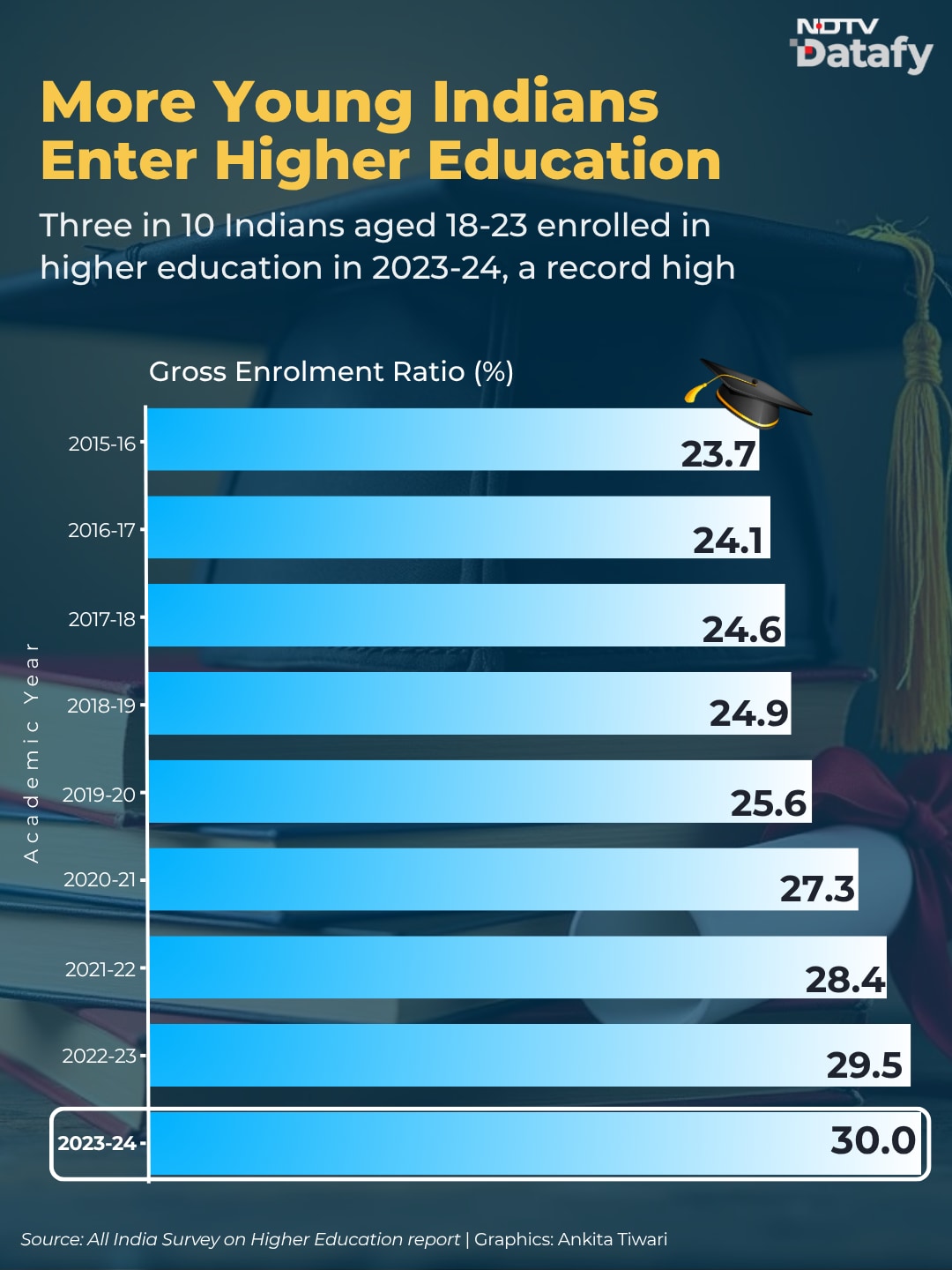
According to the latest All India Survey on Higher Education (AISHE) 2023-24 report, GER has increased steadily from 23.7 per cent in 2014-15 to 30 per cent in 2023-24, an increase of 6.3 percentage points in a decade. The GER measures the percentage of the population aged 18-23 years enrolled in higher education. A higher GER indicates that a larger share of young people is accessing colleges and universities.
Women Continue To Outpace Men
The rise in GER has been accompanied by a stronger participation of women. In 2019-20, the female GER stood at 27.3 per cent, slightly higher than the male GER of 26.9 per cent, giving women a lead of 0.4 percentage points. The gap widened to 2.3 percentage points, with women recording a GER of 31.2 per cent compared with 28.9 per cent for men in the latest survey.
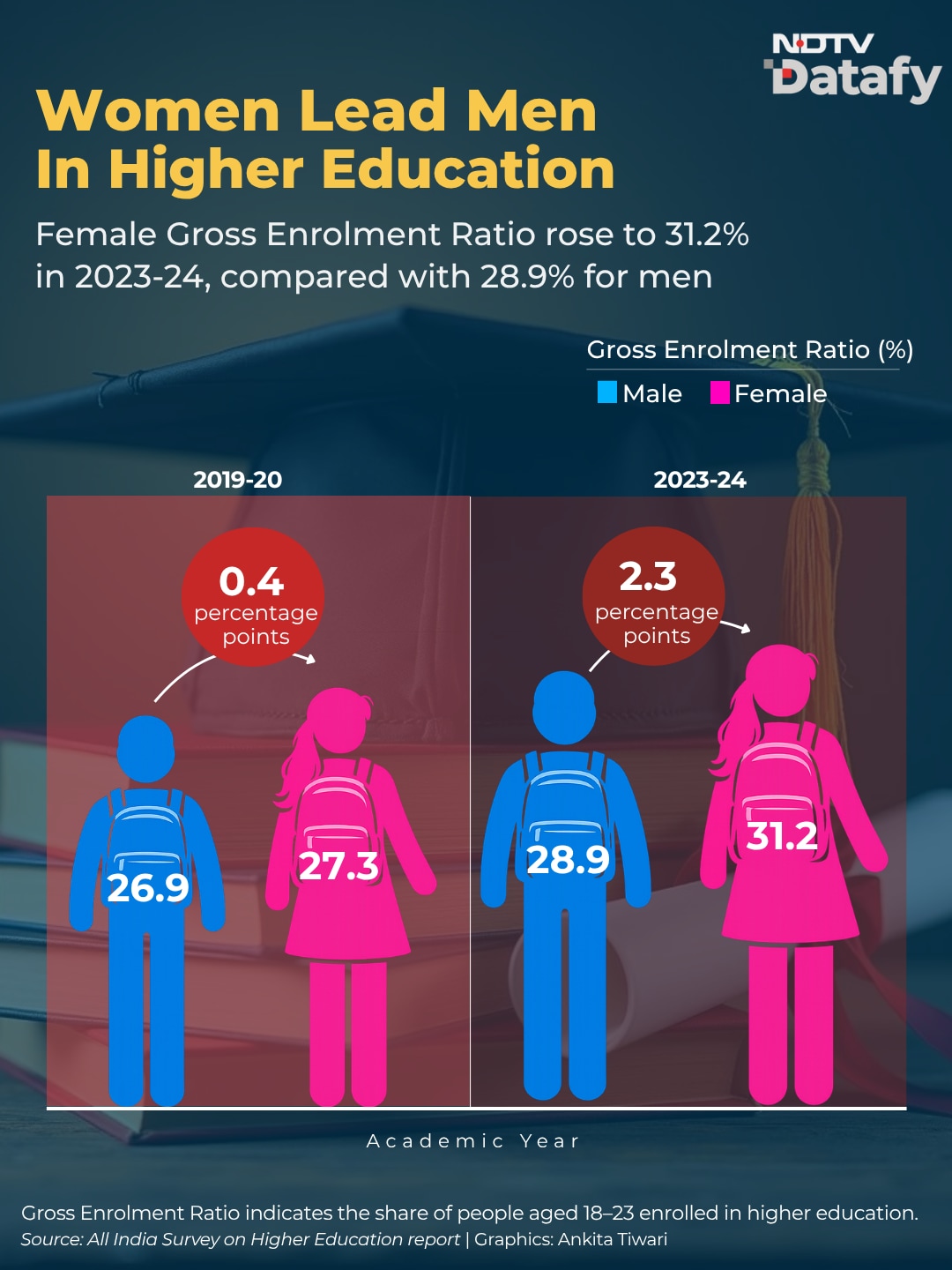
The report also places the Gender Parity Index (GPI) at 1.08, indicating that women’s participation in higher education is now higher than men’s. The GPI compares the female with the male GER. A value of 1 indicates equal participation by men and women. A value above 1 means women have a higher enrolment ratio than men.
Arts Most Preferred Stream
The report shows the academic preferences of student. Arts remains the most popular undergraduate discipline, accounting for 34 per cent of total undergraduate enrolment. Science follows with 15 per cent, Commerce with 13 per cent, and Engineering and Technology with 12 per cent.
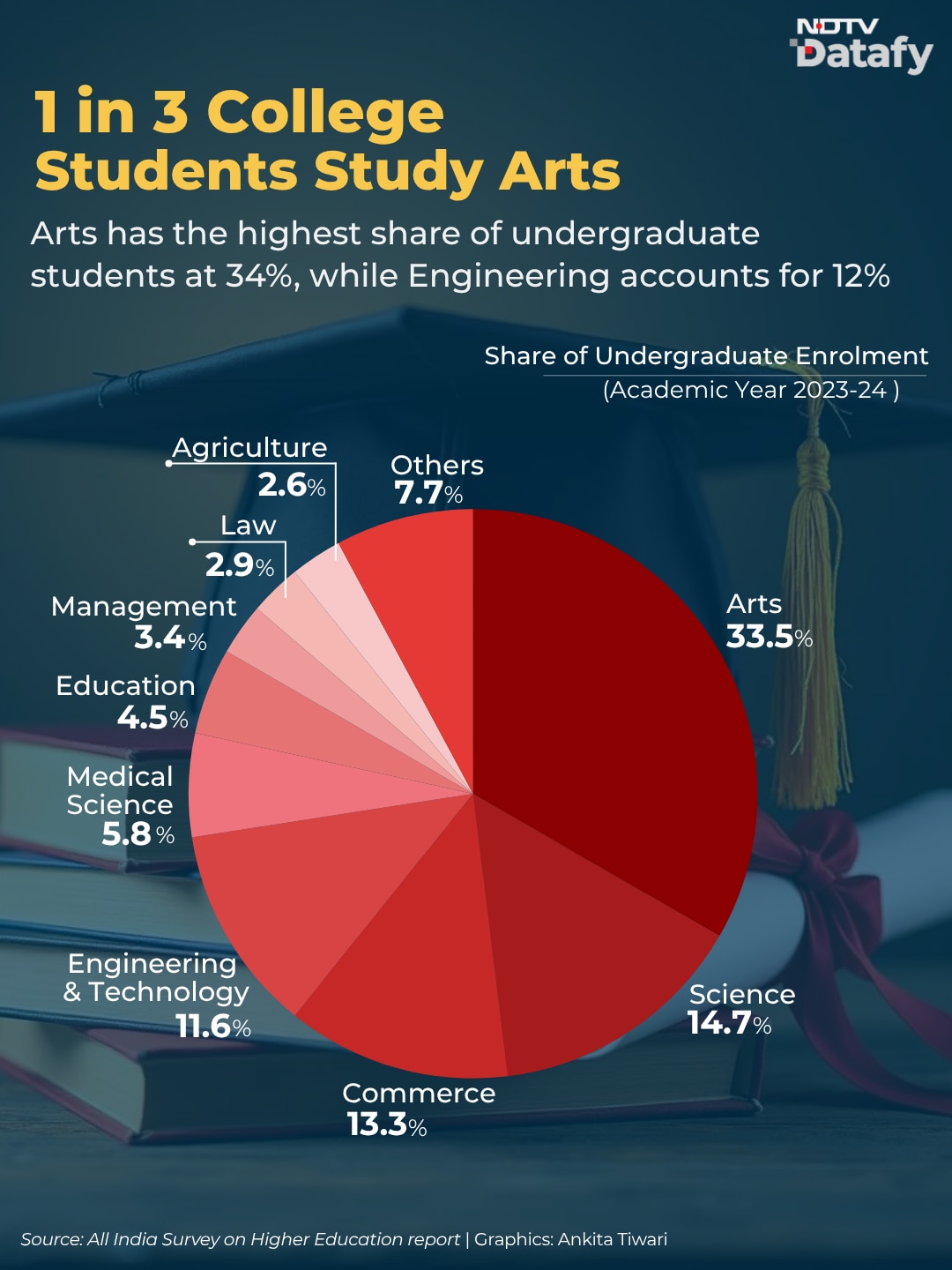
These figures show that although engineering continues to attract a large number of students, Arts remains the preferred undergraduate stream in India.
Classroom To Online
The way students pursue higher education is also changing. Regular classroom education continues to dominate, but distance education remains an important option for students who cannot attend college full-time because of work, financial constraints or location.
According to the AISHE report, around 36.5 lakh students were enrolled through the distance mode in 2023-24, accounting for about 8 per cent of total higher education enrolment.
Regular mode accounted for the overwhelming majority of students, while online mode is gradually emerging as another avenue for learning. The continued demand for distance education highlights its role in improving access to higher education, particularly for learners who require greater flexibility.
India’s higher education system has also grown in size over the years. Total enrolment increased from 3.42 crore students in 2014-15 to 4.50 crore in 2023-24, a rise of 31.5 per cent over the decade.
Undergraduate programmes account for nearly 77 per cent of all students, while postgraduate enrolment has reached 57.9 lakh. PhD enrolment has also increased, touching 3.44 lakh, the highest in the AISHE series.
The latest AISHE data points to two clear trends. More young Indians are entering higher education than ever before, and women are increasingly driving that growth. While participation has improved across the country, students’ academic preferences are becoming more diverse, with Arts continuing to attract the largest share of undergraduate enrolment and distance education remaining an important pathway for expanding access.



 2023-24 report, GER has increased steadily from 23.7 per cent in 2014-15 to 30 per cent in 2023-24, an increase of 6.3 percentage points in a decade.)