


New Delhi:
Operation Sindoor has provided India with important lessons about the country’s defence capabilities, particularly the need to build greater self-reliance in emerging technologies, manufacture drones and missiles at scale, and develop the ability to rapidly adapt when adversaries devise countermeasures — a view shared by defence industry experts who spoke about it at length at NDTV’s Defence Summit on Sunday .
Dr Samir V Kamat, former DRDO chairman and former Secretary, Department of Defence R&D said the Operation Sindoor, viewed alongside the wars currently being fought elsewhere, had underlined the need for an “Atmanirbhar” defence capability.
“I think Op Sindoor was a good learning experience for all of us. Though it was a very short conflict, this conflict, along with the current ongoing wars — the Russia-Ukraine war or the US-Iran war –has taught us that we need to have ‘atmabirbharta’ capabilities. And they have to be in the emerging domains of cyber security, information warfare, space situational awareness, space-based capabilities for ISR, it has to be in the ability to manufacture drones and missiles in numbers but also the ability to innovate and modify when an opponent comes up with a counter to whatever you have developed.”
Operation Sindoor was launched in response to the April 22, 2025 terror attack in Jammu and Kashmir’s Pahalgam. The attack, attributed to Pakistan-based terror groups, killed 26 people, including one Nepali national, and injured many others.
The missile strikes targeted facilities in Muzaffarabad, Kotli, Bahawalpur, Rawalakot, Chakswari, Bhimber, Neelum Valley, Jhelum and Chakwal. These areas had long been suspected by intelligence agencies of harbouring terrorist camps.
The sites were believed to be affiliated with Lashkar-e-Taiba (LeT) and Jaish-e-Mohammad (JeM), two terror groups responsible for multiple attacks in India over the years.
Five of the nine locations struck were in Pakistan-occupied Kashmir, while four were in mainland Pakistan.
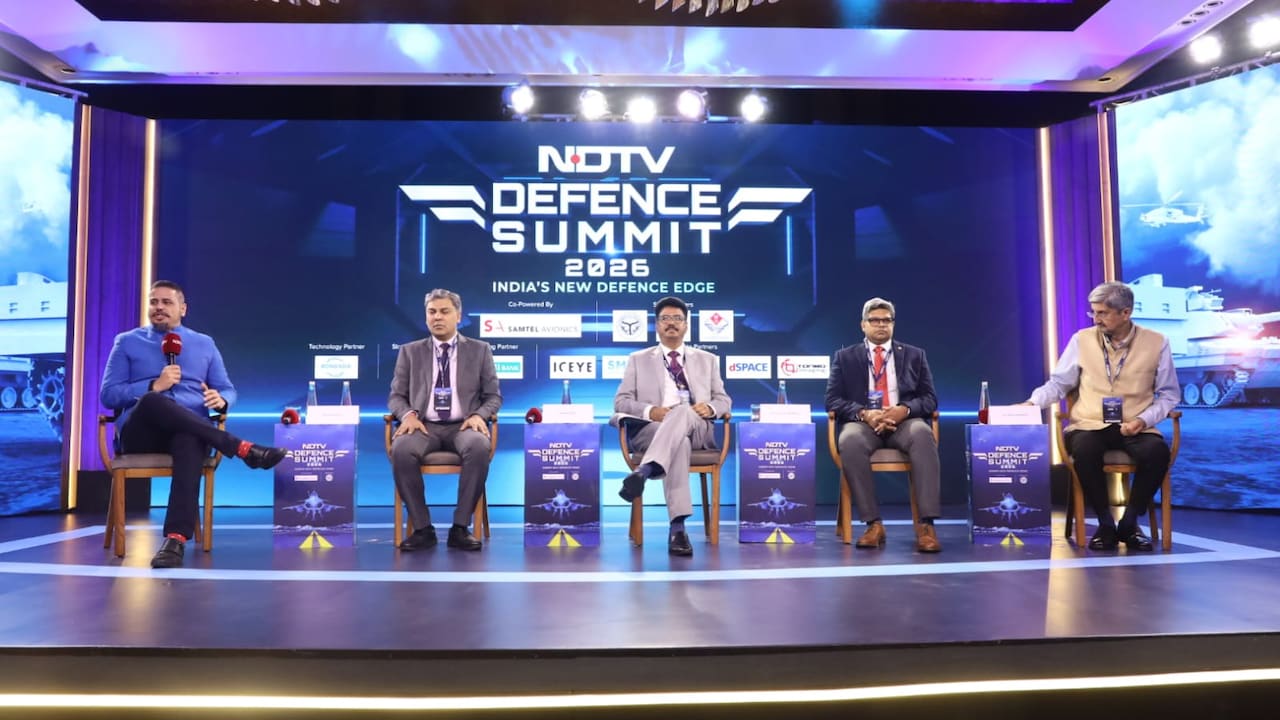
Experts from the defence industry weigh in on the future of modern warfare at NDTV’s Defence Summit.
Dr Kamat said developing these capabilities could not be the responsibility of a single organisation but there should be a “whole of nation approach”, bringing together industry, academia, MSMEs and start-ups.
“And this can only happen if we work or approach a ‘whole of nation’ approach. One organisation cannot deliver the capabilities the country needs. We have to look at how we can synergise the capabilities that exist in our industries, in our academia, our MSMEs and in our startups. And find mechanisms where we can all work together and innovate at scale, at speed..only then can compete in the wars of the future,” he said.
Dr Kamat said India had developed a sound scientific base for manufacturing drones, but argued that production would need to increase substantially to meet the demands of modern warfare. He said the number of drones being used in current conflicts showed the scale that India would need to develop.
“I think our capability in making drones is good, but we have to build scale for the numbers that are being used in the current wars. I don’t think we have the scale right now. But we have good science and if we put our minds to it and if the services start placing orders in numbers, we will be able to build this capacity,’ he said. “The capability also needs to improve. Our drones are good but they need greater innovation to make sure that whatever counter-measures our opponents come up with, they can manage to override them.”
Ashish Kansal, CEO of SMPP Limited, told NDTV that another significant change on the battlefield had been the connectivity now available to individual soldiers through modern combat systems. He said soldiers could increasingly share information about what they were seeing, effectively giving them access to multiple sources of information rather than relying only on what they could see themselves.
“They stay connected, they’re wired, and they know what each other is seeing. You now are not looking with two eyes but you are looking with multiple eyes, not just on the ground, but in the air as well. That is something which makes them much, much more aware of what’s happening around them,” he said. “Ultimately what it boils down to is territory. Occupying the territory or keeping it secured — the heart of it is the soldier standing. So you have to make sure that ultimately your soldier is not only well protected, but with the age of drones and AI, you need to ensure that the soldier is well informed.”
“Today’s protection systems — you need to give the capability to a soldier or being a smart soldier or an informed soldier. You need to integrate what a drone can see above him, the capability to see on his arm to see what his enemy looks like what his surroundings look like, what is the terrain looking like further going down and where is the enemy located what is his own capabilities in terms of his team members havin the amount of ammo the amount of food, etc. Therefore todays battlefield has changed quite a bit,’ he added.
Rakesh Ojha, Director of Munitions India Limited, said the ability to sustain operations is central to modern warfare. He said India needed to combine conventional ammunition production with newer systems, including drone-based ammunition, loitering munitions and precision-guided systems.
“Sustenance is the key in today’s warfare. At the same time, we have to be technologically superior in delivering drone-based ammunition systems, loitering munitions, precision guidance systems, etc. There has been a considerable shift in ammunition manufacturing. We not only need to have modern or next-generation ammunition but conventional ammunition is the key for sustenance.”
“During Op Sindoor, when the army called us, we acted not only in days but in hours to supply strategic ammunition to forward bases,” he added.
Jayaram M, CEO of Kalyani Rafael Advanced Systems said Operation Sindoor had been a short conflict, lasting only a few days, but argued that the operation had demonstrated India’s ability to carry out strikes with precision and speed.
“I think it was a very short conflict. We could just be active for four days or something. The scale I think is always discussed when it comes to deterrence. If you look at Op Sindoor, what we could prove in that time was clinical precision. “Apart from that, what we could see was speed — speed of sensing, speed of targeting, speed of enganement and of course postengagement analysis and the feedback mechanism. We have to sustain this kind of precision for a longer duration. That’s where scale comes in. Currently, our production capacities are quite low. Looking at what is happening in Middle East or Russia-Ukraine, if we get into a longer conflict, we are far away from the scale than what we are looking at.”


