


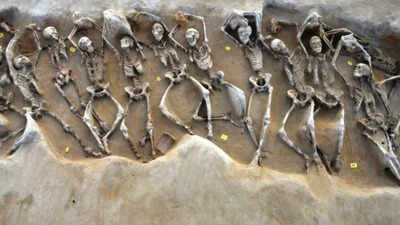
In 2016, archaeologists digging at the Phaleron cemetery on the coast near Athens uncovered one of the most unsettling finds in Greek archaeology, a mass grave holding nearly 80 adult men, many still shackled at the wrists with iron restraints. The men, known as the Esplanada group, had been laid out in orderly rows and appeared to have died violently, sparking a decade of debate over who they were. Some researchers argued they were foreign fighters or mercenaries brought into Attica during a period of political turmoil, while others suspected they were victims of an early Athenian state exercising new powers of collective punishment. A fresh scientific study has now reexamined their remains using chemical analysis of tooth enamel, and the results overturn the outsider theory entirely, showing that the shackled men were almost certainly locals who grew up in the very region where they were later executed and buried.
How researchers reexamined the Phaleron mass grave
The Esplanada mass grave forms part of the larger Phaleron burial ground, a cemetery in use from around the 8th to the 5th century BC that has yielded some of the richest evidence of daily life and death in Archaic Athens. Large-scale excavation of the site was carried out between 2012 and 2016 by the Department of Antiquities of the Hellenic Ministry of Culture, led by archaeologist Stella Chryssoulaki. Within the burial ground, the Esplanada group stood out because of how the men had died and how they had been buried, laid carefully in three parallel rows rather than dumped haphazardly, with many still bound by metal shackles at the wrists. Scholars had long dated their deaths to the end of the seventh century BC, a turbulent period when Athens was grappling with power struggles that would eventually shape its path towards democracy, but without direct evidence of the men’s origins, their identity remained a matter of speculation rather than fact.
What the new strontium isotope study found
To settle the question, a research team led by Julianne R. Stamer of Arizona State University turned to strontium isotope analysis, a technique that reads a chemical signature locked into tooth enamel during childhood. Strontium is a naturally occurring element that varies with local geology and enters the body through food and water, meaning the ratio preserved in a person’s teeth reflects where they spent their early years, long before their death. The study, titled Investigating the Residential History of the Esplanada Mass Graves at Phaleron, Greece and published in the journal Journal of Archaeological Science: Reports, examined enamel samples from 66 of the shackled men alongside 97 other individuals buried elsewhere in the Phaleron cemetery, giving the researchers a wider local population to compare against. Using two separate statistical methods, the team found that the vast majority of the Esplanada men, more than 95 per cent by the most conservative measure, carried strontium signatures consistent with growing up in the surrounding region of Attica rather than somewhere further afield.
Why the findings change the story of the shackled men
The closeness between the Esplanada group and the wider Phaleron population is the detail that reshapes the entire narrative. If the shackled men had been foreign mercenaries or invaders swept up in a failed coup, researchers would have expected a noticeably higher share of non-local strontium values among them, reflecting childhoods spent outside Attica. Instead, their chemical profiles blend almost seamlessly into the broader cemetery sample, pointing to violence that originated from within the community itself rather than from an outside threat. Working alongside Stamer were classicist Matthew Simonton of Princeton University and archaeologist Stella Chryssoulaki, who helped lead the original excavations, giving the study both a scientific and an on-site archaeological perspective. The findings do not explain exactly why the men were executed, whether as punishment for a political uprising or as casualties of a wider civic crisis, but they close the door on the idea that Athens turned its shackles on outsiders. A century of debate has instead pointed towards a harder truth: that in that violent chapter of its history, the city’s own people were made to answer for its unrest.


