



Tax breaks and subsidy packages are not what tip the scale for most private investors deciding where to set up shop in India, according to NITI Aayog’s newly released Investment Friendliness Index. Land availability, labour law flexibility and power reliability rank as the top three factors instead, the report finds, all of them levers that sit squarely within a state’s own control.
NITI Aayog released its first Investment Friendliness Index last week, a state-by-state ranking built to help India’s states compete for private capital. Alongside publicly available data, the index draws on a survey of 1,850 investors across all 36 states and union territories, asked directly what actually shapes where they choose to put their money.
According to the report, “private investors repeatedly cite land availability, labour law flexibility and power reliability — all under state control — as the top three factors dictating their investment decision.”
The index translates this feedback into a structured scoring system spanning eight pillars. Infrastructure, covering logistics, energy, digital connectivity and industrial facilities, carries the single largest weight at 25%, followed by Business Climate at 20%, which measures economic performance, innovation and ease of doing business.
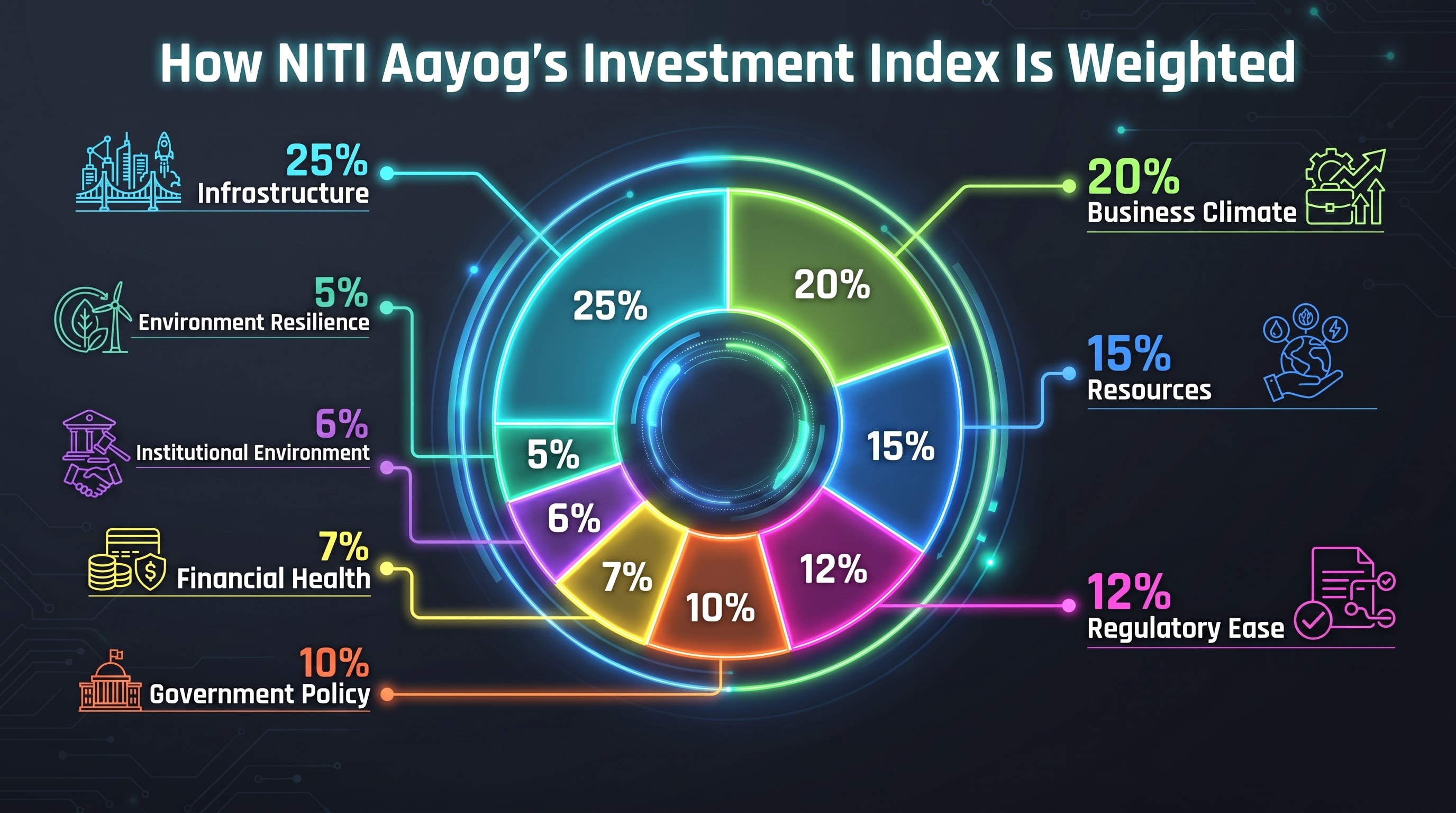
Resources, the pillar that includes land availability and human capital, is weighted at 15%, while Regulatory Ease, covering compliance and legal processes including labour-related rules, carries 12%.
The remaining pillars, Government Policy, Financial Health, Institutional Environment and Environment Resilience, are weighted at 10%, 7%, 6% and 5% respectively.
Speed of execution emerges as one of the report’s clearest points of differentiation between states. It notes that “states that have implemented single-window systems have cut approval times to under 30–60 days from 6–18 months, making those preferred investment destinations.”
That is roughly a tenfold reduction in wait times, though the report is clear this applies specifically where single-window clearance systems are functioning as intended, rather than existing only on paper.
Land, power and labour flexibility, the three factors investors named first, are folded into broader pillars like Resources and Regulatory Ease rather than standing alone as top-weighted categories.
Infrastructure and overall business climate, by contrast, make up nearly half the total score.
For investors, the index offers a fresh, standardised reference point for comparing states head-to-head. For state governments, it offers a specific, evidence-based map of where they rank against peers, and which levers, land, power, labour or something else, are most within their control to pull.
ALSO READ: Where India’s PE/VC Money Goes: Maharashtra, Karnataka Corner 57% Between Them
Essential Business Intelligence,
Sharp Market Insights,
Practical Personal Finance Advice, Daily Fuel, Gold and Silver Prices and Latest Stories — On NDTV Profit.



