


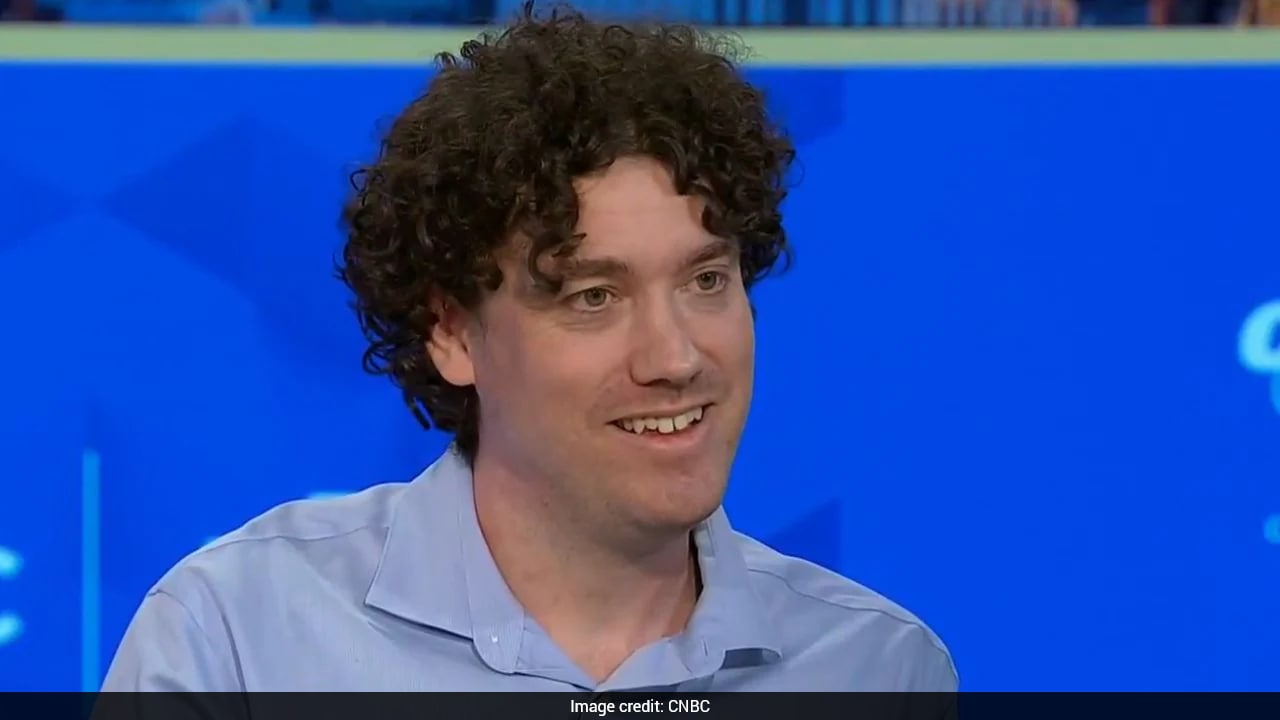
Tristan Buckmaster, a mathematics professor at New York University, said he continues to use Anthropic’s AI tools and has access to OpenAI Codex but avoids entering ideas he considers original into these systems. Speaking to CNBC about the developments and his chances of receiving the million-dollar prize, Buckmaster said solving the Navier-Stokes problem had never been his goal and that he was happy to have solved the Euler problem.
“Honestly, it was never my goal to solve the Navier-Stokes problem. To solve the Euler problem, I am super happy,” Buckmaster said.
He also expressed concern about the impact of OpenAI’s latest mathematical findings on early-career researchers, saying the release of papers on Tuesday had wiped out entire research programmes.
“The bigger picture is this recent dump of papers on Tuesday, which destroyed the careers of early-career mathematicians. We’ve had whole research programmes wiped out on Tuesday by their dump,” he said.
NYU math professor Tristan Buckmaster says OpenAI’s Tuesday drop of 722 AI-generated math papers wiped out entire research programs: “This recent dump of papers on Tuesday destroyed the careers of early career mathematicians.” https://t.co/0yiz7G9wwr
— Big Brain AI (@realBigBrainAI) October 9, 2026
He explained that researchers submitting proposals often have their work reviewed by panel members who are required to prepare summaries of the submissions. He suggested that these summaries may be prepared using large language models, potentially exposing original research ideas to AI systems.
“You have to understand, they have access to all our research proposals,” Buckmaster said, adding that the issue extended beyond the direct use of large language models.
Buckmaster argued that AI developers could have access to mathematicians’ and scientists’ research programmes, including their approaches to solving problems, through the data used to train their systems. He warned that this could create a significant conflict of interest.
Meanwhile, mathematicians have been taken aback by the rapid advancement of artificial intelligence, with recent developments raising questions about the role of AI in solving some of the most challenging open problems in mathematics.
On Tuesday, OpenAI released findings on 377 mathematical problems, spanning fields such as algebra, number theory, theoretical computer science, mathematical logic, and topology. The development further stirred debate in the mathematics community over the implications of increasingly capable AI systems.
The announcement followed OpenAI’s claim last month that it had solved a problem involving the Navier-Stokes equations, one of the so-called Millennium Prize Problems, each of which carries a $1 million prize for an accepted solution.
The developments have prompted questions about whether AI systems are demonstrating mathematical creativity or building on ideas developed by human researchers to produce solutions.


