


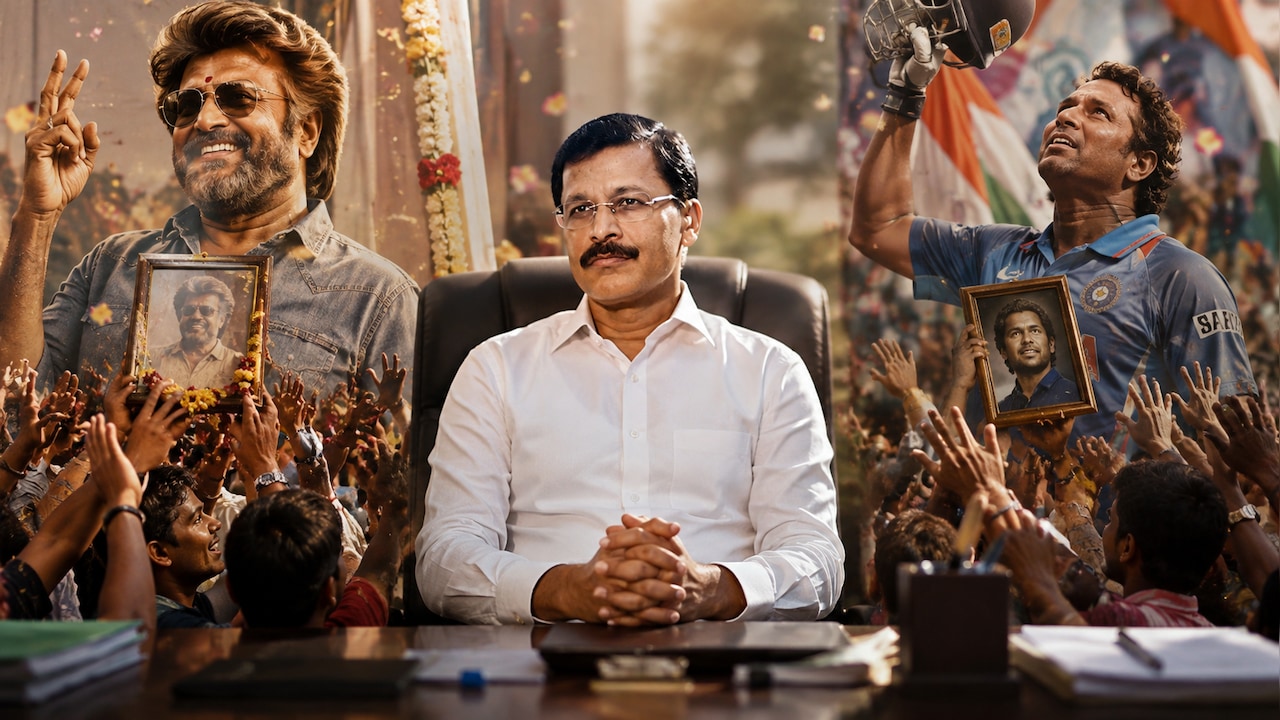
Maharashtra has found its hero in Tukaram Mundhe, a Food & Drug Administration Commissioner. He has been in the news for raiding restaurants and shutting down establishments that violate food safety standards. It did not take long for him to become a people’s favourite.
At a time when concerns over food quality have spread, here is an officer trying to bring about change. But we know what happens to good bureaucrats. Transfers are part and parcel of the service, and Mundhe has already seen many during his tenure. So people began pleading that he should not be transferred because they did not want to lose an honest officer.
That brings us to an important question: Why is this an exception? And why do we fall back on good officers rather than a good system?
The Maibaap Sarkar Syndrome
India inherited a colonial system structured around extraction rather than governance. Much of that remains in spirit, even if not in letter.
After independence, the government was present almost everywhere. It centralised power in several ways to keep the country together. Its socialist policies created the License Raj, which constrained economic growth for decades. From production to pricing, the state micromanaged much of the economy.
Consumers suffered too. There were shortages, long waits for telephone connections and scooters, limited choice and inflation.
ALSO READ: Meet The ‘Nayak’ Who Is Shaking Up Maharashtra’s Food Industry
Simply put, the government decided who could produce what, how much they could produce and what people would pay for it. The relationship between the government and businesses, and between the government and citizens, began to resemble that of parents and children.
That is where the phrase maibaap sarkar came from. It describes a society in which the state is feared, depended upon and petitioned at the same time.
Things have changed. Poverty has fallen, the private sector is stronger, businesses can be set up by people from around the world and consumers have far more choice. But the government’s role remains large enough to matter.
For a much larger population that still depends on the state for rations, education, healthcare, banking or loan waivers, the government can feel almost like a member of the family.
What’s Wrong With Singhamisation?
Despite its power, the state has not always reached deep into society. Weak capacity, bureaucratic lethargy, corruption and entrenched social and power structures often shape how it works.
When formal channels are slow, costly or unreliable, people turn to personal networks, local patrons or a ‘Singham’ officer willing to cut through the system.
That is why an officer who does the job well stands out.
Political scientists describe this as patrimonialism, in which authority becomes attached to the person who exercises it and the boundary between public office and personal discretion becomes weak.
But what is wrong with having heroic officers?
The problem is that hero worship can make citizens trust an individual more than the institution. It may improve governance today, but it does not necessarily strengthen the system for tomorrow.
ALSO READ: Tukaram Mundhe’s FDA Cracks Down on Goregaon Film City, AICWA Demands State-Wide Inspections
That is what I fear about the Mundhe episode. I admire him, and he deserves to be celebrated. In a slow and often corrupt system, officers like him give people hope.
But there are questions we usually forget to ask.
Can the trust he has built in himself be transferred to the institution? Can people stop saying, “I trust Mundhe to act,” and start saying, “I trust the FDA to act”?
India has shown that this is possible.
P.C. Mahalanobis built India’s statistical system. C. Rangarajan strengthened the RBI’s independence. G.V. Ramakrishna helped establish a culture of professionalism at SEBI. T.N. Seshan transformed the Election Commission. E. Sreedharan built the Delhi Metro around efficiency and accountability. Verghese Kurien created a cooperative dairy model that empowered farmers.
Their greatest achievement was not becoming heroes themselves. It was building institutions that could outlast them.
The most uncomfortable part of what we see is the broader culture of celebrating individuals. Heroic officers give us hope, but they can also make us accept a system that needs a constant supply of heroes.
This worship of strong individuals is not new.
In India, patriarchs and matriarchs at home, teachers in classrooms and bosses at work have traditionally held considerable authority. As a result, obedience, conformity and hierarchy have often been valued more than questioning and debate.
Perhaps that is why India does not do quiet admiration. We go all in.
We take our love and respect for individuals to another level. Remember how fans wrote letters to Rajesh Khanna in their own blood, how crowds roared for Sachin Tendulkar and how temples were built for actors such as Rajinikanth?
For decades, Indian popular culture reflected the same idea: when institutions failed, the individual hero stepped in.
ALSO READ: Tukaram Mundhe On Why India’s Most Talked-About Bureaucrat Won’t Enter Politics
Pop Culture Celebrates Saviours
The ‘angry young man’ of the 1970s was a hero for a generation that felt abandoned by institutions. He was not a policeman or an officer of the state. He was a victim of a broken system who fought back against it.
In the 1990s, the hero, particularly in Sunny Deol films, increasingly came from within the system itself. He could be a policeman, an advocate or an army officer. He was louder and more patriotic.
Later, films such as Dabangg and Singham turned the idea that one man could fix everything into entertainment. The focus shifted from changing broken institutions to celebrating the powerful individual who could bypass them.
For decades, popular culture reinforced the idea that institutions were weak and only heroes could deliver justice.
But perhaps the next generation is beginning to ask a different question.
One reason I like to believe that is that they have not watched many of the films that my generation and those before us grew up watching. They mostly did not watch Bollywood films that promoted this idea in the same way. They consume global culture and may therefore approach politics, society and their relationship with institutions differently.
They are not necessarily waiting for a saviour to turn things around.
Whether that translates into institutional change remains to be seen. But it offers a different kind of hope.
Tukaram Mundhe’s actions may be short-lived. But if his work makes people demand a better Food & Drug Administration, rather than just a better officer, then perhaps that is the real legacy of a ‘Singham’ officer.
Essential Business Intelligence,
Sharp Market Insights,
Practical Personal Finance Advice, Daily Fuel, Gold and Silver Prices and Latest Stories — On NDTV Profit.


