


England has not often been a happy place for Pakistan cricket in recent times. In the ongoing three-Test series, Pakistan have already lost the first two matches by big margins. They suffered an innings defeat in the series opener at Headingley before losing the second Test at Lord’s by 194 runs. The third Test is set to begin at Edgbaston on Wednesday.However, what followed the defeat at Lord’s surprised even those familiar with the unpredictable nature of Pakistan cricket.The Pakistan Cricket Board (PCB) sent seven players home and called up another seven, with five of the replacements uncapped at Test level.The PCB also removed Test coach Sarfaraz Ahmed and bowling coach Umar Gul. They were replaced by Pakistan’s white-ball coaches Mike Hesson and Ashley Noffke.Salman Ali Agha, who captained Pakistan at Headingley in the absence of the injured Babar Azam, was among those sent home. Left-arm spinner Ali Usman, who took a five-wicket haul in that Test, was also released.Experienced wicketkeeper Mohammad Rizwan and opener Imam-ul-Haq were also told to leave. Imam did not bat in either innings at Lord’s because of a calf injury.Hesson admitted last week that the changes had added to the uncertainty around the team.“The guys are probably more used to a little bit of chaos than I am. I don’t think anyone wants this to happen in the middle of a series.”The situation took another turn on Monday when the PCB announced an investigation into the squad’s conduct during the England tour, bringing the issue of match-fixing back into focus.As reported by TimesofIndia.com, the changes within Pakistan cricket were driven by reasons that were “more than cricket” and were not simply a response to the team’s poor performances.According to Pakistani outlet 365 News, the players’ devices have been handed over to the PCB and will remain in the board’s custody until the final Test is completed. The report did not reveal which players had their phones taken, while the PCB has not publicly explained why the devices were confiscated.
Horror of 2010
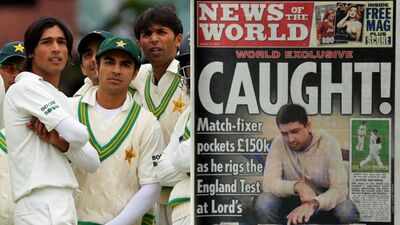
The developments have also brought back memories of Pakistan’s 2010 spot-fixing scandal, one of the biggest corruption cases in cricket.The scandal took place during Pakistan’s tour of England, during the fourth Test at Lord’s. It centred on allegations that Pakistani players had deliberately bowled no-balls at specific points in the match in return for money.When Mohammad Amir overstepped the crease while bowling a no-ball against England on the opening day of the 2010 Lord’s Test, there was no indication that the moment would become part of a fixing scandal that would affect Pakistan cricket for years.Two days later, it emerged that three no-balls — two by Amir and one by his pace partner Mohammad Asif — were part of a betting deal.Pakistan captain Salman Butt had arranged the deliberate no-balls in return for money offered by undercover journalist Mazhar Majeed, who was posing as a bookmaker.The scandal, exposed in the sting by Britain’s now-defunct News of the World tabloid, rocked the cricketing world , and aftershocks can still be felt more than a decade on in Pakistan. Not only did that dark morning at the revered ‘home of cricket’ derail the careers of three players who were banned and jailed, the saga also led to calls for Pakistan to be booted from international cricket. Butt, Amir and Asif were tried in a London court for offences under the Gambling Act and were jailed in November 2011.Announcing the sentences, the judge underscored the severity of the crime. “The image and integrity of what was once a game, but is now a business, is damaged in the eyes of all, including the many youngsters who regarded three of you as heroes,” Justice Jeremy Cooke said. It marked a new low for Pakistan cricket, already reeling from the aftermath of terror attacks in Lahore on the Sri Lankan team a year before, which triggered the suspension of home internationals.In November 2011, after a high-profile trial in London, all three players were found guilty of corruption and conspiracy to accept illegal payments. Salman Butt received a 30-month prison sentence, Mohammad Asif was jailed for a year, and Mohammad Amir, due to his age and early confession, was sentenced to six months.Only one of them, Amir, returned to international cricket after serving the ICC-ban when he made his comeback in 2016.


